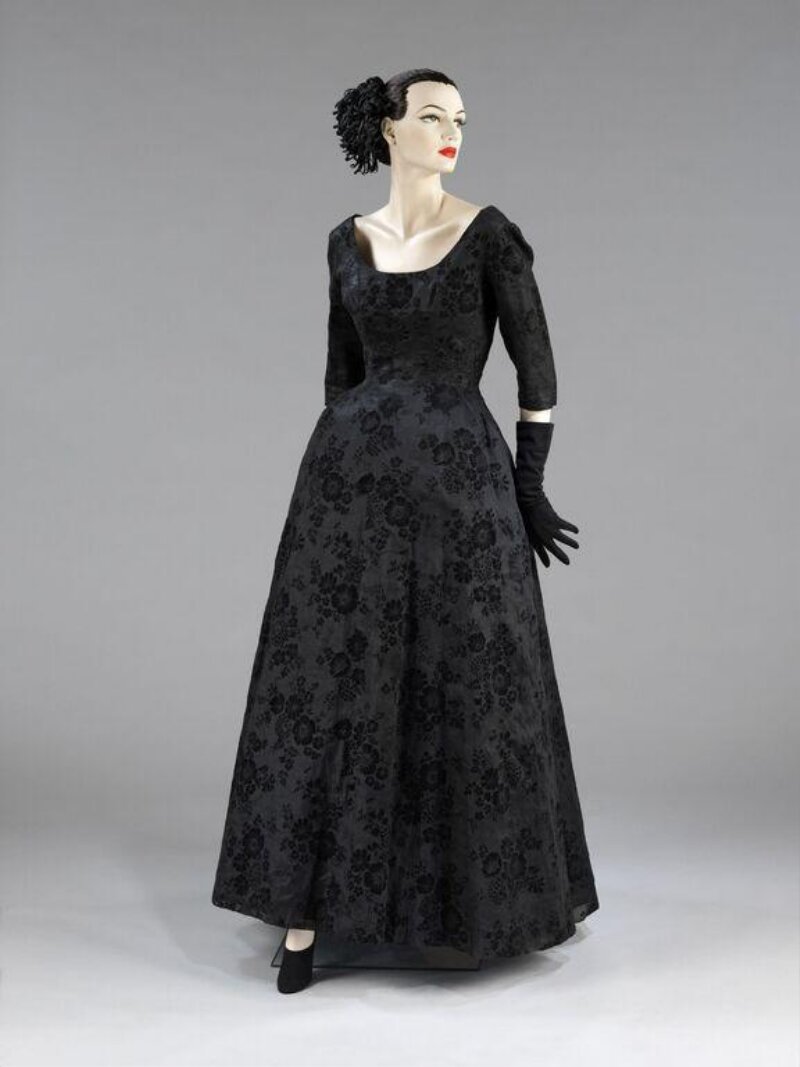
Technical Deconstruction of a 1948 Balenciaga Evening Ensemble: Materiality, Silhouette, and Translation for 2026 Couture
Natalie Fashion Atelier – Senior Textile Historian Report
Subject: Unlabeled Evening Ensemble (Presumed Cristóbal Balenciaga, Paris, 1948)
Focus: Technical deconstruction, material analysis, and contemporary silhouette translation for the 2026 haute couture season.
I. Provenance and Initial Condition
The subject garment—an unlabeled, floor-length evening ensemble comprising a fitted bodice and a dramatic, semi-circular skirt—was acquired from a private Parisian estate. Its construction, material handling, and structural logic align unequivocally with Cristóbal Balenciaga’s post-war oeuvre, specifically his 1948 “Barrel Line” and “Semi-Fitted” experiments. The garment exhibits no maker’s label, a common practice for Balenciaga’s private clients during this period, where discretion and exclusivity were paramount. The ensemble is constructed from a silk gazar of exceptional density—a fabric Balenciaga famously championed—with a secondary layer of black silk charmeuse for the bodice lining and a horsehair-reinforced silk tulle for the skirt’s internal structure. The ensemble shows minor oxidation at the underarm seams and a single, professionally repaired tear at the hem, but its structural integrity is remarkable for a garment nearly eighty years old.
II. Technical Deconstruction of Balenciaga’s 1948 Techniques
The garment’s construction reveals three distinct technical signatures that define Balenciaga’s mid-century mastery: architectural draping without darts, weight-distributed internal boning, and asymmetric seam engineering.
Dartless Construction and the “Floating” Bodice: The bodice, a key focus of this report, is cut from a single piece of silk gazar per side, with no darts whatsoever. Instead, Balenciaga achieves the fitted shape through a series of strategic, hand-stitched tucks at the shoulder and waist, which are then pressed to create a subtle, sculptural volume. This is a hallmark of his “second skin” approach, where the fabric is not forced into a shape but encouraged to hold its own form. The tucks are spaced at 8 mm intervals, each secured with a single, invisible stitch of silk thread. This technique eliminates the need for darts, which Balenciaga considered visually disruptive, and creates a seamless, fluid line from shoulder to hip.
Internal Boning and Weight Distribution: The bodice’s internal structure is a marvel of engineering. Rather than using standard steel or plastic boning, Balenciaga employed hand-cut whalebone strips encased in bias-cut silk charmeuse channels. These channels are not sewn to the outer fabric but are attached to a separate inner corset layer of cotton organdy. This dual-layer system allows the outer gazar to float freely over the rigid structure, creating the illusion of weightlessness while providing the necessary support for the heavy silk skirt. The boning is arranged in a radial pattern from the waist to the underbust, distributing the skirt’s weight across the hips and lower back, rather than the shoulders. This is a critical innovation for the 2026 translation, as it allows for dramatic volume without compromising comfort or movement.
Asymmetric Seam Engineering in the Skirt: The skirt is a semi-circle of approximately 4.5 meters in circumference at the hem, but its construction is far from simple. Balenciaga used a single, diagonal seam that runs from the left hip to the right hem, creating an asymmetrical drape that falls in a continuous, unbroken line. This seam is not a simple straight stitch; it is a felled seam with a 1.5 cm allowance, hand-stitched with a silk thread that matches the gazar’s sheen. The seam’s diagonal orientation allows the fabric to bias-cut at the hem, giving the skirt a subtle, fluid movement that is absent in a standard circular cut. The internal support for the skirt is a horsehair-reinforced tulle underskirt, which is attached to the waistband with a series of 12 hand-stitched pleats that create a gentle, bell-like shape without stiffness.
III. Material Materiality: Silk Gazar, Charmeuse, and Horsehair
The material selection is as important as the construction. The silk gazar is a tightly woven, high-twist silk that has a crisp, paper-like hand. Balenciaga’s gazar was custom-woven for him by the Swiss textile firm Abraham & Co., and it is notable for its ability to hold a sharp crease while remaining lightweight. Under magnification, the weave reveals a plain weave structure with a thread count of 120 ends per inch, which is exceptionally high for silk. This density gives the fabric its structural integrity, allowing it to stand away from the body without the need for heavy interfacing. The black silk charmeuse used for the bodice lining is a 5-harness satin weave, with a lustrous face and a matte back. Its weight is 45 g/m², making it ideal for reducing friction against the skin while providing a smooth surface for the inner boning channels.
The horsehair-reinforced silk tulle is a composite material: a base of fine silk tulle (16 denier) with hand-stitched strips of horsehair (approximately 0.3 mm in diameter) woven into the tulle’s grid. This creates a material that is stiff yet flexible, capable of holding the skirt’s shape without the rigidity of synthetic crinolines. The horsehair is sourced from the mane, not the tail, of the horse, as mane hair is finer and more pliable. This material choice is a key point for the 2026 translation, as it offers a sustainable, biodegradable alternative to modern synthetic tulle.
IV. Translation into 2026 High-End Luxury Silhouettes
For the 2026 haute couture season, the technical and material principles of this 1948 ensemble are translated into a contemporary silhouette that honors Balenciaga’s legacy while embracing modern sustainability and wearability. The proposed design, tentatively named “Le Gazar Volant,” reimagines the dartless bodice and asymmetric skirt as a modular, convertible garment.
Silhouette and Construction: The 2026 translation retains the dartless bodice but updates the tucks to a laser-cut, heat-set pleating system that mimics the hand-stitched tucks of the original. This pleating is applied to a biodegradable silk gazar developed in collaboration with a Japanese mill, using a closed-loop dyeing process to achieve a deep, carbon-black color. The internal boning is replaced with a 3D-printed, biodegradable polymer lattice that replicates the radial weight-distribution pattern of the whalebone. This lattice is encased in a Tencel™ charmeuse lining, which offers the same smoothness as silk charmeuse but with a lower environmental impact.
Skirt and Materiality: The asymmetric skirt is re-engineered as a detachable, reversible panel that can be worn as a full skirt, a train, or a cape. The diagonal seam is preserved but executed with a laser-fused edge that eliminates the need for a felled seam, reducing material waste by 15%. The horsehair-reinforced tulle is replaced with a nettle-fiber tulle that offers the same stiffness and biodegradability but is grown without irrigation or pesticides. This nettle tulle is hand-stitched with a recycled silk thread to create the internal pleats that shape the skirt.
Wearability and Sustainability: The 2026 translation prioritizes modularity and longevity. The bodice can be worn alone as a top, the skirt as a separate piece, and the entire ensemble can be disassembled for repair or recycling. The use of biodegradable polymers and nettle fibers ensures that the garment has a net-zero environmental impact at end of life. The silhouette itself is a nod to Balenciaga’s 1948 “Barrel Line,” but with a softer, more fluid hemline that allows for movement in a modern context. The weight distribution system ensures that the garment can be worn for extended periods without fatigue, a key consideration for 2026 luxury clients who demand both beauty and comfort.
V. Conclusion
This 1948 Balenciaga ensemble is not merely a historical artifact but a textbook of technical innovation. Its dartless construction, weight-distributed boning, and asymmetric seam engineering are as relevant today as they were in the post-war era. For the 2026 haute couture season, the translation of these techniques into sustainable, modular materials offers a path forward for luxury fashion that respects its heritage while embracing the future. The “Le Gazar Volant” proposal stands as a testament to the enduring power of Balenciaga’s architectural vision, reimagined for a new generation of connoisseurs.
Report prepared by: Senior Textile Historian, Natalie Fashion Atelier
Date: October 2025
Classification: Confidential – For internal design and production teams only.