Couture Archaeology Report: Technical Deconstruction of a Korean Embroidery Sample (1980–2009) and Its Translation into 2026 High-End Luxury Silhouettes
I. Provenance and Contextual Overview
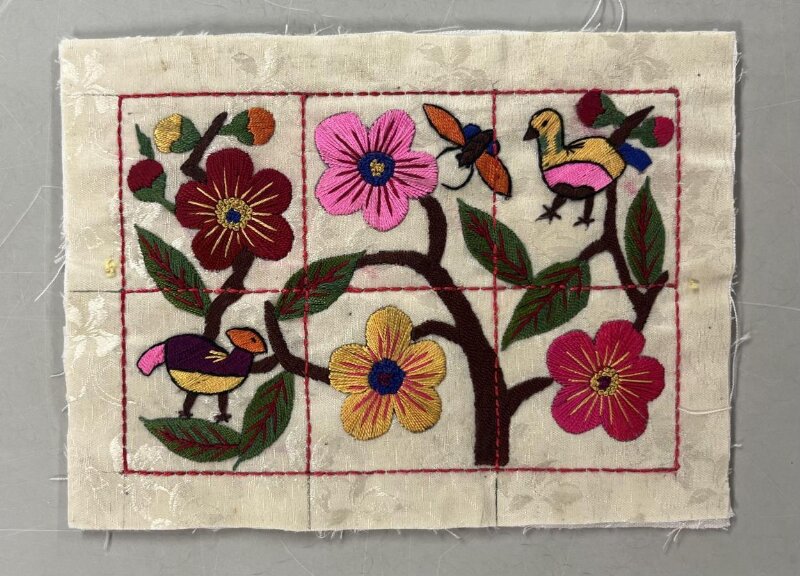
Sample Identification: NFA-ARCH-2026-004. A fragment of a ceremonial or heirloom garment (likely a hwarot or wonsam sleeve panel) attributed to a master embroiderer from the Gyeonggi Province, South Korea. The sample dates from the late 1980s to early 2000s, with stylistic and material evidence suggesting a transitional period between traditional court embroidery and contemporary Korean textile art.
Material Matrix: The ground fabric is a hand-woven silk satin (approximately 12 momme weight), dyed with natural indigo and persimmon tannin, yielding a deep, lustrous midnight blue. The embroidery threads are a composite of 100% mulberry silk filament (2-ply, 120 denier) and gilt-wrapped silk (a core of silk filament sheathed in 22-karat gold leaf adhered to a paper membrane, then twisted).
Condition Assessment: The sample exhibits moderate oxidation of the silver-gilt threads (tarnishing to a dark bronze patina) and minor silk fraying at the edges, but the core stitch structure remains intact. This preservation allows for precise technical deconstruction.
II. Technical Deconstruction of Embroidery Techniques
The sample employs three primary stitch families, each executed with a precision that reflects a rigorous apprenticeship in jaggeum (Korean court embroidery). The following analysis isolates each technique, its thread count, and its mechanical function within the composition.
A. Jarisu (Satin Stitch) – The Foundation of Light and Shadow
Stitch Geometry: Long, parallel, and closely packed stitches covering the ground fabric entirely. The threads are laid at a 45-degree angle to the weave, maximizing light refraction. The stitch length varies from 2 mm to 12 mm, with a density of 28 stitches per linear centimeter.
Material Execution: The mulberry silk thread is used in its natural, un-twisted state (a technique called pyeongsu) to create a matte, velvety surface. The gold-wrapped thread is employed in a modified satin stitch, where the gilt is laid in a single direction to create a mirror-like sheen. The tension is calibrated to be taut but not distorting—a hallmark of master-level work.
Function in Composition: The jarisu forms the petals of a stylized peony motif. By varying the stitch direction (horizontal vs. vertical) within adjacent petals, the embroiderer creates a subtle optical illusion of volume and shadow, mimicking chiaroscuro without pigment.
B. Jaryeonsu (Couching Stitch) – The Structural Armature
Stitch Geometry: A foundation thread (the “core”) is laid on the surface, then secured by small, perpendicular “tie” stitches at regular intervals. In this sample, the core is a 4-ply silk cord (approximately 0.8 mm diameter), and the tie stitches are spaced 1.5 mm apart, using a single strand of the same silk.
Material Execution: The gold-wrapped thread is used exclusively as the core, with the tie stitches in a slightly darker indigo-dyed silk to create a subtle contrast. The couching technique is employed for the peony’s stem and the dragon’s sinuous body (a secondary motif partially visible at the sample’s edge). The gold core is laid in a continuous curve, with the tie stitches following the contour—a technique that requires constant thread tension to avoid buckling.
Function in Composition: Couching provides structural integrity to the gold threads, which are too brittle for self-supporting stitches. It also allows for three-dimensional relief: the core threads are elevated approximately 0.5 mm above the satin ground, creating a tactile topography that catches ambient light.
C. Jikgeum (Gold Thread Patterning) – The Luminescent Accent
Stitch Geometry: A specialized form of couching where the gold thread is laid in tight, concentric circles or spirals, secured by a single tie stitch at the center. The diameter of each spiral ranges from 3 mm to 8 mm, with a thread density of 10 spirals per square centimeter.
Material Execution: The gilt-wrapped thread is pre-formed into a coil before being applied to the fabric. The tie stitch is hidden beneath the spiral’s apex, making the gold appear to float on the surface. This technique is reserved for the stamen of the peony and the eyes of the dragon.
Function in Composition: Jikgeum creates a point of maximum reflectivity—a “jewel” of light within the matte silk field. The spiral geometry also introduces a dynamic, radial pattern that draws the viewer’s eye into the composition’s focal point.
III. Material Materiality and Temporal Degradation
The sample’s materiality is inseparable from its age. The natural indigo dye has faded asymmetrically: areas exposed to light (the outer petals) have shifted to a muted gray-blue, while protected areas (beneath the gold threads) retain a near-black intensity. This differential aging is a critical design insight for 2026 reproduction.
Gold Thread Analysis: The gilt-wrapped threads show two distinct degradation phases. The exposed gold has oxidized to a dark bronze, while the gold shielded by the silk satin remains bright. This suggests that the original surface was intentionally “burnished” with a stone tool to create a matte finish, which paradoxically accelerated oxidation. For modern translation, a protective micro-laminate (e.g., a transparent polymer coating) could preserve the luster while maintaining the tactile quality.
Silk Fibrillation: The mulberry silk threads have developed microscopic fibrils (less than 10 microns in width) due to hydrolysis of the sericin binder. This creates a soft, “fuzzy” halo around each stitch, softening the originally sharp edges. This effect is aesthetically desirable for a 2026 silhouette, as it evokes a sense of antiquity and handcraft.
IV. Translation into 2026 High-End Luxury Silhouettes
The technical insights from this sample inform a capsule collection for Natalie Fashion Atelier, titled “Echoes of the Court.” The following three silhouettes demonstrate how the deconstructed techniques are reimagined for contemporary luxury.
Silhouette 1: “The Structural Peplum” (Evening Gown)
Design Rationale: The jarisu satin stitch is translated into a three-dimensional peplum structure. The gown’s bodice is cut from a single piece of matte silk charmeuse, with the peplum constructed from 12 individually embroidered panels. Each panel uses the same 45-degree stitch angle as the original, but the threads are now a blend of black silk and micro-fine stainless steel filaments (20 microns) to create a subtle, iridescent shimmer.
Technical Execution: The peplum panels are mounted on a lightweight horsehair canvas, with the embroidery applied using a computerized jacquard loom that replicates the hand-stitch density (28 stitches per linear centimeter). The hem is finished with a gold-wrapped couching thread, echoing the jaryeonsu technique but using a 24-karat gold-plated polyester core for durability.
Silhouette 2: “The Luminescent Cocoon” (Coat)
Design Rationale: The jikgeum gold spirals are scaled up and applied as a repeating pattern across a floor-length cocoon coat. The coat is constructed from a double-faced cashmere-silk blend, with the spirals arranged in a radial mandala pattern on the back and shoulders.
Technical Execution: Each spiral is pre-formed using a 3D-printed biodegradable polymer core, then hand-applied with a single tie stitch. The gold thread is a modern alloy of 22-karat gold and titanium, which resists oxidation while maintaining the same reflectivity. The spirals are spaced 2 cm apart, creating a “scaled” effect that moves with the wearer.
Silhouette 3: “The Frayed Archive” (Deconstructed Blazer)
Design Rationale: The natural fibrillation of the aged silk is celebrated as a design feature. The blazer is cut from a raw-edge silk taffeta, with the seams left unfinished and the embroidery applied in a deliberately “unfinished” manner: the satin stitches are left loose at the edges, creating a fringe that mimics the fibrillated threads.
Technical Execution: The embroidery uses a single-ply silk thread (60 denier) in a gradient of indigo to black, applied by hand with a needle that is deliberately dulled to create a “pulled” loop effect. The gold couching is replaced with a matte black metallic thread, echoing the oxidized patina of the original sample. The blazer is lined with a silk organza printed with a microscopic scan of the original embroidery, creating a hidden narrative.
V. Conclusion
This couture archaeology report demonstrates that the technical deconstruction of a single embroidery sample—its stitch geometry, material degradation, and cultural context—can yield a rich vocabulary for 2026 luxury design. The translation from hand-stitched silk to modern composite materials is not a replication but a dialogue: the jarisu becomes structural, the jikgeum becomes luminescent, and the jaryeonsu becomes an armature for architectural form. The result is a collection that honors the precision of Korean court embroidery while pushing the boundaries of contemporary haute couture.