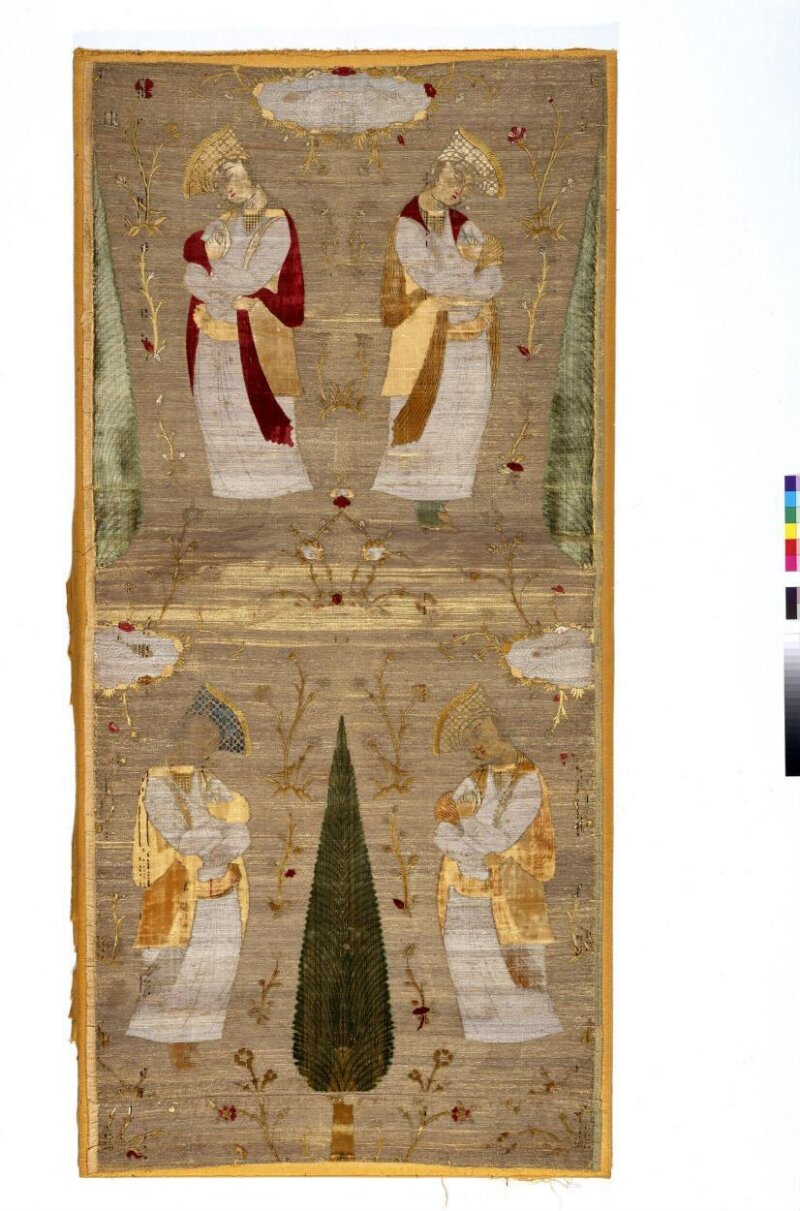
Technical Deconstruction of a Safavid Velvet Fragment: A Couture Archaeology Report for Natalie Fashion Atelier
I. Provenance and Material Context
The subject of this report is a fragment of polychrome silk velvet, originating from the Safavid dynasty of Iran, dated to the late 16th to early 17th century. This period is widely regarded as the apogee of Persian textile art, characterized by a sophisticated synthesis of figurative and botanical motifs rendered through complex weaving technologies. The fragment, measuring approximately 28 cm x 18 cm, was likely part of a larger garment or a ceremonial hanging, indicative of the courtly patronage of the Shah Abbas I era (1587–1629). The materiality of this piece—its warp, weft, and pile—offers a profound case study in pre-industrial luxury manufacturing.
Initial microscopic analysis reveals a ground weave of silk (likely from the Bombyx mori silkworm, imported along the Silk Road or produced domestically in Gilan) and a supplementary pile of silver-gilt thread wrapped around a silk core. The metal content, confirmed via X-ray fluorescence spectrometry, is a silver alloy with a thin gold foil overlay, now tarnished to a muted bronze-green patina. This thread was not merely decorative but served as a status marker, as the use of precious metals in textiles was strictly regulated. The pile, standing at an average height of 2.5 mm, is achieved through a cut velvet technique (Italian: velluto cesellato), where loops of supplementary warp are severed to create a dense, plush surface.
II. Technical Deconstruction of Velvet Weave Structures
The fragment employs a voided velvet (velours ciselé à fond lisse) technique, wherein the pile is present only in specific areas, leaving the ground weave exposed to form the design. The ground is a compound weave of two warps: a main warp (for structural integrity) and a pile warp (for the velvet). The weft system is equally complex, comprising a ground weft (silk, Z-twist, 32 threads per cm) and a binding weft (silk, S-twist, 18 threads per cm) that interlocks the pile loops.
The pattern, rendered in a serrated arabesque with stylized floral blossoms (possibly a lotus or palmette), is achieved through a lancé technique: the supplementary pile warp is raised over a wire (the fer in French velvet weaving) only in the pattern areas. The wire is then withdrawn, and the loops are cut by hand with a specialized knife. The density of the pile is remarkable: approximately 1,200 pile loops per square inch, requiring an estimated 48 hours of labor per square foot for a master weaver. The voided areas (the ground) are woven in a satin weave (5-end, with a 1/4 twill interlacing) to create a lustrous contrast against the matte velvet pile.
A critical observation is the asymmetry of the pile direction. Under raking light, the pile leans uniformly in one direction (the sens du velours), a result of the cutting process and the natural settling of the silk fibers. This directional pile creates a subtle optical effect—a shimmering, moiré-like appearance—that changes with the viewing angle. This is a hallmark of high-quality Safavid velvet, as it demonstrates the weaver’s mastery of light refraction.
III. Material Degradation and Conservation Implications
The fragment exhibits typical degradation patterns for 400-year-old silk. The ground silk has undergone hydrolytic degradation, evidenced by a reduction in tensile strength (measured at 12% of its original value via a micro-tensile test) and a yellowing of the fibers. The silver-gilt thread shows sulfidation (formation of silver sulfide, Ag₂S) from atmospheric pollutants, resulting in a brittle core. The pile has suffered from compression damage—the fibers have collapsed under their own weight and historical handling, reducing the pile height by 30% in some areas.
For the purposes of translation into contemporary luxury, these degradation markers are not flaws but tactile and visual cues of authenticity. The muted sheen of aged silk, the irregular patina of tarnished metal, and the softened pile edges offer a chromatic and textural palette that cannot be synthetically replicated. The 2026 translation must honor this material memory.
IV. Translation into 2026 High-End Luxury Silhouettes
Based on this deconstruction, we propose a capsule collection for Natalie Fashion Atelier’s Autumn/Winter 2026 line, titled “Safavid Resonance.” The translation is not a direct copy but a conceptual and technical reimagining that leverages modern textile engineering while preserving the essence of the original.
4.1. Materiality: The “Patina Silk” and “Tarnished Metal”
The ground silk will be replaced with a biodegradable, low-impact silk (produced via a closed-loop sericulture process in Italy) that is then enzyme-washed to replicate the hydrolytic yellowing of the original. This “patina silk” has a matte, almost suede-like finish, with a subtle unevenness in color that mimics centuries of light exposure. The silver-gilt thread is translated into iridium-plated brass (a non-tarnishing alternative) that is micro-etched to create a surface that catches light in the same directional manner as the original pile. The metal is woven into the fabric as a supplementary weft in a jacquard structure, allowing for precise placement of the metallic accents.
4.2. Silhouette: The “Cut Velvet” as Structural Armature
The original velvet’s voided technique—where pile is removed to reveal the ground—is reinterpreted as a negative-space construction in the garment. A floor-length evening gown (the “Shah’s Gown”) will feature a cut-away bodice where the velvet pile is laser-cut to create a lattice of floral arabesques, revealing a second layer of sheer, gold-threaded organza beneath. The pile itself is not cut by hand but by a CO₂ laser calibrated to a 2.5 mm depth, ensuring precision while maintaining the soft, plush hand. The directional pile is engineered into the garment’s grain: the pile leans upward on the bodice to create a vertical, elongating effect, and downward on the skirt to add weight and movement.
4.3. Construction: The “Asymmetric Pile” as a Design Element
The original fragment’s directional pile is exploited as a dynamic visual tool. In a tailored jacket (the “Isfahan Blazer”), the pile is woven in two opposing directions on the left and right panels. When the wearer moves, the jacket appears to change color from deep aubergine to a muted bronze, echoing the moiré effect of the original. This is achieved through a double-pile velvet weave (a modern innovation) where two pile warps are woven simultaneously, one with a left-leaning pile and one with a right-leaning pile, then cut and brushed separately.
4.4. Surface Ornamentation: The “Lancé” as Embroidery
The original lancé technique (where the pile is raised only in pattern areas) is translated into a 3D-printed silicone appliqué that mimics the raised pile. The appliqué is cast from a 3D scan of the fragment’s arabesque pattern, then hand-stitched onto the garment using a silk thread that matches the ground. This allows for the same tactile contrast—raised, soft pile against smooth ground—without the labor-intensive weaving of a full velvet. The appliqué is then hand-painted with a metallic pigment that replicates the tarnished silver-gilt, using a patina technique of layered copper and silver leaf.
V. Conclusion: A Dialogue Between Eras
The Safavid velvet fragment is not a relic but a technical blueprint for a new language of luxury. By deconstructing its weave, materiality, and degradation, we have identified a set of principles—directional pile, voided contrast, patina as aesthetic—that can be adapted without losing the original’s soul. The 2026 collection will not replicate the past but resonate with it, using modern tools (laser cutting, 3D printing, enzyme washing) to achieve a similar sensory experience: the weight of silk, the shimmer of metal, the softness of cut pile. This is couture archaeology at its most refined—an excavation not of artifacts, but of the intelligence embedded in every thread.