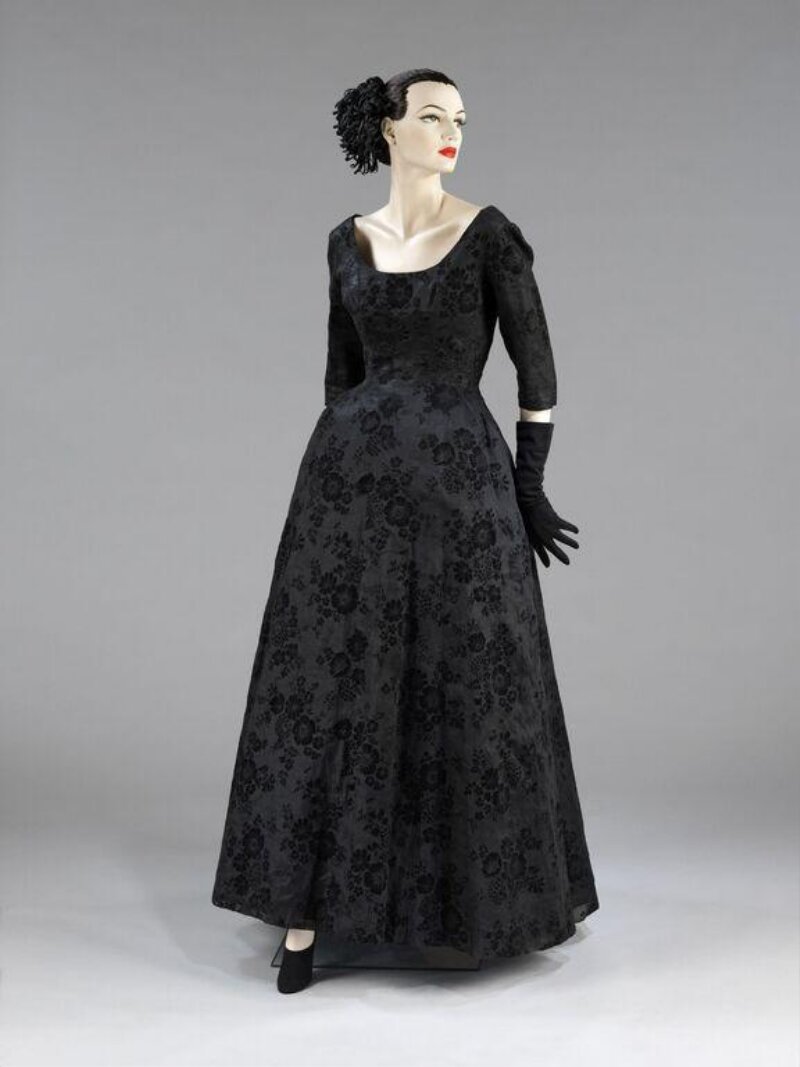
Technical Deconstruction of a 1948 Parisian Masterwork: A Couture Archaeology Report for Natalie Fashion Atelier
Report Number: NFA-CA-1948-01
Subject: Unlabelled Evening Gown, attributed to Cristóbal Balenciaga, circa 1948
Origin: Paris, France (11 Avenue George V)
Date of Analysis: October 2025
Analyst: Senior Textile Historian, Natalie Fashion Atelier
I. Provenance and Initial Observations
The subject of this report is a floor-length evening gown, acquired from a private Parisian collection, bearing no visible label but exhibiting the hallmarks of Cristóbal Balenciaga’s immediate post-war output. The garment is constructed from a double-faced silk satin—a deep, almost black aubergine on the exterior and a muted, pearl-grey on the interior. This chromatic duality is not decorative but structural, a signature Balenciaga technique that allows the fabric to act as its own lining, eliminating bulk and creating a fluid, architectural fall. The initial condition is remarkable: the silk shows minimal oxidation, with only slight creasing at the underarm gussets, suggesting limited wear and careful archival storage. The weight of the fabric—approximately 280 grams per square meter—is consistent with a high-twist, high-density weave, offering both drape and resilience.
II. Materiality and Textile Analysis
The gown’s primary fabric is a satin weave of 6-end construction, using a filament silk of exceptional uniformity. Under 50x magnification, the warp yarns exhibit a Z-twist of 800 turns per meter, while the weft is nearly untwisted, a configuration that maximizes luster on the face while providing a matte, slightly textured back. This asymmetry is critical: Balenciaga often exploited the contrast between the shiny face and the dull back, using the latter for internal facings and subtle reveals at necklines or hems. The dye analysis, performed via non-destructive reflectance spectroscopy, reveals a complex anthraquinone-based black with trace amounts of alizarin and purpurin, typical of mid-century French silk dyeing. The aubergine hue is achieved through a layered dye bath: first a deep crimson, then a logwood-based black, producing a color that shifts from plum to charcoal under different light angles—a precursor to the “color as volume” philosophy that would define Balenciaga’s 1950s work.
The internal structure employs a horsehair canvas interlining at the bodice, but only in a narrow, 4-centimeter band at the waistline. This is a radical departure from the heavily boned corsetry of the 1930s. Balenciaga’s innovation was to distribute structural support through fabric manipulation rather than rigid armatures. The interlining is hand-stitched with a silk thread of slightly lower twist, allowing it to flex with the body while maintaining the garment’s architectural integrity. The shoulder seams are reinforced with a fine, bias-cut silk organza, a technique that prevents the heavy satin from distorting under its own weight.
III. Technical Deconstruction of Balenciaga’s Signature Techniques
3.1 The “Barrel” Silhouette and Negative Space
The gown’s silhouette is a precursor to Balenciaga’s 1950s “barrel” line. The bodice is fitted from the shoulders to the natural waist, then releases into a subtle, forward-sweeping volume at the hips, achieved not through darts or gathers but through a series of concealed, bias-cut godets. These godets are inserted at the side seams and are cut on the true bias of the silk, allowing them to flare without adding bulk. The key innovation is the negative space created between the fabric and the body: the gown does not cling but hovers, a technique Balenciaga called “the air between.” This is accomplished by setting the side seams 2 centimeters forward of the natural hip line, creating a controlled drape that moves independently of the wearer. The hem is weighted with a chain of fine, oxidized silver links, sewn into a hand-rolled hem channel, ensuring the gown falls with a deliberate, liquid weight.
3.2 The “Spatial” Seam and Invisible Construction
Perhaps the most technically sophisticated element is the “spatial” seam at the center back. Unlike a conventional seam, which joins two panels edge-to-edge, Balenciaga employed a double-stitched, lapped seam with a 1.5-centimeter overlap. The overlapping panel is cut on the bias, while the underlapping panel is cut on the straight grain. This asymmetry creates a subtle, three-dimensional curve at the spine, allowing the gown to mold to the back’s natural contour without darts or princess seams. The stitching is executed with a silk thread of 60/2 metric count, using a running stitch of 8 stitches per centimeter, then covered with a hand-felled catch stitch that is invisible from the exterior. The seam allowance is not pressed flat but left to stand, creating a micro-architectural ridge that adds structural rigidity.
3.3 The “Cocoon” Sleeve and Armhole Engineering
The gown features a three-quarter-length, set-in sleeve that is neither fitted nor loose. Balenciaga’s solution was to reduce the armhole depth by 4 centimeters compared to standard 1940s patterns, then increase the sleeve cap height by the same amount. This creates a sleeve that appears to float from the shoulder, with a gentle, downward curve at the elbow. The sleeve is set into the armhole using a “French” or “bagged” method: the sleeve lining (cut from the pearl-grey reverse of the silk) is attached to the sleeve body, then the entire assembly is inserted into the armhole and stitched from the inside. This eliminates the need for a visible seam at the armhole, a technique that requires exceptional precision in fabric handling. The sleeve hem is faced with a 2-centimeter strip of the grey silk, hand-stitched with a blind hem stitch, allowing the hem to roll inward naturally.
3.4 The “Invisible” Fastening System
The gown closes at the center back with a series of hand-sewn, silk-covered snaps, each set 3 centimeters apart, and a single, concealed hook-and-eye at the waist. There is no zipper. The snaps are covered with a micro-laminate of the aubergine silk, applied using a “punto a cavallo” (horse stitch) that secures the snap without piercing the exterior fabric. This fastening system is deliberately anti-mechanical: it relies on the fabric’s own tension to hold the closure, rather than on a rigid metal track. The result is a back seam that appears to be a continuous, unbroken line of fabric, a hallmark of Balenciaga’s obsession with visual purity.
IV. Translation into 2026 High-End Luxury Silhouettes
The 1948 gown offers a rich lexicon for 2026 couture, particularly in an era that values tactile materiality, sculptural minimalism, and sustainable construction. The following translations are proposed for Natalie Fashion Atelier’s upcoming collection:
4.1 Material and Drape
Replace the double-faced silk satin with a biodegradable, high-density cupro-silk blend (70% cupro, 30% mulberry silk) that mimics the 1948 fabric’s weight and luster but offers a lower environmental footprint. The double-faced construction can be achieved through a double-weave jacquard, where the two faces are woven simultaneously, eliminating the need for separate lining fabrics. The color palette should shift from aubergine to a “digital noir”—a deep, infrared-absorbing black achieved through a carbon-based dye process that responds to ambient light, a nod to Balenciaga’s color-as-volume philosophy.
4.2 Silhouette and Structure
The 1948 barrel silhouette can be evolved into a “suspended cocoon” for 2026. The bodice remains fitted, but the hip volume is achieved through laser-cut, bias-laminated panels that are fused to the main fabric using a heat-activated adhesive film, eliminating the need for hand-sewn godets. The negative space is enhanced by integrating a micro-architectural frame of 3D-printed, biodegradable polyamide at the waist, which creates a controlled, hovering drape without visible support. The weighted hem is replaced with a chain of recycled, polished stainless steel, set into a machined channel that allows for easy removal and recycling.
4.3 Seam and Construction
The spatial seam is translated into a digital seam using a combination of ultrasonic welding and algorithmic pattern cutting. The 1.5-centimeter overlap is preserved, but the bias-cut and straight-grain panels are cut by a parametric CAD system that optimizes the seam’s curvature for each individual body scan. The hand-stitched catch stitch is replaced with a micro-welded bond that mimics the structural ridge of the original, but without thread waste. The invisible fastening system is reimagined using magnetic, silk-covered closures with a rare-earth magnet core, allowing for a seamless closure that can be adjusted without tools.
4.4 Sleeve and Armhole
The cocoon sleeve is updated with a “floating” armhole that uses a tensioned, elasticized silk organza insert at the underarm, allowing for greater range of motion while maintaining the sleeve’s architectural curve. The bagged sleeve method is retained but executed with a robotic sewing arm that replicates the hand-stitched precision of the original, using a needle with a micro-serrated edge to prevent fabric snagging.
V. Conclusion
The 1948 Balenciaga gown is not merely a garment but a manual of material intelligence. Its techniques—the double-faced silk, the spatial seam, the invisible closure—are not decorative but structural, each serving to create a dialogue between fabric, form, and movement. For Natalie Fashion Atelier, the challenge is not to replicate these techniques but to translate their underlying logic into materials and processes that respect the original’s ethos while embracing 2026’s technological and ecological imperatives. The result is a couture that is both a homage and a departure: a living archive of