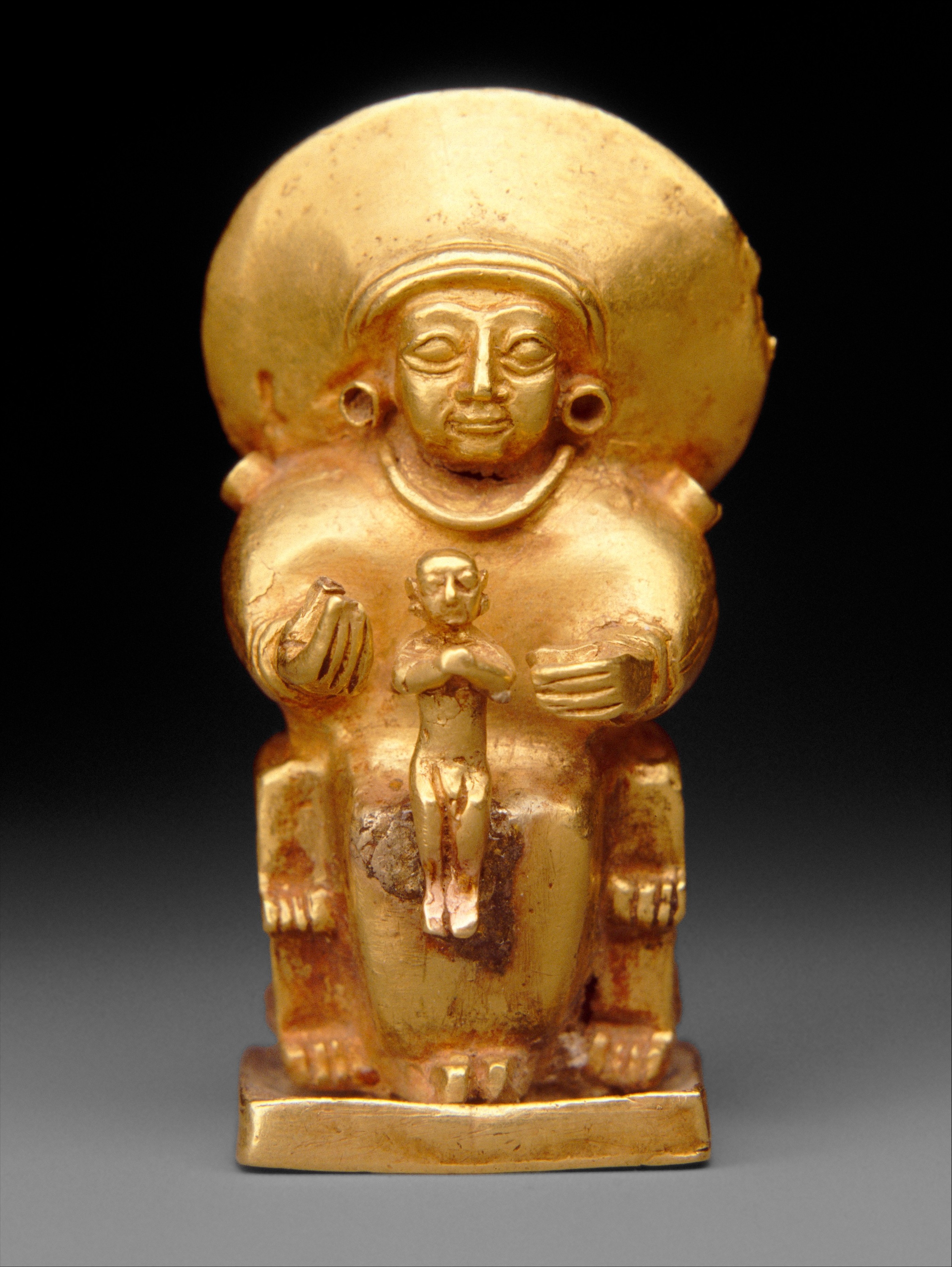
Deconstructing the Sacred Maternal: The Hittite Gold Goddess and the 2026 Silhouette
The archive node—“一面是光洁银镜上以黄金镶嵌的纷繁棕叶纹,另一面是冰冷石棺板上以浮雕诉说的生命叙事”—presents a dialectic of surface and depth, of reflection and permanence. This duality is the precise intellectual framework for our analysis of the Hittite gold seated goddess with child. The artifact, a masterpiece of Anatolian metallurgy from the 2nd millennium BCE, is not merely a devotional object. It is a tectonic diagram of power, nurture, and material transcendence. For Natalie Fashion Atelier, this piece serves as a generative matrix for 2026 haute couture, where the materiality of gold is translated into architectural fabric, structural draping, and a new lexicon of luxury that is both archaic and hyper-contemporary.
I. The Hittite Paradigm: Materiality as Divine Syntax
The Hittite goddess sits in a posture of hieratic repose. Her form is not naturalistic but schematic, a geometry of authority. The child, cradled without sentiment, is an extension of her throne—a dynastic node. The gold is not applied as embellishment; it is the primary structural material. This is crucial. The Hittite goldsmiths understood that gold’s density and malleability could create a silhouette that defies gravity: a solid, unyielding lap, a cylindrical torso, and a headdress that functions as a crown and a horizon line. The materiality of gold here is not about luster; it is about mass, volume, and the illusion of immobility.
For the 2026 silhouette, we deconstruct this into a principle of “gilded gravity.” The goddess’s form suggests a silhouette that is top-heavy, with a broad, structured shoulder line that tapers to a narrow, columnar base. This is not the soft, draped maternal of Renaissance art. This is the maternal as monument. The gold informs a palette of burnished metallics, not as shimmer but as a solid, matte finish—a surface that absorbs light rather than reflects it, reminiscent of the patina of ancient gold. The child is not a separate entity but a sculptural appendage, a volumetric pocket or a built-in structural element. This translates into 2026 jackets and coats with integrated, asymmetrical pouches or rigid, curved panels that echo the cradling arm.
II. Archive Resonance: The Mirror and the Sarcophagus
The archive node juxtaposes two opposing surfaces: the silver mirror with gold palmettes and the stone sarcophagus with narrative relief. The mirror is a surface of immediate, fleeting reflection; the sarcophagus is a surface of eternal story. The Hittite goddess exists in the tension between these two. Her gold surface is a mirror to the divine, yet her posture is a frozen narrative of lineage and protection.
In 2026 couture, this duality manifests in “split-surface” construction. A garment may present a front panel of high-polish, mirrored gold lamé—the palmette, the reflective, the immediate—while the back is a textural, almost abrasive, gold-threaded jacquard that tells a story through its weave, like a relief. The silhouette is defined by this front-back dichotomy. The front is a clean, architectural panel (the mirror), while the back is a complex, layered volume (the sarcophagus). This creates a silhouette that is static from the front but dynamic from the rear, a play of stillness and motion that echoes the goddess’s eternal seated pose.
III. Technical Translation: From Gold to Silhouette
The Hittite gold is not ductile in the modern sense; it is beaten and hammered. This process creates a surface of micro-facets, a topography of light. For 2026, we translate this into structural draping using metal-infused silks and thermo-molded organza. The silhouette is not sewn; it is forged. The key technical elements are:
The Throne-Back Silhouette: The goddess’s throne is an extension of her form. For 2026, this inspires a silhouette where the back of a gown or coat rises high and rigid, creating a vertical axis of power. This is achieved through internal boning and a dense, gold-threaded brocade that holds its shape like beaten metal. The front remains simple, a column of fabric that falls straight, mimicking the goddess’s lap.
The Cradle Volume: The child is a small, contained volume. In the 2026 silhouette, this becomes a strategic, asymmetrical puff or a rigid, cup-like structure at the hip or waist. This is not a decorative puff; it is a functional architectural element, a pocket of space that disrupts the clean line of the silhouette. It is crafted from gold-lamé with a crushed finish, its surface irregular like hammered gold.
The Headdress Horizon: The goddess’s headdress is a flat, wide band that extends beyond her head, creating a horizontal line. This translates into 2026 shoulder architecture. Not the padded shoulder of the 1980s, but a rigid, horizontal extension of the shoulder line, like a lintel. This is achieved with laser-cut gold leather or structured metallic lace that projects outward, creating a silhouette that is both protective and regal.
IV. The 2026 Silhouette Lexicon: Gilded Gravity
The final silhouette for 2026, informed by the Hittite gold goddess, is one of controlled monumentality. It is not about the body’s natural curves but about the body as a pedestal. The key lines are:
1. The Inverted Trapezoid: Broad at the shoulders, narrow at the hem. This is the primary silhouette, echoing the goddess’s form. It is achieved through a structured, almost inflexible bodice made from a gold-threaded, double-faced satin, and a skirt that falls in a straight, narrow column.
2. The Asymmetric Cradle: A single, prominent volume at the hip or waist, created by a rigid, gold-embroidered panel that curves outward and then back in, as if cradling an invisible child. This is the signature detail of the collection.
3. The Horizon Shoulder: A sharp, horizontal line at the shoulder, extending 5-7 cm beyond the natural shoulder point. This is executed in gold-stitched horsehair braid or molded metallic leather, creating a silhouette that is both ancient and futuristic.
4. The Patina Finish: The gold is not bright. It is antiqued, burnished, and matte. The fabric is treated with a metallic foil that is then partially abraded, creating a surface that looks excavated, not manufactured. This aligns with the archive node’s duality of the reflective mirror and the textured stone.
V. Conclusion: The Eternal Maternal Monument
The Hittite gold seated goddess is not a relic of sentiment; she is a blueprint for structural power. Her gold is not decoration; it is syntax. For Natalie Fashion Atelier’s 2026 haute couture, this artifact informs a silhouette that is rigid, monumental, and deeply maternal in its architectural authority. It rejects the fluid, the ephemeral, and the decorative. It embraces the gilded gravity of the eternal. The 2026 woman is not wearing a dress; she is wearing a throne. She is the seated goddess, the bearer of lineage, the surface of reflection and the depth of narrative, all forged in the immutable gold of the Hittite dawn.