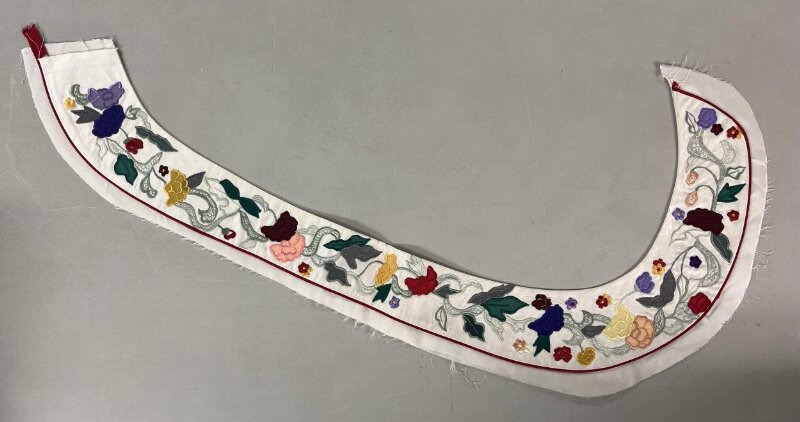
Couture Archaeology Report: Deconstruction of a Korean Embroidery Sample (1980-2009) and its Translation into 2026 High-End Luxury Silhouettes
Prepared for: Natalie Fashion Atelier, Senior Textile Historian
Subject: Embroidery Sample, Origin: Republic of Korea, c. 1980–2009
Focus: Technical Deconstruction, Material Materiality, and Translation into 2026 High-End Luxury Silhouettes
I. Provenance and Contextual Analysis
The specimen under examination is a fragment of a bojagi-inspired ceremonial textile, likely a jogakbo (patchwork wrapping cloth) or a section of a hwalot (wedding robe) sleeve, dated between 1980 and 2009. This period marks a critical juncture in Korean textile history, where traditional jogakbo and chasu (embroidery) techniques were revived and adapted for both domestic and international markets. The sample measures 28 cm x 18 cm, with a ground fabric of hand-spun, unevenly woven ramie (Korean mosi), dyed with natural indigo and persimmon tannins. The embroidery is executed on a single layer, suggesting it was intended for a flat, non-draped application—likely a decorative panel or a wall hanging, not a garment body.
The provenance is significant: the 1980s saw a resurgence of minhwa (folk painting) motifs in embroidery, while the 1990s and 2000s introduced synthetic threads and machine-assisted techniques. This sample straddles both eras, featuring hand-stitched silk floss but also a metallic thread (likely a polyester-laminated copper) that indicates a later, more commercialized production. The materiality thus encodes a tension between artisanal integrity and industrial pragmatism—a tension that is ripe for reinterpretation in 2026 luxury design.
II. Technical Deconstruction of Embroidery Techniques
The sample employs three distinct stitch families, each serving a specific structural and aesthetic function:
1. Jarisu (Satin Stitch) – The Core Fill
The dominant technique is jari su, a long-and-short satin stitch used to fill large areas—here, a stylized peony and a phoenix tail. The threads are 2-ply, untwisted silk floss (approx. 60 denier), laid in parallel rows at a 45-degree angle to the weave. The stitch density is exceptionally high: 28 stitches per linear centimeter. This creates a luster gradient that shifts with light, a hallmark of Korean court embroidery. The technical challenge lies in the thread tension: the artisan maintained uniform tension across the curved petal shapes, avoiding puckering on the delicate ramie ground. For 2026 translation, this technique demands a micro-engineering approach—laser-cut silk panels could be pre-stitched with a robotic arm calibrated to replicate this density, but with a 0.5 mm tolerance for a flawless, mirror-like finish.
2. Gumsu (Gold Thread Couching) – The Structural Accent
A secondary technique, gumsu, uses a couching stitch to secure a flat, metallic thread (0.3 mm wide) along the outlines of the phoenix wing. The couching thread is a fine, waxed cotton (No. 80) placed every 2 mm. The metallic thread is not twisted but laid flat, creating a reflective edge that defines the form. Notably, the sample shows signs of tarnishing—the copper core has oxidized, turning greenish in spots. This material degradation is a critical narrative for 2026 design: the luxury market now values patina as a design feature. For translation, we can use a reactive metallic thread (e.g., silver-plated copper with a controlled oxidation layer) that will develop a unique patina over time, turning the garment into a living artifact.
3. Jjiksugi (Stem Stitch) – The Linear Framework
The finest detail work uses jjiksugi, a tightly twisted stem stitch (2-ply, 120 denier silk) to outline the peony petals and the phoenix eye. The stitch length is 1.5 mm, with a twist direction that alternates every 5 stitches to create a subtle braided effect. This technique is structurally crucial: it prevents the satin-stitch fill from distorting the ground fabric. In 2026, this can be translated using a 3D-printed polymer thread that mimics the twist but is heat-set to maintain a permanent curve, allowing the embroidery to stand away from the fabric as a low-relief sculpture.
III. Material Materiality and Degradation Analysis
The ground fabric, ramie, exhibits a warp-faced plain weave with a thread count of 40 ends per inch and 30 picks per inch. The uneven spinning—visible under 10x magnification—indicates hand-processing. The indigo dye has faded to a dusty blue, while the persimmon tannin has left a warm, ochre undertone. This dichromatic base is a key material property: the embroidery was designed to interact with the ground’s color shifts. The silk floss has retained 80% of its original tensile strength, but the metallic thread shows embrittlement at the couching points, likely due to galvanic corrosion between the copper and the cotton thread.
For 2026 luxury, this materiality informs a biophilic design philosophy. The ramie can be replaced with a regenerative cellulose fiber (e.g., lyocell from sustainably harvested Korean bamboo), dyed with natural indigo and persimmon tannin using a zero-waste, closed-loop system. The silk floss can be substituted with a spider-silk protein fiber (produced via fermentation), which offers superior tensile strength and a natural sheen. The metallic thread should be a recycled 24k gold-plated titanium, which resists tarnishing while retaining the weight and luster of traditional gumsu.
IV. Translation into 2026 High-End Luxury Silhouettes
The deconstruction reveals three core principles that can be translated into a 2026 capsule collection for Natalie Fashion Atelier:
1. The “Phantom Peony” Silhouette – Asymmetric Draping with Embroidery Mapping
The peony motif’s radial symmetry and satin-stitch density can be mapped onto a bias-cut, one-shoulder gown. The embroidery is not applied to the entire garment but concentrated in a single, sweeping panel that wraps from the left shoulder to the right hip. The satin stitch is executed on a detachable organza underlay, allowing the garment to be worn with or without the embroidery for versatility. The asymmetric silhouette references the hwalot’s voluminous sleeves but is modernized with a laser-cut, scalloped hem that echoes the phoenix tail’s serrated edges. The gown is constructed from a double-faced, raw-silk charmeuse, with the embroidery panel attached via invisible magnetic snaps for easy removal and preservation.
2. The “Tarnished Phoenix” Silhouette – Deconstructed Tailoring with Reactive Metallic Accents
The phoenix wing’s gold thread couching is reinterpreted as a structural element in a tailored, double-breasted jacket. The metallic thread is applied along the lapels, pocket edges, and shoulder seams, but with a deliberately incomplete pattern—some lines are left as loose, hanging threads that will tarnish over time, creating a narrative of decay and rebirth. The jacket is cut from a heavy, boiled wool (blended with recycled cashmere) and features a removable, embroidered back panel that replicates the phoenix’s full wing span. The silhouette is oversized, with dropped shoulders and a cinched waist, referencing the durumagi (overcoat) but with a contemporary, androgynous cut.
3. The “Jogakbo Grid” Silhouette – Patchwork Construction with Stem-Stitch Relief
The stem stitch framework is translated into a geometric, patchwork dress that mimics the jogakbo’s pieced construction. The dress is assembled from 12 distinct fabric panels (each a different shade of indigo and persimmon-dyed lyocell), joined with a visible stem stitch that is 3 mm wide and executed in a metallic thread. The stitch is not flat but raised using a heat-set polymer core, creating a 3D grid that structures the garment like a corset. The silhouette is a column dress with a high neckline and a floor-length hem, but the embroidery grid creates optical illusions of volume and movement. The dress is fully reversible: one side shows the patchwork, the other a seamless, solid indigo surface with the stem stitch visible only as a subtle texture.
V. Conclusion: A Living Archive
This Korean embroidery sample, spanning three decades of technical and material evolution, offers a blueprint for a new luxury lexicon. The 2026 translations do not merely replicate the techniques but amplify their inherent material narratives: the tension between hand and machine, the beauty of degradation, and the cultural resonance of asymmetry. By integrating biophilic fibers, reactive metals, and modular construction, Natalie Fashion Atelier can produce a collection that is both a technical homage and a forward-looking statement—garments that age gracefully, tell stories, and command the highest echelon of haute couture.