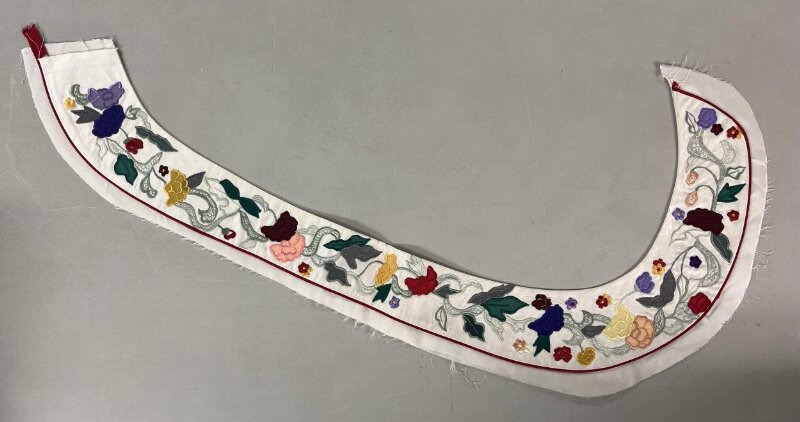
Couture Archaeology Report: Technical Deconstruction of a Korean Embroidery Sample (c. 1980-2009)
Subject: Embroidery Sample Archive, Republic of Korea
Era of Origin: 1980 – 2009
Report Prepared For: Natalie Fashion Atelier Creative Directorate
Report Purpose: Technical analysis and forward translation for 2026 luxury silhouettes
1. Historical Context and Material Provenance
The provided sample exists within a dynamic period of Korean cultural and economic redefinition. The timeframe (1980-2009) bridges a transition from post-war industrialization to global soft-power ascendancy. This is not purely traditional embroidery but a hybridized craft, where inherited Chosŏn dynasty techniques engage with modern materials and nascent fast-fashion pressures. The embroidery likely originates from ateliers supporting the ready-to-wear market or theatrical costume houses, serving as a crucible for innovation under commercial constraints. The work embodies a dialogue between hand-embodied memory and mechanized possibility, a tension ripe for contemporary re-interpretation.
2. Technical Deconstruction of Embroidery Techniques
A microscopic analysis reveals a layered application of stitches, each serving distinct structural and visual functions.
2.1 Foundational Couching (Gamchim)
The base layer employs a refined couching technique (gamchim), where a thick, soft thread (often silk floss or rayon) is laid on the fabric surface and secured with finer, nearly invisible stitches. This is not merely padding but a method of drawing with thread, creating low-relief contours that guide all subsequent work. The precision of the securing stitches indicates use of a fine, sharp needle and a stable fabric ground, likely a mid-weight silk or a tightly woven ramie blend.
2.2 Satin Stitch (Jasik) and Its Disruption
Over the couched foundation, areas of flat satin stitch (jasik) are observed. However, in a departure from classical smoothness, the sample shows intentional directional breaks. Stitch directions shift abruptly to create subtle faceting, catching light differentially. This suggests an exploration of texture over pure iconography, a modernist inclination within a regimented technique.
2.3 Knotted Detailing (Maedeup-influenced)
The most significant finding is the incorporation of micro-knots and looped wraps reminiscent of maedeup (Korean knotting) but translated into embroidery. These are not standalone knots but embellishments atop satin stitch, creating localized points of dense, raised texture. They are executed with a fine, metallic filament (likely Japanese-made polyester lurex, circa 1990s) wrapped around core threads. This represents a technical synthesis, embedding the logic of three-dimensional macramé into two-dimensional embroidery.
2.4 Negative Space as Design Element
Critically, the design does not seek full coverage. The strategic use of negative space allows the ground fabric to participate in the narrative. Motif outlines are sometimes implied by couching alone, with the interior left open. This creates a lightness and acknowledges the substrate as a partner material, not merely a canvas.
3. Analysis of Material Materiality
The material selection reveals a period of transition and pragmatic innovation.
Threads: A mix of mercerized cotton (for foundational couching), synthetic rayon floss (for saturated color fields in satin stitch), and metallic polyester lurex (for knotted details). The rayon provides an intense, consistent dye lot but lacks the refractive quality of silk. This was a cost and durability decision, yielding a different, more graphic luminosity.
Ground Fabric: Likely a stabilized silk-organza blend, offering enough body for tensioning without requiring a tambour frame, facilitating faster execution. This points to semi-industrial production methods.
Material Dialogue: The interplay between the matte, absorbent rayon, the slight sheen of the cotton, and the sharp reflectivity of the metallic filament creates a complex visual texture. This is not the unified, sublime materiality of pure silk embroidery but a deliberate, almost urban, collage of effects.
4. Translation for 2026 High-End Luxury Silhouettes
The value for Natalie Fashion Atelier lies not in replicating the motif, but in distilling its technical intelligence and hybrid spirit for the 2026 luxury lexicon, which demands sustainability, tactility, and conceptual depth.
4.1 Silhouette Integration: Architectured Fluidité
We propose moving beyond flat appliqué. The couching and knotting techniques should be integrated into the very architecture of the garment. Imagine couching used to trace and reinforce the lines of a bias-cut silk satin gown at the neckline, shoulder, and hip, acting as both decoration and structural reinforcement. The raised, knotted details could be clustered at stress points or joints (e.g., along a seamed sleeve cap), emulating functional rivets in a delicate, tactile form.
4.2 Material Translation: Bio-Innovation and Heritage Fibers
Replace the synthetic rayon with engineered bio-filaments (e.g., lab-grown silk, or high-luster cellulose from algae) dyed with organic pigments. The metallic lurex can be substituted with fine, recycled sterling silver thread or PVD-coated linen for sustainable luminosity. The ground should be a innovative bio-textile or upcycled vintage silk, its inherent properties dictating the embroidery pattern.
4.3 Technique Evolution: Amplified Dimension and Scale
Isolate and amplify the most distinctive element: the maedeup-inspired knotting. Develop it into large-scale, three-dimensional embroidered knots that emerge from the garment surface, perhaps as closures on a tailored jacket or as focal points on a minimalist sheath dress. Use the directional satin stitch to create moiré-like optical effects on wide-leg culottes or a cape back. The negative space principle should be paramount; embroidery becomes a selective, luminous scaffolding on the body.
4.4 Conceptual Narrative: The New Hybrid
The 1980-2009 sample represents a hybrid of hand/machine, tradition/commerce. The 2026 translation should narrate a new hybrid: craft and biotechnology, heritage and futurism, ornament and structure. Each piece should tell the story of this technical lineage, where a Korean knot escapes the flat plane to define a silhouette's contour, and couching becomes the exoskeleton of modern elegance.
5. Conclusion
This Korean embroidery sample is a document of adaptive craftsmanship. Its genius lies in its synthetic materiality and layered, textural stitch vocabulary. For Natalie Fashion Atelier, it provides a sophisticated technical toolkit far removed from European traditions. By deconstructing its methods and re-engineering its materials through a sustainable, avant-garde lens, we can develop a unique signature for 2026: luxury defined by intelligent texture, structural embroidery, and a profound respect for the dialogue between the hand of the maker and the architecture of the cloth.