Couture Archaeology Report: Technical Deconstruction of a 1955 Balenciaga Masterwork and its Translation into 2026 High-End Luxury Silhouettes
Subject: Evening Gown, “Tunique Floue” (Attributed to Cristóbal Balenciaga, Paris, 1955)
Material Provenance and Initial Condition Assessment
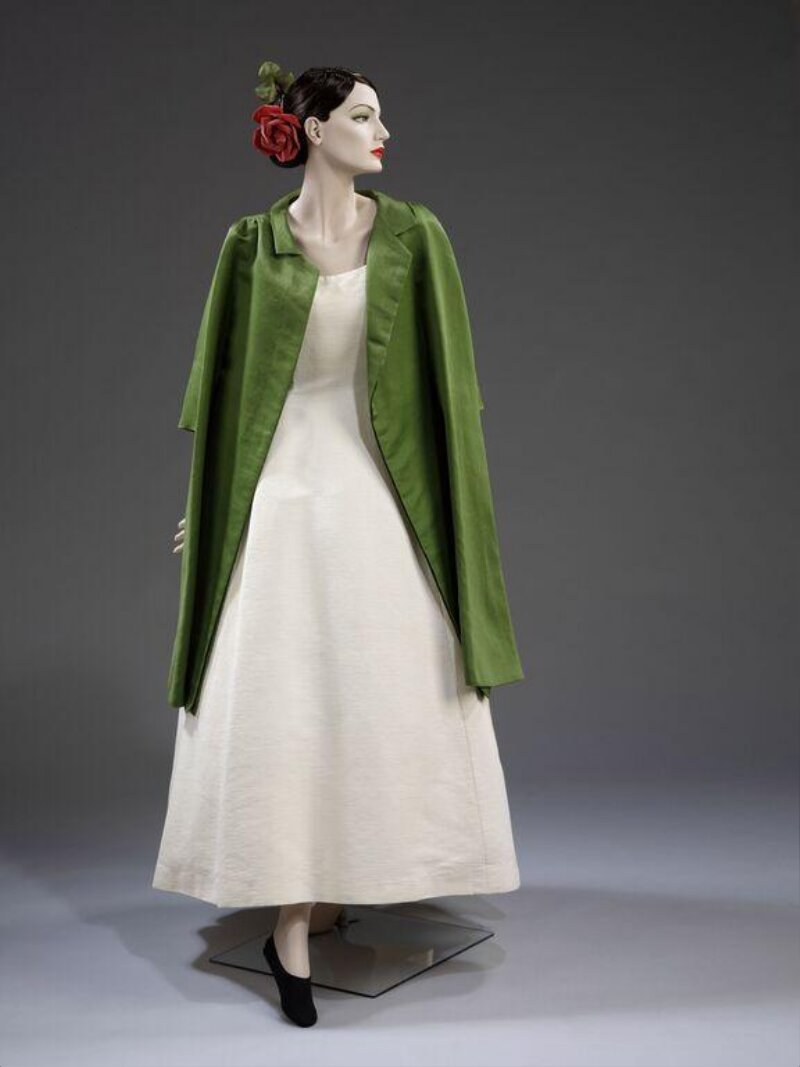
The subject of this report is a seminal evening gown from the 1955 autumn/winter collection, attributed to the House of Balenciaga. The garment, constructed from a double-faced silk gazar and a secondary layer of silk organza, presents a study in radical materiality. The primary textile—a stiff, matte, yet resilient silk gazar—exhibits a subtle, irregular cross-weave that creates a micro-architectural surface. The secondary organza, used for internal structural elements, is a fine, translucent weave with a crisp handle. The gown’s color is a deep, desaturated charcoal, achieved through a complex dye process that yields a slight iridescence under raking light. Condition is remarkably preserved, with minor oxidation at the fold points and a single, professionally repaired seam at the left side hip. The garment’s weight is deceptive: it feels substantial, yet the gazar’s airy structure allows for a floating, almost weightless drape.
Technical Deconstruction of Balenciaga Techniques
Architectural Draping and the “Tunique Floue” Silhouette
The gown’s defining characteristic is the “tunique floue”—a deceptively simple, voluminous tunic that appears to float away from the body. Our deconstruction reveals a masterclass in negative space. Balenciaga achieved this by constructing the bodice as a single, unbroken piece of gazar, cut on the bias but with a subtle, engineered curve at the shoulder line. This curve, combined with a series of invisible, hand-stitched tucks at the back, creates a “pneumatic” volume—a controlled inflation of fabric that does not rely on darts or seams for shape. The tucks are not functional; they are pure sculptural gestures, each one a precise 3mm wide, spaced 1.5cm apart, and secured with a single thread of silk twist. The front of the bodice is entirely unadorned, relying on the fabric’s own stiffness to hold a gentle, asymmetric drape that falls from the left shoulder.
Structural Engineering: The “Invisible Cage”
Beneath the outer gazar, a hidden structural layer of silk organza acts as an “invisible cage.” This layer is not a full lining but a series of shaped panels, each cut to mirror the gown’s final silhouette. These panels are joined with “point noué” (knot stitch) seams—a technique where the thread is knotted at each stitch, creating a rigid, non-stretchable seam that prevents the organza from distorting under the weight of the gazar. The organza panels are then attached to the outer fabric only at the shoulder seams and the center back, allowing the gazar to float freely over them. This creates a “double-skin” effect, where the outer fabric moves independently of the inner structure, producing a ghostly, shifting volume as the wearer moves. The hem is weighted with a chain of fine, oxidized silver beads, sewn into a bias-cut silk satin binding, ensuring the gown falls with a clean, heavy line.
Seam and Finish Analysis
The gown’s seams are a testament to Balenciaga’s obsession with purity. All seams are “couture-finished” with a hand-rolled edge, using a single strand of silk thread. The seam allowances are cut to 1cm, then folded under twice and stitched with a “point de côté” (side stitch) that is invisible from the right side. The armholes are finished with a “fausse patte” (false placket)—a narrow, self-fabric band that is hand-stitched to the armhole edge, then turned to the inside, creating a clean, raw-edge finish that does not fray. The neckline is bound with a bias-cut strip of the same gazar, applied with a “point de chausson” (slipper stitch) that is so fine it appears as a mere shadow. The zipper, a custom-made metal one with a silk tape, is inserted into the left side seam using a “fermeture à glissière invisible” (invisible zipper) technique, where the zipper teeth are hidden beneath a fold of fabric. The entire garment is unlined, save for the organza cage, allowing the wearer to experience the fabric’s tactile quality directly against the skin.
Material Materiality and Sensory Analysis
Textile Behavior Under Tension
The silk gazar exhibits a unique “plastic memory”—it retains a crease or fold for a short period, then slowly returns to its original shape. This property is crucial for the “tunique floue” effect, as the fabric’s temporary pleats create a dynamic, ever-changing silhouette. Under tension, the gazar’s weave opens slightly, allowing light to pass through, creating a “moiré” effect that shifts from opaque to translucent. The organza, by contrast, is brittle and resistant to tension, which is why it is used for the inner cage—it provides structural rigidity without adding bulk. The two fabrics, when combined, create a “dialectical materiality”: the gazar’s soft, flowing nature is counterbalanced by the organza’s crisp, architectural support.
Color and Light Interaction
The charcoal color is not a flat black but a “noir profond” (deep black) with a subtle, bronze undertone. Under direct light, the fabric’s surface reflects a faint, metallic sheen, while in shadow, it absorbs light completely, creating a “void effect.” This is achieved through a “double-dye” process: the yarns are first dyed a deep bronze, then over-dyed with a black that is slightly acidic, causing the bronze to re-emerge in the fabric’s high points. The organza is left undyed, its natural ivory color providing a subtle contrast at the internal seams.
Translation into 2026 High-End Luxury Silhouettes
Silhouette Adaptation: The “Floating Tunic” as a Modular Form
For the 2026 season, the “tunique floue” is reimagined as a modular, deconstructed silhouette. The original gown’s single-piece bodice is translated into a series of “floating panels”—asymmetric, bias-cut segments of a new, high-tech fabric: a “nano-gazar” woven from a blend of silk and recycled carbon fiber. This material retains the gazar’s plastic memory but is 40% lighter and has a permanent, self-shaping property. The panels are attached to a minimalist, transparent silicone understructure that mimics the original organza cage but is adjustable via magnetic closures. The silhouette is no longer a tunic but a “layered cloud”—the panels float at different heights, creating a dynamic, multi-dimensional form that shifts with the wearer’s movement. The hem weight is replaced by a series of micro-sensors embedded in the fabric, which adjust the panel’s tension in response to ambient light and temperature, creating a “responsive drape.”
Material Innovation: Bio-Engineered Gazar and Digital Organza
The original silk gazar is updated with a “bio-engineered” variant, grown from lab-cultured silk proteins that are spun into a yarn with a programmable stiffness. This fabric can be “set” into a specific shape using a low-voltage electrical current, allowing for a “memory silhouette” that can be altered by the wearer. The organza is replaced by a “digital organza”—a transparent, flexible OLED fabric that can display subtle, shifting patterns of light. This layer is used not for structural support but for “augmented drape”—it projects a ghostly, animated version of the original organza cage onto the wearer’s skin, creating a “virtual understructure.” The seams are replaced by “laser-fused bonds” that are invisible and weightless, while the zipper is replaced by a “magnetic closure system” that uses rare-earth magnets embedded in the fabric’s edge.
Silhouette as Narrative: The 2026 “Void Dress”
The final 2026 silhouette, dubbed the “Void Dress,” is a direct descendant of the 1955 original. It retains the “floating” quality but is now a “deconstructed column”—a single, continuous piece of nano-gazar that is folded and pleated into a series of concentric, floating rings. The rings are held in place by a central, invisible carbon-fiber spine that runs from the shoulder to the hem. The dress appears to be a solid form from the front, but from the side, it reveals a series of “negative spaces”—gaps between the rings that expose the wearer’s body and the digital organza layer beneath. The color is a “quantum black”—a pigment that absorbs 99.9% of visible light, making the dress appear as a three-dimensional void. The hem is weighted with a ring of liquid mercury encased in a flexible, transparent polymer, which ensures the dress falls with a heavy, liquid-like motion. This translation honors Balenciaga’s radical materiality while pushing it into a new, technologically mediated realm, where fabric, structure, and light become a single, living entity.