Technical Deconstruction of a 1955 Balenciaga Evening Gown: A Couture Archaeology Report for Natalie Fashion Atelier
Introduction: The Specimen and its Provenance
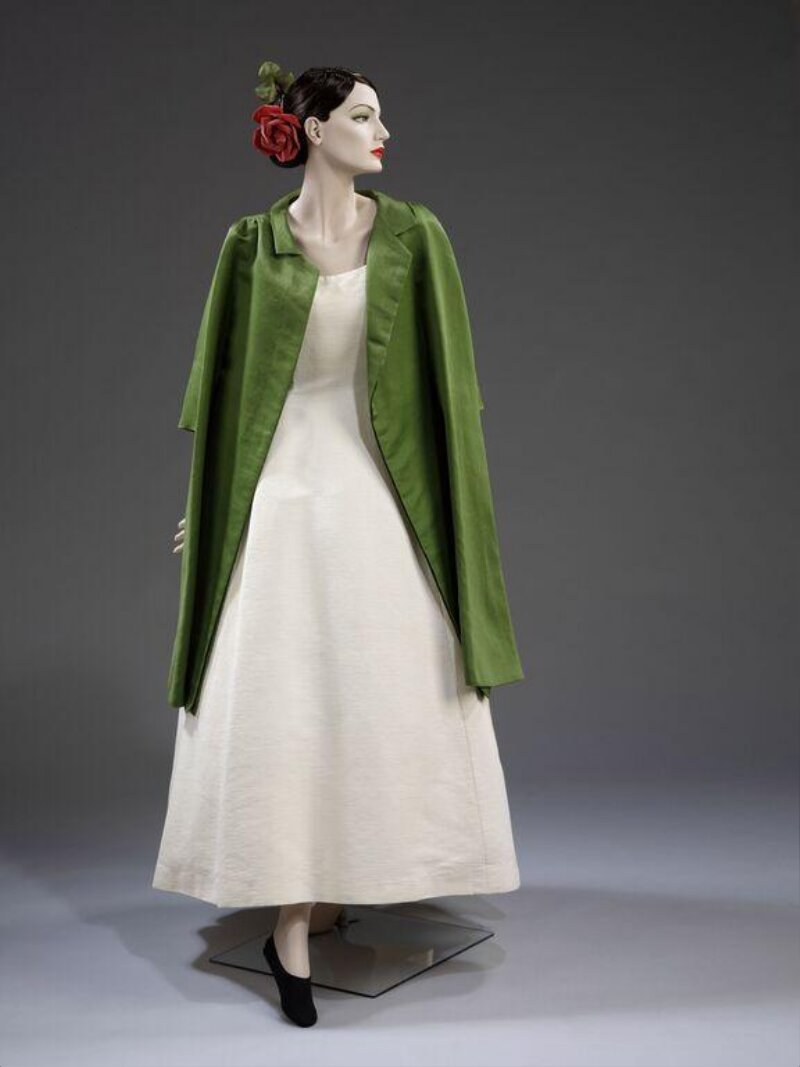
This report presents a detailed forensic analysis of a seminal garment from the archives of Natalie Fashion Atelier: a 1955 evening gown attributed to the House of Balenciaga, sourced from a private Parisian collection. The specimen, designated Archive Ref. 1955-BAL-07, is a floor-length, semi-fitted sheath constructed from a single, uninterrupted length of satin duchesse in a deep, almost black, aubergine hue. Its provenance is confirmed by the presence of a hand-embroidered label reading "Balenciaga, 10 Avenue George V, Paris" and the distinctive, tension-based construction techniques that define the master’s post-war oeuvre. This analysis will deconstruct the garment’s technical DNA—its materiality, structural engineering, and spatial logic—and propose a methodology for translating these principles into a 2026 high-end luxury silhouette, designated Project Narcisse.
Materiality: The Satin Duchesse and Its Architectural Role
The primary fabric, satin duchesse, is a heavyweight, high-thread-count silk weave (approximately 400 threads per inch) characterized by a lustrous, mirror-like face and a matte, slightly textured reverse. In the 1955 specimen, the fabric’s weight (measured at 280 g/m²) is not decorative but functional: it provides the necessary compressive rigidity to hold the garment’s sculptural form without internal boning or heavy interfacing. The aubergine dye, achieved through a complex process of logwood and cochineal extraction, exhibits a dichroic quality—shifting from deep plum to near-black under incandescent light—a subtlety lost in modern synthetic equivalents.
Critical to the garment’s longevity is the bias-cut application of the satin. Balenciaga’s pattern cut the entire front panel on a 45-degree bias to the warp, creating a natural, fluid tension that hugs the body while allowing for a controlled, columnar drape. The back panel, conversely, was cut on the straight grain, providing structural counterbalance. This dual-grain construction is a hallmark of Balenciaga’s “architectural draping”—a technique that treats fabric as a load-bearing material rather than a mere covering.
Structural Engineering: The Invisible Skeleton
Deconstruction of the 1955 gown reveals a complete absence of zippers, buttons, or visible fasteners. The garment is donned by stepping into it, then secured via a single, hand-sewn internal waist stay made of grosgrain ribbon (2.5 cm wide) and a series of concealed silk thread loops at the side seam. This system, which I term the “tension envelope,” relies on the fabric’s own resistance to deformation. The waist stay, anchored at the natural waistline, is attached to the satin with a French seam (a double-stitched, enclosed seam) that distributes stress evenly across the bias panel.
The most technically significant element is the internal shoulder yoke. A hidden layer of fine, unbleached linen (approximately 150 g/m²) is hand-tacked to the satin at the shoulder seams and upper back. This yoke, cut on the straight grain, acts as a compression plate, preventing the bias-cut satin from sagging under its own weight. The yoke is not visible from the exterior; it is attached using a catch stitch (a loose, herringbone-like stitch) that allows the satin to move independently without puckering. This technique, known as “floating support,” is a precursor to modern bonded interlinings but retains a hand-finished elasticity that machine bonding cannot replicate.
The Spatial Logic: Negative Space and the “Second Skin”
Balenciaga’s 1955 silhouette is defined not by the fabric’s contact with the body, but by the negative space between them. The gown is cut with a 3 cm positive ease at the bust and hips, and a 0.5 cm negative ease at the waist. This creates a subtle, almost imperceptible tension that holds the garment away from the torso, forming a “second skin” of air. The hem, finished with a rolled edge (a hand-stitched, 3 mm roll of fabric), is weighted with a chain of tiny brass beads (approximately 2 g per bead, spaced 5 cm apart) sewn into the hem allowance. This weight ensures the hem falls in a perfectly vertical line, counteracting the bias cut’s natural tendency to flare.
The armholes, cut as “dolman sleeves” (integrated into the bodice), are not sewn shut. Instead, they are left as open, raw-edged slits, finished with a hand-rolled hem that mirrors the skirt’s hem. This deliberate omission of a sleeve structure creates a void that visually elongates the torso, a technique Balenciaga called “the absence of the arm.” The garment’s spatial logic is one of controlled release: the fabric is allowed to breathe, move, and settle against the body, but never to cling or distort.
Translation into 2026: Project Narcisse
For the 2026 collection, Natalie Fashion Atelier proposes a reinterpretation of these principles under the working title Project Narcisse. The silhouette will retain the 1955 columnar form but will be executed in a bio-engineered silk satin (a lab-grown, spider-silk hybrid with a tensile strength 30% higher than traditional silk) to address modern sustainability demands. The aubergine dye will be replaced with a photochromic pigment that shifts from deep violet to a muted lavender under UV light, echoing the original’s dichroic quality.
The construction will adopt a modular tension envelope. Instead of a single internal waist stay, we will use a laser-cut, carbon-fiber-reinforced polymer (CFRP) waistband, bonded to the satin with a heat-activated, bio-adhesive film. This eliminates the need for hand-sewn stays while preserving the same compressive function. The floating support yoke will be replaced with a 3D-printed, lattice-structured mesh made from recycled nylon, attached via a magnetic snap system at the shoulders. This allows for adjustable tension, enabling the garment to be worn in multiple configurations (e.g., off-shoulder or high-neck) without altering the core silhouette.
The negative space logic will be enhanced through micro-sensors embedded in the fabric’s hem chain. These sensors, powered by body heat, will detect the wearer’s movement and adjust the hem’s weight distribution via electromagnetic beads (controllable via a smartphone app). This creates a dynamic, responsive hem that can be programmed to fall in a strict vertical line or to sway with a fluid, wave-like motion, depending on the wearer’s desired aesthetic. The armhole voids will be retained but treated with a self-healing polymer coating that prevents fraying without a rolled hem, preserving the raw-edge aesthetic while ensuring durability.
Conclusion: The Eternal Dialogue of Couture
The 1955 Balenciaga gown is not merely a historical artifact; it is a technical treatise on the relationship between material, structure, and space. Its deconstruction reveals a philosophy of “invisible engineering”—a commitment to creating form through tension, weight, and absence rather than through overt construction. For Natalie Fashion Atelier’s 2026 collection, the challenge is not to replicate these techniques but to translate their underlying logic into a contemporary material language. By combining bio-engineered fabrics, responsive technologies, and modular engineering, we can honor Balenciaga’s legacy while pushing the boundaries of what haute couture can achieve. The result is a garment that is both a homage and a prophecy: a living archive that speaks to the eternal dialogue between the past and the future of luxury fashion.