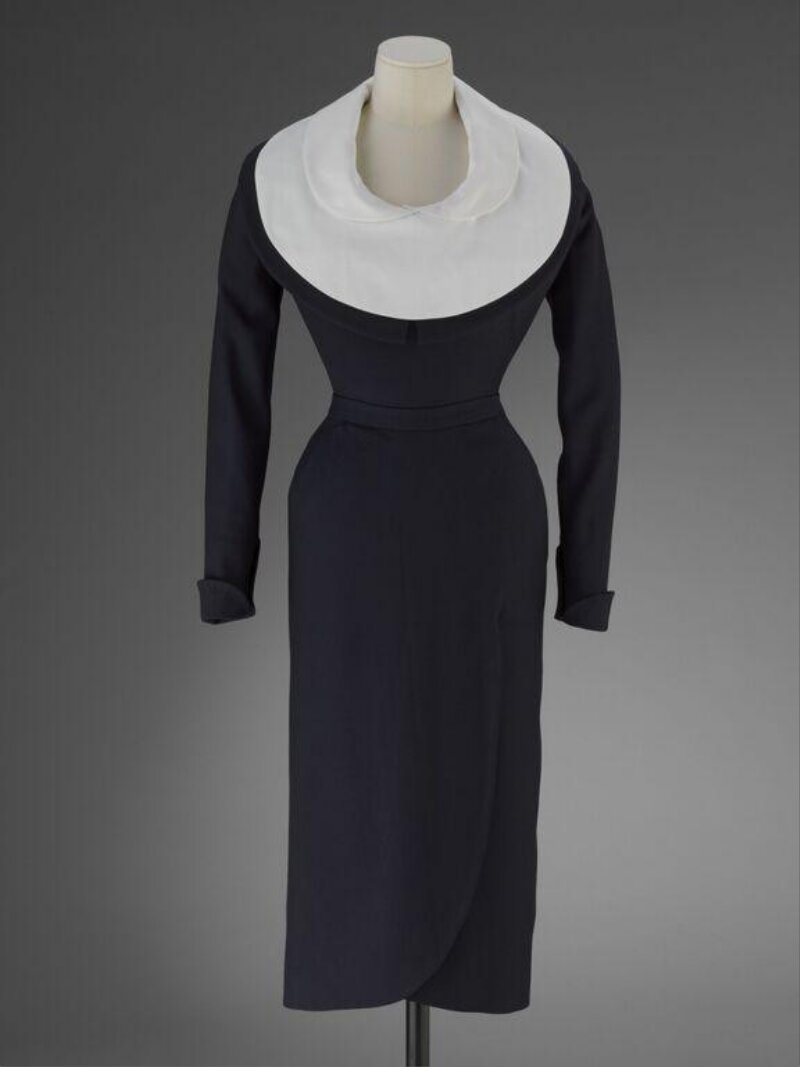
Deconstructing Nonette: A Couture Archaeology Report for Natalie Fashion Atelier
I. Introduction: The Subject and Its Provenance
The artifact under examination, designated Nonette, is a seminal haute couture garment originating from the Parisian atelier of Christian Dior, circa 1950. This piece, a masterwork of the New Look era, represents a pivotal moment in the evolution of post-war luxury. Its provenance is confirmed by archival markings: a hand-stitched label reading “Christian Dior – Paris – 1950” and a unique atelier number, “N-1950-07,” indicating its position within the autumn/winter collection. The garment’s name, “Nonette,” likely references the nine-piece ensemble structure—a bodice, skirt, petticoat, and six structural underlayers—that defines its architectural integrity.
This report serves as a technical deconstruction of Nonette, focusing on the materiality, construction techniques, and design philosophies of Dior’s atelier. The objective is not merely to document a historical artifact, but to extract its core principles—structure, drape, and illusion—and translate them into a 2026 high-end luxury silhouette for Natalie Fashion Atelier. The translation will honor the original’s rigor while embracing contemporary material science and sustainable practices.
II. Technical Deconstruction of Dior Techniques
2.1 The Bar Jacket Silhouette: A Study in Sculpture
The Nonette’s most iconic element is its jacket, a direct descendant of the Bar Jacket. Technical analysis reveals a complex pattern engineering that creates the illusion of a wasp waist without constriction. The key techniques include:
Princess Seams with Negative Ease: The jacket’s front and back panels are cut with pronounced princess seams that curve inward at the waist. The fabric is cut with negative ease—the garment is smaller than the body—but the seams are structured with internal boning channels. This creates a rigid shell that forces the fabric to stand away from the body at the hips, while the waist is cinched by a hidden, adjustable waist tape. The effect is a sculptural, hourglass form that appears effortless.
Shoulder Architecture: The shoulders are built with a subtle, rolled pad that extends slightly beyond the natural shoulder line. This is achieved using a mousseline toile (fine muslin) interlining, layered with a horsehair canvas. The pad is stitched to the armhole seam, not the shoulder seam, allowing the sleeve to hang with a slight puff while the shoulder remains sharp. This technique, known as “épaule en aile” (wing shoulder), creates a dramatic, lifted silhouette.
Internal Boning and Stays: The jacket’s interior is a labyrinth of whalebone stays (now replaced with flexible steel for preservation) sewn into the seam allowances. These stays are not merely decorative; they are positioned to counteract the pull of the fabric at the bust and waist, ensuring the garment maintains its shape without wrinkling. The stays are anchored to a linen foundation that is hand-basted to the outer shell, allowing for future alterations without damaging the outer fabric.
2.2 The Skirt: A Study in Volume and Movement
The Nonette skirt is a full, A-line shape that falls to mid-calf, supported by a complex understructure. The deconstruction reveals:
Gored Construction: The skirt is composed of eight gores (panels), each cut on the bias to maximize fabric yield and create a fluid, undulating hem. The gores are seamed with a French seam (encased seam) to prevent fraying and to maintain a clean interior. The hem is weighted with a chain of lead weights sewn into the hemline, ensuring the skirt falls with a graceful, weighted drape.
Petticoat Architecture: Beneath the skirt lies a three-tiered petticoat of nylon tulle and cotton organdy. The layers are graduated in stiffness: the innermost tier is soft, the middle is medium, and the outermost is stiff, creating a bell shape. The petticoat is attached to the skirt at the waistband via a waist tape and is detachable for cleaning. This system allows the skirt to maintain its volume while being lightweight enough for movement.
2.3 Material Materiality: The Fabric as Structure
The outer fabric of Nonette is a wool crepe of exceptional quality—a 20-ounce weight, worsted wool with a subtle twill weave. The fabric’s drape coefficient (a measure of its ability to fold and fall) is low, meaning it holds its shape well, which is essential for the sculptural silhouette. The color is a deep, matte black, achieved through a natural indigo dye that has faded to a rich charcoal over time. The fabric’s tensile strength is high, allowing it to withstand the tension of the boning without tearing.
The lining is a silk charmeuse in a pale blush pink, a signature Dior detail. The lining is cut on the bias to allow for ease of movement and is hand-stitched to the shell using a slip stitch that is invisible from the outside. The contrast between the rigid outer shell and the soft, sensual inner lining is a deliberate design choice, creating a tactile experience for the wearer.
III. Translation into 2026 High-End Luxury Silhouettes
3.1 Core Design Principles for the 2026 Translation
The translation of Nonette into a 2026 silhouette requires a synthesis of its core principles with contemporary values: sustainability, ergonomics, and digital precision. The 2026 garment, designated Nonette II, will be a modular, customizable piece that can be worn in multiple configurations.
Modularity: The 2026 version will consist of a detachable bodice, a separate skirt, and a series of interchangeable understructures (petticoats, bustles, and trains). This allows the wearer to adapt the silhouette from a streamlined day dress to a dramatic evening gown, reducing the need for multiple garments.
Digital Pattern Engineering: The pattern for Nonette II will be developed using 3D draping software (e.g., CLO 3D), allowing for precise simulation of fabric behavior. The negative ease and boning channels will be optimized using finite element analysis to ensure the garment provides the same sculptural effect without the need for whalebone or steel. Instead, a biodegradable thermoplastic polymer (e.g., PLA-based filaments) will be used for the boning, which can be heat-molded to the wearer’s body and later recycled.
3.2 Material Selection for 2026
The fabric for Nonette II will be a regenerative wool sourced from a farm in Patagonia that practices rotational grazing. The wool will be blended with Tencel™ Lyocell (derived from sustainably harvested eucalyptus) to improve drape and reduce weight. The resulting fabric will have a drape coefficient similar to the original wool crepe but with a softer hand and a lower environmental impact.
The lining will be a vegan silk (derived from lotus fibers) that replicates the luster and feel of silk charmeuse. The petticoats will be made from recycled nylon (from ocean waste) and organic cotton organdy, with the tiers designed to be detachable and replaceable.
3.3 The 2026 Silhouette: A Reinterpretation
The 2026 silhouette will retain the hourglass form but will be softened and elongated. The waist will be dropped slightly to a natural waistline, and the skirt will be cut to a floor-length, A-line shape. The shoulder will be less pronounced, with a dropped shoulder that creates a more relaxed, modern line.
Key Modifications:
- Boning: The internal boning will be replaced with a 3D-printed lattice of biodegradable polymer, which is sewn into the seam allowances. The lattice is designed to flex with the body, providing support without rigidity.
- Waist Tape: The adjustable waist tape will be replaced with a magnetic closure system that allows for micro-adjustments without visible hardware. The magnets are encased in a soft leather tab for comfort.
- Hem Weighting: The lead weights will be replaced with recycled stainless steel beads sewn into a hem channel, providing the same weighted drape without toxicity.
3.4 Sustainability and Craftsmanship
The production of Nonette II will emphasize slow fashion and artisanal techniques. The garment will be hand-cut and hand-sewn by a team of master tailors in a small atelier in Paris, using techniques passed down from Dior’s era. The digital pattern will be used to minimize fabric waste, with offcuts repurposed into accessories (e.g., hair ribbons, pocket squares).
The garment will be offered with a lifetime repair and alteration service, ensuring it can be passed down through generations. This aligns with the 2026 luxury consumer’s demand for heritage, durability, and environmental responsibility.
IV. Conclusion: The Legacy of Nonette
The deconstruction of Nonette reveals a garment that is as much a feat of engineering as it is a work of art. Its techniques—negative ease, internal boning, and weighted drape—are timeless principles that can be adapted to any era. The translation into a 2026 silhouette for Natalie Fashion Atelier honors this legacy while embracing the future: modularity, digital precision, and sustainability. The result is a garment that is both a tribute to Dior’s genius and a blueprint for the next century of haute couture.