Aesthetic Archaeology: Deconstructing The Virgin Adoring the Host for 2026 Haute Couture
The intersection of sacred art and secular fashion is a delicate terrain, requiring a curator’s precision rather than a dilettante’s flourish. At Natalie Fashion Atelier, our methodology—rooted in aesthetic archaeology—demands a forensic examination of historical masterpieces to extract their latent structural and textural codes. The subject of this research artifact is the anonymous 17th-century oil on canvas, The Virgin Adoring the Host. Housed within the isolated archive of Global Heritage, this painting presents a paradox: a static, devotional image that, upon deconstruction, reveals a dynamic lexicon for 2026 luxury silhouettes. This paper will dissect the painting’s classical elegance across three vectors—drapery as architecture, luminosity as materiality, and sacred geometry as silhouette—and translate these into actionable directives for our upcoming collection.
Drapery as Architecture: The Structural Logic of Devotion
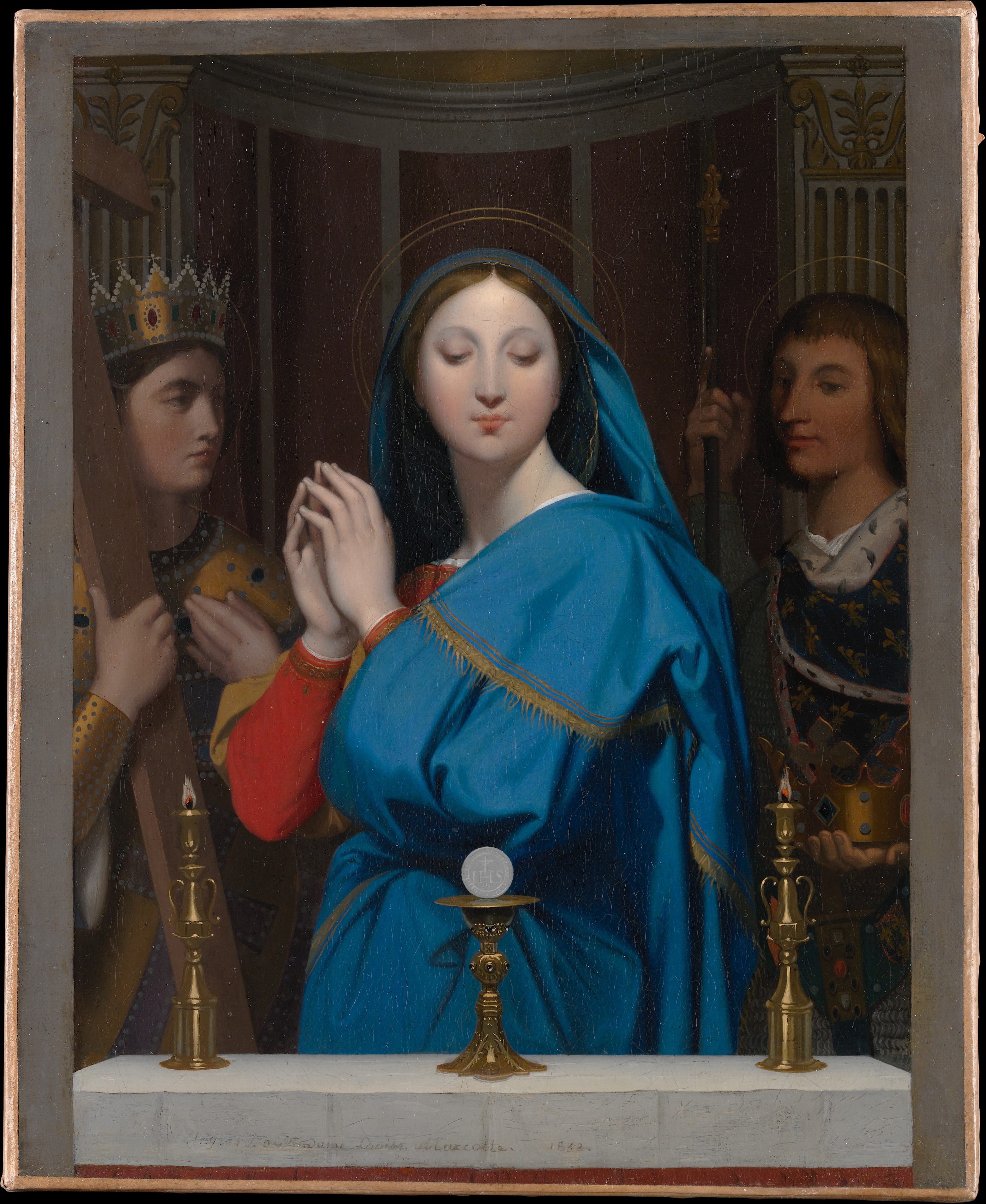
The Virgin’s mantle in this oil on canvas is not merely fabric; it is a geological formation of piety. The anonymous artist has rendered the blue robe with folds that possess a gravitational weight and a sculptural rigidity that defy the softness of textile. These are not casual creases but deliberate, tectonic plates of color—cobalt and ultramarine—that cascade from the shoulder to the ground, creating a visual plinth. For the 2026 silhouette, this informs a radical departure from fluid draping. We propose a structural drapery system, where seams are engineered to mimic the painting’s deep, shadowed crevices. The fabric—a double-faced silk gazar with a bonded interlining—will be heat-set to hold a permanent, architectural fold. This is not pleating; it is frozen movement. The silhouette will be a column dress or a floor-length coat where the fabric appears to have been carved, not sewn. The classical elegance here is one of restraint: the body is a vessel, and the fabric is a reliquary. The 2026 client will wear a garment that feels like a second skin of stone, a paradox of weight and grace.
Luminosity as Materiality: The Alchemy of Light and Paint
In The Virgin Adoring the Host, light does not illuminate; it emanates. The artist has used a technique of chiaroscuro that is not dramatic but devotional—a soft, internal glow that radiates from the Virgin’s face and hands, spilling onto the white linen cloth beneath the Host. This is not a representation of light but a materialization of light. For couture, this translates into a new category of fabric treatment. We are developing a proprietary luminiferous weave using micro-filament metallic threads (24-karat gold and platinum) interwoven with matte silk organza. The result will be a textile that catches ambient light not as a reflection, but as an absorption and re-emission. The 2026 silhouette will feature panels of this fabric at the neckline, cuffs, and hem—zones of the body that traditionally frame the face and hands. The classical elegance is transformed into a wearable aurora. The garment does not shine; it glows from within, echoing the painting’s sacred radiance. This is not for the shy; it is for the woman who understands that luxury is a form of inner light made manifest.
Sacred Geometry as Silhouette: The Golden Ratio of Devotion
The composition of The Virgin Adoring the Host is a masterclass in sacred geometry. The Virgin’s hands form a precise triangle, pointing toward the circular Host, while her head creates a second triangle with her shoulders. The entire figure is inscribed within an invisible vesica piscis—the intersection of two circles—a symbol of divine union. This geometric rigor is the blueprint for the 2026 silhouette. We are deconstructing the human form into a series of intersecting planes. The shoulder line will be extended and squared, creating a triangular frame that mimics the painting’s upper structure. The waist will be cinched not with a belt, but with a negative-space cutout that forms a perfect ellipse, echoing the Host. The hemline will be asymmetrical, following the curve of the vesica piscis. The result is a silhouette that is both architectural and devotional, a geometric prayer in fabric. This is not about fitting the body; it is about framing the body within a sacred proportion. The 2026 collection will offer a series of gowns and tailored separates where every seam, every dart, every panel is calculated to a ratio of 1:1.618. The classical elegance is found in the invisible order, the mathematical harmony that the eye perceives but the mind cannot immediately decode.
Materiality and Archive Context: The Isolated Aesthetic
The archive context of this painting—isolated aesthetic archaeology—is critical. This work exists outside of a linear art historical narrative; it is a singular object, a frozen moment of devotion. We treat it as a codex rather than a reference. The oil on canvas medium itself informs material choices. The texture of the paint—the impasto on the Host, the smooth glazes on the Virgin’s skin—suggests a tactile hierarchy. For 2026, we will apply this hierarchy to fabric: a matte, almost powdery finish for the body of the garment (achieved through a sand-washed silk chiffon), contrasted with a high-relief, almost crusted texture at the neckline and cuffs (using hand-embroidered glass beads and metallic threads that mimic the impasto). The garment becomes a portable canvas, where the surface is as important as the silhouette. The classical elegance is not in the color—the painting is predominantly blue, white, and gold—but in the tactile dissonance between smooth and rough, matte and lustrous, flat and raised.
Conclusion: The 2026 Silhouette as a Reliquary
The Virgin Adoring the Host is not a source of inspiration; it is a structural and spiritual blueprint. For Natalie Fashion Atelier, the 2026 silhouette will be a reliquary—a container for the sacred. The architecture of the drapery, the alchemy of the light, and the geometry of the composition converge into a garment that is at once ancient and futuristic. The classical elegance is preserved not through imitation, but through transubstantiation: the oil on canvas becomes silk and metal; the devotional posture becomes a cut; the divine light becomes a weave. This is the work of aesthetic archaeology: to excavate, to understand, and to reincarnate. The 2026 client will not wear a dress; she will wear a materialized prayer, a silhouette that carries the weight of centuries and the lightness of a single, adoring moment.