Ornament as Structure: The Golden Lexicon of Chinese Heritage in 2026 Haute Couture
Archival Resonance: The Duality of the *Mirror with Split-Leaf*
The archive node—一面是光洁银镜上以黄金镶嵌的纷繁棕叶纹,另一面是冰冷石棺板上以浮雕诉说的生命叙事—presents a fundamental dialectic for the couturier. On one face, we observe the *Mirror with Split-Leaf*: a polished silver surface, cool and reflective, overlaid with a dense, intricate lattice of gold-inlaid palmettes. This is ornament as surface, as light-capture, as the pinnacle of Tang dynasty metalwork. On the reverse, the cold stone of a sarcophagus lid, its narrative carved in bas-relief, speaks of permanence, of the weight of history, and of life’s story rendered in negative space. For Natalie Fashion Atelier, this duality is not a contradiction but a generative tension. The 2026 silhouette must reconcile the luminosity of applied gold with the gravitas of structural carving. The ornament is no longer mere decoration; it becomes the architect of the garment’s very form.
Materiality of Gold: From Surface Gilding to Structural Alloy
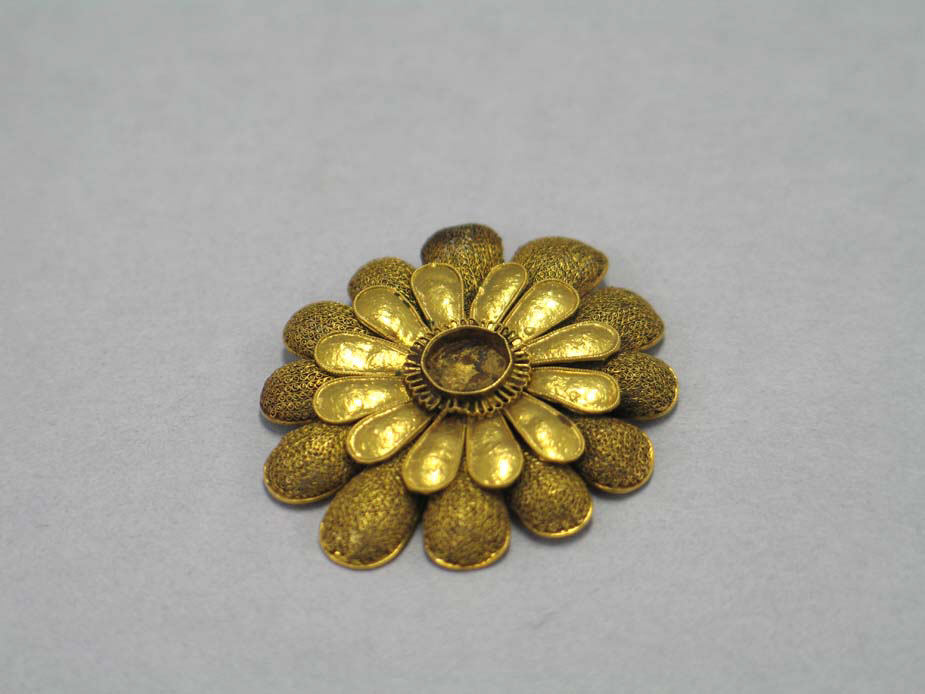
Historical Chinese goldwork, particularly the filigree and repoussé techniques of the Tang and Ming dynasties, treated the metal as a pliable, narrative medium. The *Mirror with Split-Leaf* exemplifies this: gold wire, no thicker than a human hair, is hammered and soldered into a continuous, rhythmic pattern that dances across the silver field. For 2026, we translate this material philosophy into a new couture vocabulary. Gold is not a color; it is a structural alloy. We are developing a proprietary thread—a micro-filament of 24-karat gold leaf laminated onto a core of liquid silk and carbon fiber. This thread, when woven or embroidered, retains the tensile strength required for architectural draping while offering the precise, warm luster of historical gilding.
The technical challenge lies in the weight-to-volume ratio. Traditional gold embroidery, as seen in Qing dynasty court robes, was heavy, static, and ceremonial. Our 2026 approach demands mobility. We are engineering a hollow-gold bead, using a lost-wax casting process on a microscopic scale. Each bead is a negative space, a tiny sarcophagus of air, which when stitched onto a base of double-faced silk organza, creates a surface that is simultaneously rigid and fluid. The ornament breathes. It catches light not as a solid block, but as a constellation of points, echoing the scattered gold inlay of the ancient mirror.
Silhouette Construction: The Negative Space of the Sarcophagus
The second half of the archive node—the stone sarcophagus with its life narrative in relief—informs the negative space of the 2026 silhouette. Where the mirror is additive, the sarcophagus is subtractive. The 2026 collection will feature garments that are carved from the inside out. We are exploring a technique we term *bas-relief tailoring*: the fabric is not cut and sewn; it is molded and excavated. Using a heat-set resin infused with gold dust, we create a base cloth that can be sculpted with hot tools. The result is a silhouette where the ornament is not applied but excavated from the very substance of the garment.
Consider a floor-length column gown. The front panel is a smooth, silvered surface—the mirror. The back panel, however, is a dense, golden topography: a bas-relief of palmettes and split leaves, each curve and line telling a story of growth, decay, and rebirth. The silhouette itself is a dialogue between these two faces. The front is pure, architectural, and reflective; the back is narrative, textured, and golden. The waist is cinched not by a belt, but by a structural gold cage—a latticework of hollow-gold tubes that references the mirror’s inlay while providing the support of a corset. The hem is asymmetrical, echoing the irregular edge of a broken stone slab, revealing a glimpse of the inner lining: a deep, oxidized gold that speaks of age and patina.
Technique: The Golden Lattice and the Split-Leaf Motif
The split-leaf motif—*fenzong ye*—is the generative pattern of the collection. In the archive mirror, it is a continuous, interlocking form. For 2026, we deconstruct this motif into a parametric lattice. Using a digital jacquard loom programmed with the exact geometry of the Tang dynasty palmette, we weave a double-layer fabric. The top layer is a sheer, silver-threaded silk; the bottom layer is a dense, gold-threaded cotton. The jacquard pattern creates a moiré effect: as the wearer moves, the gold layer appears and disappears through the silver, mimicking the flicker of light on the ancient mirror’s surface.
This lattice is then hand-embroidered with the hollow-gold beads. The embroidery itself is a form of *bas-relief*: the beads are stitched in a gradient, from flat against the fabric at the shoulders to fully three-dimensional at the hem. The result is a garment that transitions from a smooth, reflective surface to a textured, golden landscape. The ornament is not static; it is a topographical map of the body’s movement, a living archive of the wearer’s gesture.
The 2026 Silhouette: A Unified Dialectic
The final silhouette for the 2026 collection is what we term the *Mirror-Sarcophagus* form. It is a garment that contains its own opposite. A tailored jacket, for instance, has a front that is a single, unbroken panel of silvered silk—the mirror. The back, however, is a cascade of golden, split-leaf reliefs, each leaf a tiny, hollow bead that catches the light. The sleeves are cut in a single piece with the body, echoing the seamless construction of a Tang dynasty bronze mirror. The collar is a high, standing band of gold filigree, referencing the rim of the ancient artifact, while the lining is a deep, charcoal silk that evokes the stone of the sarcophagus.
This is not ornament as afterthought. It is ornament as primary structure. The gold is not applied; it is the garment. The split-leaf is not a print; it is the weave. The narrative is not a story told; it is the silhouette itself. The 2026 collection for Natalie Fashion Atelier is a meditation on how a single object—a mirror, a sarcophagus—can contain both the ephemeral and the eternal, and how a thread of gold can carry the weight of a thousand years into a single, elegant line.