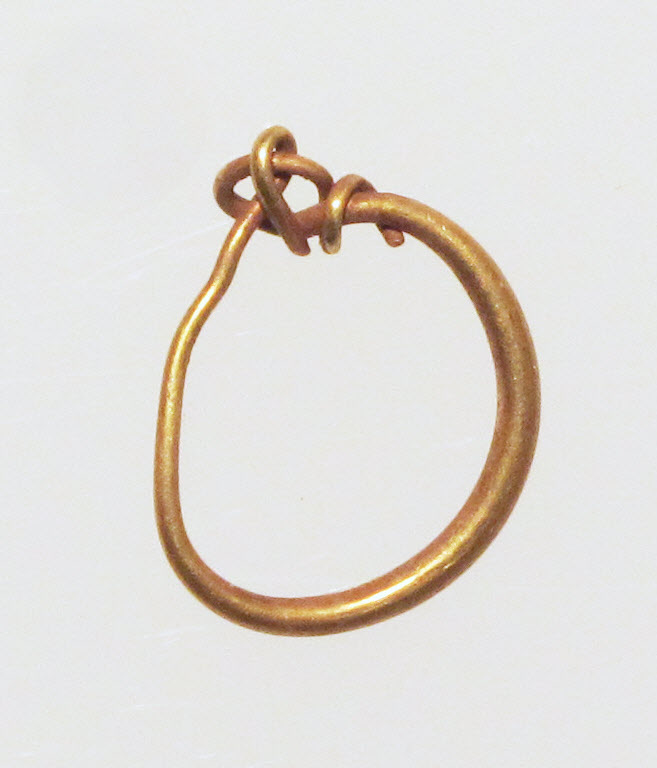
Deconstructing the Classical Loop: A Study in Materiality and Silhouette
The gold loop earring, in its most reductive form, is a paradox: a perfect, unbroken circle that simultaneously signifies eternity and the fleeting moment of adornment. Within the archive of Natalie Fashion Atelier, this object is not merely a piece of jewelry but a condensed treatise on aesthetic archaeology. Its heritage is global, tracing a lineage from the Sumerian lunulae to the Etruscan granulation, and onward to the minimalist revolutions of the 20th century. However, the specific resonance of this artifact is deepened by its juxtaposition with Archive Node: Mirror with Split-Leaf. One surface presents a polished silver mirror inlaid with intricate gold palmettes; the other, a cold stone sarcophagus narrating a life in bas-relief. This duality—the reflective, ornamental surface versus the deep, narrative structure—provides the critical lens for deconstructing the classical elegance of the gold loop and translating its materiality into the 2026 luxury silhouette.
The Materiality of Gold: From Surface to Structure
Gold’s intrinsic value is often misread as mere opulence. In the context of haute couture, its materiality is a study in weight, reflectivity, and malleability. The gold loop earring, particularly when crafted from 24-karat gold, possesses a specific heft—a gravitational pull that anchors the wearer. This is not a fleeting metal; it is a permanent archive of light. The Mirror with Split-Leaf teaches us that gold is not a pigment but a surface that captures and distorts reality. In 2026, this principle translates into silhouette through the concept of metallic scaffolding. We are moving away from gold as an appliqué or embroidery thread. Instead, the gold loop’s logic—a continuous, self-supporting arc—informs the construction of garments. Jackets will feature rigid, gold-leafed shoulder yokes that function as architectural cantilevers, mimicking the earring’s ability to define space without enclosing it. The materiality is not about coverage but about defining negative space.
Furthermore, the cold, reflective quality of the gold loop, as opposed to the warm, matte finish of a brushed surface, introduces a dialectic of temperature into the silhouette. The 2026 high-end silhouette will exploit this thermal contrast. We will see gowns where a fluid, matte silk crepe body is abruptly interrupted by a rigid, polished gold-bronze panel that wraps from the hip to the waist, creating a structural interruption that is both sensual and severe. This is the gold loop’s logic: a perfect, unyielding circle that holds the chaos of the body in a state of elegant tension.
Deconstructing the Classical Loop: The Split-Leaf Narrative
The classical elegance of the gold loop lies in its geometric purity. It is a circle—a symbol of wholeness, infinity, and the cyclical nature of time. However, the Mirror with Split-Leaf archive node introduces a critical fracture. The split-leaf motif, carved in gold on the mirror, is a representation of growth, bifurcation, and organic asymmetry. It is the narrative of life interrupting the perfect reflection. To deconstruct the classical loop is to introduce this split—to break the circle without destroying its essential character. This is not a rupture of violence but a rupture of narrative.
For the 2026 silhouette, this translates into the asymmetric loop. Consider a coat silhouette: a traditional double-breasted structure is bisected by a single, sweeping gold loop that begins at the left shoulder, arcs across the back, and terminates in a split-leaf clasp at the right hip. The loop is not a closed circle; it is an open, dynamic arc that suggests a story of movement. This is the narrative structure of the stone sarcophagus—a linear, unfolding story—applied to the reflective surface of the mirror. The garment becomes a wearable artifact, where the gold loop is both the frame and the narrative thread. The elegance is no longer in the static perfection of the circle but in the dynamic tension of its interruption.
From Adornment to Architecture: The 2026 Silhouette
The gold loop earring, historically, is an object of adornment that sits on the body. The 2026 high-end silhouette demands that this logic be inverted: the gold loop must become the body’s architecture. This is the fundamental shift from classical to contemporary. The materiality of gold—its ability to be drawn into a fine wire, hammered into a sheet, or cast into a solid form—allows for unprecedented structural possibilities.
We are developing a series of integrated loop systems for the torso. Imagine a column dress of black double-faced cashmere. The silhouette is severe, almost monastic. However, a series of graduated gold loops—starting at 2 cm in diameter at the neckline and expanding to 15 cm at the hem—are sewn directly into the seams. These loops are not decorative; they are functional. They create a structural exoskeleton that holds the fabric away from the body in specific zones, creating a controlled volume. The gold loops act as tension points, pulling the fabric taut in some areas and allowing it to drape freely in others. The result is a silhouette that is both rigid and fluid, a direct echo of the gold loop earring’s ability to be both a solid object and a space-defining void.
Furthermore, the split-leaf narrative informs the hemline. Instead of a straight or curved hem, the 2026 silhouette will feature a gold loop hem—a continuous, flexible band of gold mesh that terminates the garment. This hem is not a line but a threshold. It reflects light and creates a shimmering, fragmented edge, blurring the boundary between the garment and the body. This is the mirror surface: reflective, distorting, and infinitely suggestive.
Conclusion: The Eternal Return of the Loop
The gold loop earring, deconstructed through the lens of the Mirror with Split-Leaf, is no longer a simple ornament. It is a philosophical tool for understanding the relationship between surface and structure, reflection and narrative. For Natalie Fashion Atelier, the 2026 silhouette is not a rejection of classical elegance but its re-articulation. We are not discarding the circle; we are splitting it, bending it, and weaving it into the very fabric of the garment. The gold becomes the structural grammar of the silhouette, a language of tension, volume, and light. The result is a collection that is deeply archaeological, profoundly material, and unmistakably Parisian in its rigorous, elegant logic. The loop endures, not as a symbol of stasis, but as a dynamic, narrative force that continues to shape the future of luxury form.