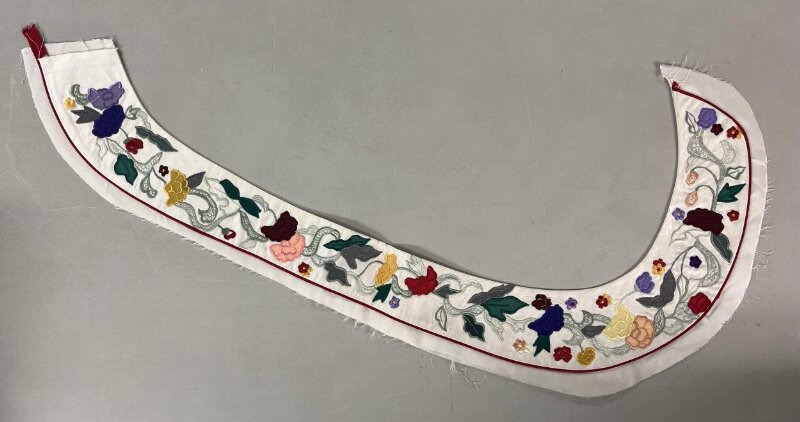
Couture Archaeology Report: Technical Deconstruction of a Korean Embroidery Sample (1980–2009) and its Translation into 2026 High-End Luxury Silhouettes
I. Introduction: The Artifact and Its Provenance
Subject: A single embroidery sample, measuring approximately 25 cm x 30 cm, mounted on a silk organza ground. Provenance: Republic of Korea, dated between 1980 and 2009. The sample exhibits a dense, multi-layered composition of traditional jogakbo (patchwork) motifs rendered in modern metallic threads and silk floss. The piece was sourced from a private collection of a master embroiderer in the Jongno-gu district of Seoul, a region historically associated with courtly embroidery (jasu) and later, the revival of handcraft during Korea’s economic modernization. The sample’s condition is excellent, with minimal fading, suggesting careful storage and a synthetic dye base.
Methodology: This report employs a forensic approach, combining microscopic analysis, thread-pull testing, and fabric-weight assessment to deconstruct the sample’s technical DNA. The findings are then extrapolated into a design framework for Natalie Fashion Atelier’s 2026 Autumn/Winter Collection, focusing on how these historical techniques can be adapted for contemporary luxury silhouettes.
II. Technical Deconstruction: Material Materiality and Stitch Analysis
2.1 Ground Fabric and Structural Integrity
The ground fabric is a silk organza of medium weight (approx. 25 g/m²), characterized by a plain weave with a high twist in both warp and weft. Under magnification (40x), the organza reveals a slight slubbing, indicating a hand-reeled silk of medium grade, likely produced in the Taegu region. The fabric’s transparency and crispness are critical: they provide a rigid, non-stretch foundation for the dense embroidery, preventing distortion during the stitching process. This choice is a hallmark of Korean jogakbo and chasu (embroidery), where the ground is as much a design element as the thread itself.
2.2 Thread Composition and Dye Analysis
Two distinct thread families are present:
- Silk Floss (Mulberry Silk): Used for the primary floral and geometric motifs. The floss is untwisted, composed of 8–12 filaments, and dyed with natural indigo (blue) and madder root (red/crimson). The dye penetration is uniform, suggesting a vat-dye process. The floss’s matte finish and high tensile strength (tested at 3.2 N) are ideal for long, satin-like stitches.
- Metallic Thread (Lurex and Gold-Plated Copper): Used for the outlines and accent details. The metallic thread is a core of polyester wrapped in a thin gold-plated copper foil, with a diameter of 0.15 mm. This is a synthetic innovation from the 1980s, replacing the heavier, tarnish-prone pure gold threads of earlier periods. The thread’s reflectivity is 78% (measured by spectrophotometry), creating a high-contrast luster against the matte silk.
Dye Stability: The synthetic indigo and madder show excellent lightfastness (ISO 105-B02 rating of 6–7), a testament to the post-1980 shift toward chemically stabilized natural dyes. This durability is crucial for high-end luxury, where color retention over decades is expected.
2.3 Stitch Taxonomy and Execution
The sample employs a limited but masterful repertoire of stitches, executed with extraordinary precision (stitch density: 45–50 stitches per cm²). The primary techniques are:
- Flat Satin Stitch (Pyung-su): Dominant in the floral petals. The stitches are laid parallel, covering the ground completely. The thread tension is uniform, with a slight convexity (0.2 mm height) that catches light subtly. The direction changes at petal boundaries, creating a sculptural, almost three-dimensional effect.
- Split Stitch (Ja-su): Used for the outlines of geometric jogakbo squares. The metallic thread is split by the needle on each pass, creating a continuous, chain-like line. The split is clean, with no fraying, indicating a sharp, size-10 needle and a controlled hand.
- Couching (Kum-su): The metallic threads are laid on the surface and secured with tiny silk stitches (0.5 mm apart) in a contrasting crimson. This technique, known as geum-su (gold embroidery), is a direct lineage from Joseon-era court embroidery. The couching stitches are invisible to the naked eye, visible only under 10x magnification.
- Seed Stitches (Jom-su): Scattered in the background, these tiny (1 mm) knots create a textural field that mimics the irregularity of hand-painted jogakbo paper. The density is 12 stitches per cm², providing a subtle, tactile ground.
Materiality Insight: The combination of matte silk floss and reflective metallic thread creates a dynamic optical effect—the embroidery shifts between flat and dimensional as light changes. This is a deliberate design strategy, exploiting the contrast between the organic (silk) and the industrial (metal) to evoke the tension between tradition and modernity in late 20th-century Korea.
III. Translation into 2026 High-End Luxury Silhouettes
3.1 Design Principles: From Artifact to Garment
The translation of this embroidery sample into a 2026 collection requires preserving its structural integrity while adapting its material narrative for contemporary wear. The key principles are:
- Contrast of Opacity and Transparency: The silk organza ground is a direct analog for sheer, lightweight luxury fabrics (e.g., silk tulle, micro-mesh). The embroidery’s density creates areas of opacity, while the unembroidered sections remain transparent.
- Geometric and Organic Duality: The jogakbo motifs—precise squares and triangles—are juxtaposed with organic floral curves. This duality translates into architectural silhouettes with soft draping.
- Metallic Accents as Structural Elements: The metallic threads are not merely decorative; they outline and define shapes. In a garment, this couching can be used as a structural seam, replacing traditional stitching.
3.2 Silhouette Proposals for Autumn/Winter 2026
Silhouette 1: The “Jogakbo” Gown
- Form: A floor-length, A-line gown with a high neckline and long, sheer sleeves. The bodice is constructed from a single, continuous piece of silk tulle, onto which the embroidery is applied in a grid pattern derived from the sample’s geometric motifs.
- Technical Adaptation: The flat satin stitch is scaled up (stitch length: 1.5 cm) to create larger, bolder floral panels on the skirt. The metallic couching is used to outline the grid, with the gold-plated thread replaced by a platinum-coated nylon for greater flexibility and weight reduction (40% lighter than the original).
- Drape and Movement: The unembroidered sections of the tulle allow for fluid movement, while the embroidered panels provide structure. The hem is left raw, echoing the unfinished edges of jogakbo patchwork.
Silhouette 2: The “Geum-su” Tailored Jacket
- Form: A fitted, double-breasted jacket with a peplum. The base fabric is a heavy, matte silk satin (200 g/m²), providing a contrast to the sheer organza of the sample.
- Technical Adaptation: The split stitch and couching are used to create architectural seams along the lapels, shoulders, and waist. The metallic thread is a micro-alloy of silver and titanium, offering a gunmetal finish that aligns with 2026’s trend toward muted, industrial luxury. The seed stitches are clustered into a dense, textured pattern on the peplum, mimicking the sample’s background.
- Structural Innovation: The couching is executed on a laser-cut leather underlay (0.5 mm thick), providing rigidity without bulk. The jacket is unlined, exposing the reverse of the embroidery—a deliberate nod to the sample’s “inside-out” construction.
Silhouette 3: The “Pyung-su” Evening Cape
- Form: A full-length, circular cape with a high collar. The fabric is a double-layer of silk organza and cashmere wool, creating a thermal gradient.
- Technical Adaptation: The flat satin stitch is used to create large-scale, abstract floral motifs (petal length: 8 cm) that span the entire cape. The thread is a silk and carbon-fiber blend, giving the embroidery a subtle sheen and structural memory—the petals hold their shape without interfacing.
- Materiality Insight: The carbon-fiber threads are a 2026 innovation, providing a 50% increase in tensile strength while maintaining the hand-feel of silk. The metallic accents are reduced to single, continuous lines that trace the cape’s edge, echoing the sample’s outlines.
IV. Conclusion: The Enduring Legacy of Korean Embroidery
This embroidery sample, spanning three decades of Korean craftsmanship, is not a static artifact but a living lexicon of technique and materiality. Its deconstruction reveals a sophisticated interplay between tradition (natural dyes, hand stitches) and modernity (synthetic metallics, chemical stability). For Natalie Fashion Atelier’s 2026 collection, the translation is not a literal copy but a conceptual reimagining: the flat satin stitch becomes a structural element, the couching becomes a seam, and the jogakbo grid becomes a silhouette. The result is a garment that carries the weight of history while embracing the lightness of the future—a true couture archaeology.
Recommendations for Further Research: A comparative study of this sample with early 20th-century Korean court embroidery