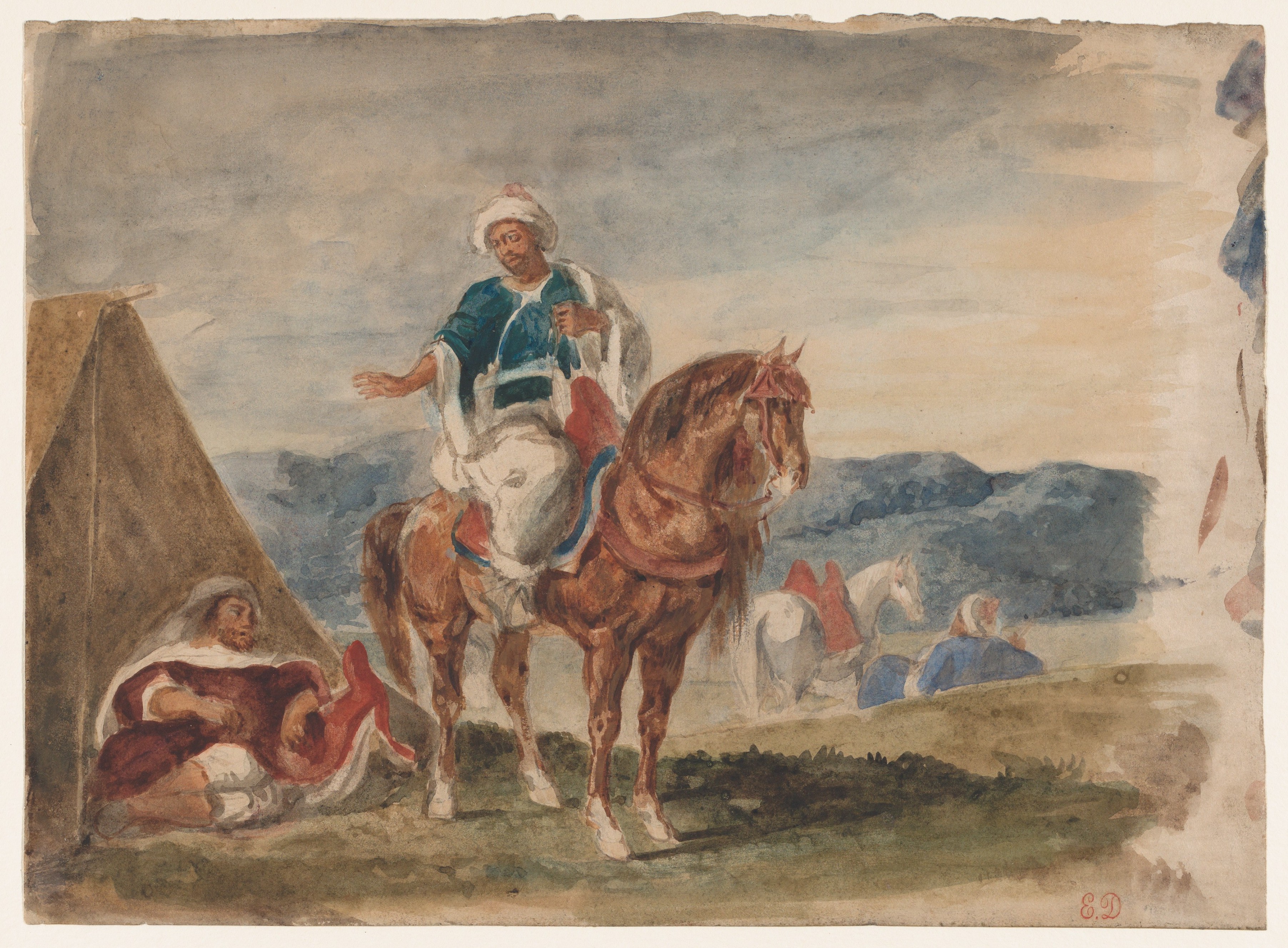
Deconstructing the Classical Elegance: Three Arab Horsemen at an Encampment as a Blueprint for 2026 Haute Couture
Within the hallowed archives of Natalie Fashion Atelier, the subject Three Arab Horsemen at an Encampment—rendered in the delicate medium of watercolor over graphite—represents a pivotal artifact of aesthetic archaeology. This work, isolated from its broader historical narrative, offers a profound lexicon of form, movement, and material restraint. For the 2026 haute couture season, this piece is not merely a reference; it is a technical masterclass in translating ephemeral artistry into structural luxury. The watercolor’s inherent fluidity and the graphite’s precise scaffolding provide a dualistic framework for silhouettes that balance disciplined architecture with organic, almost nomadic grace.
The Graphite Skeleton: Architectural Precision in Silhouette Construction
The graphite underdrawing in this work is not a preparatory sketch but a deliberate, visible armature. It defines the axial lines of the horsemen—the vertical thrust of the spine, the angular sweep of an arm holding a rein, the horizontal plane of a horse’s back. For 2026, this translates directly into the skeletal structure of a garment. We are not designing fabric; we are designing a carapace of line. The silhouette must be built on a foundation of sharp, unyielding seams that mimic the graphite’s decisive strokes. Think of a tailored riding jacket where the shoulder seam is not a gentle curve but a deliberate, almost brutalist angle, echoing the horseman’s posture. The graphite informs a zero-tolerance approach to drape—every fold must be pre-determined, every pleat a calculated vector. This is the antithesis of free-flowing bohemianism; it is a controlled tension that evokes the latent energy of a horse held in check. The 2026 silhouette, therefore, begins with a graphite line—a sharp, clean cut that defines the body’s architecture before any fabric is considered.
The Watercolor Wash: Fluidity and Atmospheric Volume
Where graphite provides structure, the watercolor wash introduces atmospheric volume. In the original work, the washes are not uniform; they bleed, pool, and evaporate, creating a sense of ephemeral mass. This is the key to the 2026 silhouette’s second layer. The garment must possess a liquid quality that appears to be in a state of becoming. We achieve this through gradated opacity—using silk organza, chiffon, or micro-pleated tulle that transitions from a dense, almost opaque core to a translucent, water-like edge. The watercolor technique of wet-on-wet is replicated in fabric through dye-sublimation and hand-painted gradients, where the color seems to breathe and shift across the surface. The silhouette is not static; it is a field of color that expands and contracts with movement. The horsemen’s encampment, with its suggestion of wind-swept tents and shifting sands, is echoed in a skirt that flares from a tight, graphite-defined waist into a billowing, watercolor-like hem. This is not volume for volume’s sake; it is controlled atmospheric pressure, where the fabric behaves like a watercolor wash—unpredictable yet contained within the graphite’s boundary.
Materiality as Narrative: The Graphite-Watercolor Dichotomy
The 2026 haute couture collection must honor the materiality of the medium. Watercolor over graphite is a dialogue between the permanent and the transient. In garment construction, this translates to a dichotomy of textures. The graphite element is realized through matte, dense fabrics—wool crepe, double-faced satin, or bonded leather—that hold a sharp edge and resist drape. These are the structural anchors of the silhouette. The watercolor element is expressed through luminous, fluid materials—silk charmeuse, liquid jersey, or hand-painted organza—that catch light and create a sense of depth. The interplay is not a simple layering; it is a chemical reaction of textures. A graphite-structured bodice might be overlaid with a watercolor-wash panel that appears to dissolve at the edges, creating a visual friction between the rigid and the fluid. This is the essence of aesthetic archaeology: we are excavating the work’s material truth and re-contextualizing it as a tactile experience. The 2026 silhouette is not just seen; it is felt as a tension between the permanent and the ephemeral.
Silhouette Archetypes: The Horseman’s Posture and the Nomadic Drape
From the Three Arab Horsemen, we derive two primary silhouette archetypes for 2026. The first is the Equestrian Column, inspired by the horseman’s vertical, seated posture. This silhouette is a long, lean line from shoulder to floor, broken only by a sharp, graphite-defined waist. The fabric is dense at the top (graphite) and dissolves into a watercolor-like train at the back. The second archetype is the Encampment Cocoon, inspired by the tents and the gathered fabric of the horsemen’s robes. This silhouette is a study in controlled volume. It begins with a tight, graphite-defined collar and shoulder, then expands into a soft, watercolor-shaped cape or coat that falls in asymmetrical, wash-like layers. The hem is not straight; it is a bleeding edge, mimicking the watercolor’s tendency to spread beyond its original boundary. Both archetypes require a mastery of negative space—the area between the body and the fabric is as important as the fabric itself. This is the graphite line made three-dimensional, a void that defines the silhouette’s presence.
Color Palette and Light: The Watercolor Spectrum
The watercolor palette of this work—muted ochres, deep indigos, pale sands, and stark whites—dictates the 2026 color story. These are not flat colors; they are layered, translucent tones that create a sense of depth. The 2026 collection will use hand-dyed, piece-dyed, and over-dyed fabrics to achieve this watercolor effect. A single garment may transition from a deep, graphite-like indigo at the collar to a pale, water-washed sand at the hem. The light interaction is critical. Fabrics must be chosen for their ability to absorb and reflect light in the same way that watercolor paper holds a wash—some areas appear matte and absorbed, others glossy and reflective. This creates a dynamic silhouette that changes with the wearer’s movement and the ambient light, echoing the watercolor’s inherent unpredictability.
Conclusion: The 2026 Silhouette as a Living Artifact
The Three Arab Horsemen at an Encampment is not a historical relic to be copied; it is a technical and aesthetic code to be deciphered. For Natalie Fashion Atelier, the 2026 haute couture silhouette is a living artifact—a garment that exists in the tension between the graphite’s permanence and the watercolor’s flow. It is a silhouette that commands space through architectural precision while simultaneously dissolving into atmospheric grace. The horsemen’s encampment becomes a metaphor for the modern woman: grounded, powerful, yet fluid and adaptable. This is the essence of aesthetic archaeology—not to preserve the past, but to reanimate its material truth within the context of 2026 luxury. The collection will not merely reference a painting; it will embody the medium itself, transforming watercolor over graphite into a tactile, wearable experience of classical elegance redefined for a new era.