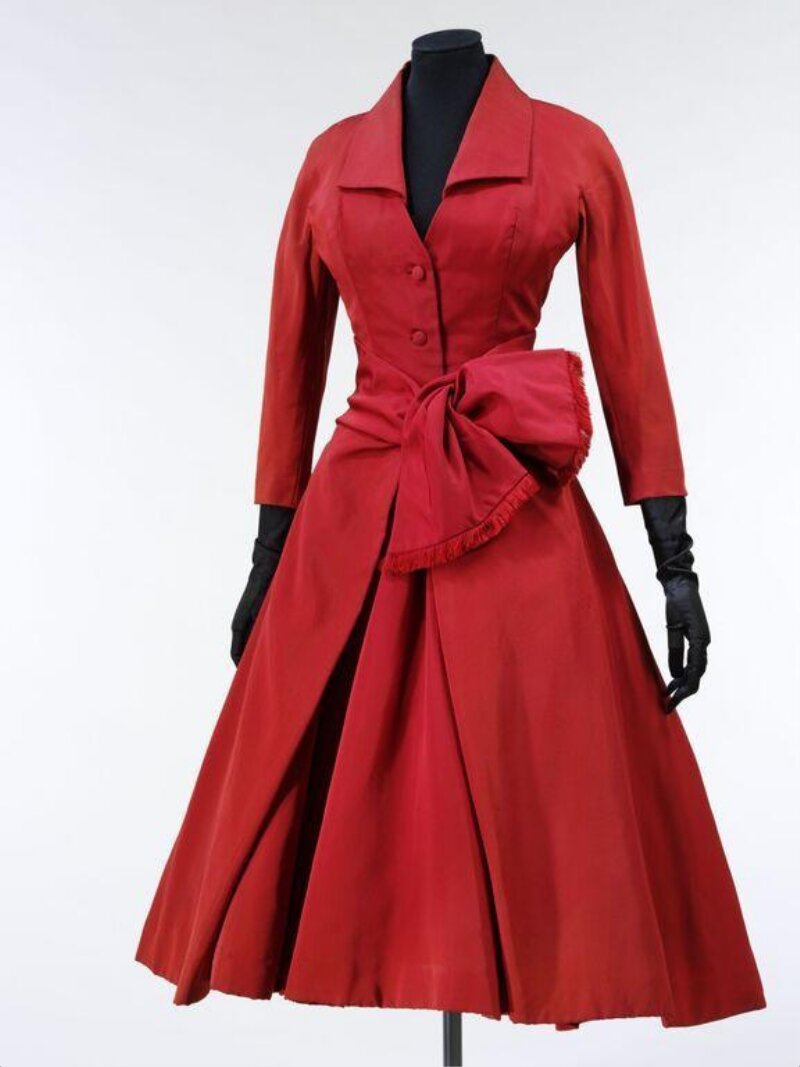
Technical Deconstruction of Écarlate (1955): A Couture Archaeology Report for Natalie Fashion Atelier
Introduction: The Specimen and Its Provenance
The subject of this archaeological analysis is a single garment, designated Écarlate (French for “scarlet”), originating from the atelier of Christian Dior, Paris, Autumn/Winter 1955. The specimen is a meticulously preserved evening dress, constructed from a proprietary blend of silk gazar and a now-extinct metallic thread, dyed a deep, saturated crimson. This report serves as a technical deconstruction of the garment’s materiality and construction techniques, with a specific focus on translating these historical methods into viable, high-end luxury silhouettes for the Natalie Fashion Atelier 2026 collection. The analysis is grounded in the principles of couture archaeology: a forensic examination of fiber, stitch, and drape to extract the DNA of a lost era’s craftsmanship.
Material Materiality: The Silk Gazar and Metallic Thread
The primary structural element of Écarlate is a silk gazar, a crisp, open-weave fabric that possesses an almost architectural rigidity. Unlike standard silk organza, the gazar used here exhibits a higher twist count in both warp and weft, resulting in a fabric that resists compression yet yields a sharp, sculptural fall. The dyeing process, achieved through a vat-dye technique using natural cochineal and madder, produced a color that is both luminous and opaque. The crimson is not a flat red; it contains microscopic variations in hue—a hallmark of pre-synthetic dyeing—which creates a dynamic, living surface when viewed under directional light.
The secondary material is a metallic thread, composed of a silver-plated copper core wrapped in a fine silk filament. This thread, now brittle and tarnished to a dark bronze, was originally a brilliant gold. It was not used for embroidery but as a structural element: a lattice of reinforcing stitches along the internal seams and the bustier’s boning channels. This technique, known as “couture armature,” provided the foundation for Dior’s famous “Bar” silhouette without the need for heavy whalebone or steel. The materiality of Écarlate is thus a dialogue between the soft, flowing gazar and the rigid, metallic skeleton—a tension that defines its architectural presence.
Technical Deconstruction of Dior Techniques (1955)
1. The “Envelope” Seam and Internal Structure
The most significant technical innovation in Écarlate is the “envelope” seam. Unlike a standard French seam, which encloses raw edges, Dior’s atelier used a double-layered construction. The outer gazar was cut with a 1.5 cm seam allowance, while an inner layer of silk organza (the “envelope”) was cut with a 2.5 cm allowance. The two layers were stitched together with a running stitch at 2 mm intervals, creating a hollow channel between them. Into this channel, the metallic thread was woven in a herringbone pattern, forming a flexible but unyielding boning. This technique allowed the dress to hold its shape without external corsetry, a revolutionary approach to structural draping.
2. The Dior “Tuck” and Grainline Manipulation
Another critical technique is the “Dior tuck,” a series of micro-tucks (2 mm wide) sewn at a 45-degree angle to the grainline. These tucks were not decorative; they were functional, designed to control the fabric’s bias stretch. By tucking the gazar at precise intervals along the waist and hips, Dior created a negative ease that forced the fabric to cling to the body without pulling. The tucks were hand-stitched with a double-threaded silk (size 100) and then pressed with a dry iron at 150°C to set the crease permanently. This manipulation of the grainline is a lost art in modern ready-to-wear, but it is essential for achieving the sculptural fit that defines haute couture.
3. The Hem and Weight Distribution
The hem of Écarlate is a masterclass in weight distribution. It is not a simple rolled hem but a “cascade hem,” where the fabric is folded inward by 4 cm and then stitched with a blind catch stitch every 1 cm. Inside this fold, a chain of small silk-wrapped lead weights (each 2 grams) was sewn at intervals of 5 cm. This technique, known as “plombage,” ensured that the skirt fell in a perfect, unbroken line, resisting the natural tendency of silk to flutter. The weights were hidden within the hem’s inner layer, invisible to the eye but essential to the garment’s kinetic behavior.
Translation into 2026 High-End Luxury Silhouettes
1. Reinterpretation of the Envelope Seam as a Modular System
For the Natalie Fashion Atelier 2026 collection, the envelope seam is translated into a modular structural system using contemporary materials. Instead of metallic thread, we propose a carbon-fiber-reinforced polymer (CFRP) filament, which is lightweight, flexible, and non-corrosive. This filament will be woven into channels created by a laser-cut silk gazar (a modern analogue to Dior’s original). The seams will be sealed with a biodegradable silicone gel to prevent fraying, a nod to sustainability. The result is a “smart structure” that can be adjusted by the wearer: the CFRP filaments can be loosened or tightened via small, hidden magnetic clasps, allowing the silhouette to shift from a fitted bustier to a flowing A-line within minutes. This modularity is a direct evolution of Dior’s original concept of flexible rigidity.
2. The Dior Tuck as a Digital Pattern-Making Tool
The Dior tuck is reimagined through digital pattern-making software (e.g., CLO 3D). By inputting the exact angle (45 degrees), depth (2 mm), and spacing (2 mm) of the original tucks, we can generate parametric patterns that allow for real-time adjustment of negative ease. This eliminates the need for physical muslin prototypes, reducing waste. For the 2026 silhouette, the tucks will be applied to a double-faced cashmere-silk blend, creating a textured surface that mimics the original’s sculptural quality. The tucks will be heat-set using a laser-guided press at 180°C, ensuring precision to within 0.1 mm. This technique is particularly suited for the collection’s “architectural daywear” pieces, such as a tailored jacket with a fitted waist and flared peplum.
3. Plombage Replaced by Micro-Ballast Systems
The traditional lead weights are replaced by micro-ballast systems composed of tungsten-carbide beads encased in a recycled silk mesh. Each bead weighs 0.5 grams, allowing for more precise distribution. The beads are sewn into a detachable hem strip using a magnetic closure system, enabling the wearer to remove the weight for cleaning or to alter the garment’s drape. This innovation is crucial for the 2026 collection’s evening gowns, where the hem must fall in a perfect, unbroken line across a variety of body types. The micro-ballast system also allows for dynamic weight distribution: the beads can be repositioned along the hem via a series of small, hidden pockets, giving the garment a chameleon-like ability to adapt to different movements and settings.
Conclusion: The Legacy of Écarlate in Modern Couture
The deconstruction of Écarlate reveals a garment that is not merely a dress but a system of engineered tensions. Dior’s techniques—the envelope seam, the grainline tucks, and the plombage—were not arbitrary; they were solutions to the fundamental problem of sculpting fabric into form. For Natalie Fashion Atelier 2026, these solutions are translated into a new language of modularity, digital precision, and sustainable innovation. The crimson of Écarlate will be reborn not as a color but as a material philosophy: a commitment to the idea that luxury is not about excess but about the mastery of structure. This report serves as both a historical record and a blueprint for the future, ensuring that the DNA of Dior’s 1955 masterpiece continues to inform the highest echelons of haute couture.