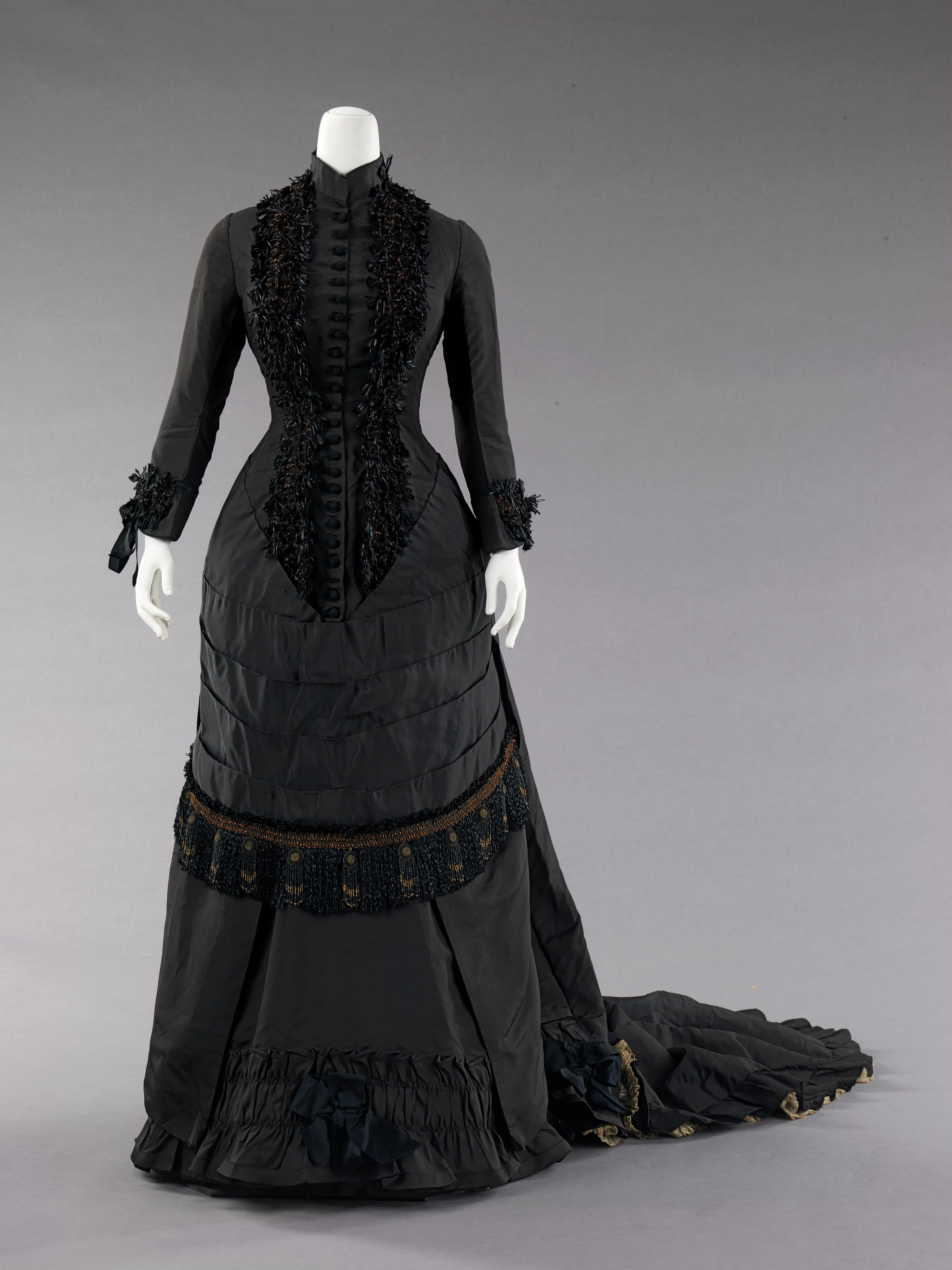
Archaeology of the Isolated Form: The Spanish Dinner Dress as a Hermetic System
Within the curated silence of the atelier archive, the Spanish dinner dress of the late 19th century exists not merely as a garment but as a hermetic system of structural intelligence. Isolated from the broader currents of European fashion—most notably the bustle-dominated silhouette of Paris—it presents a distinct architectural proposition. Its elegance is not one of additive ornament but of foundational geometry, achieved through a rigorous dialogue between non-drape silk and architectural metal. This technical report engages in an aesthetic archaeology of this isolated masterpiece, deconstructing its classical principles to inform the 2026 luxury silhouette, which we posit will be defined by structured fluidity and internal armature.
Deconstruction of a Classical Dialectic: Silk as Wall, Metal as Beam
The classical Spanish dinner dress, particularly from the era of the maja and the formal traje de luces influences, operated on a clear material dialectic. The silk, often a heavy duchesse satin or crisp taffeta, was treated not as a fluid medium but as a structural skin. It rejected the soft, cascading drapery of the French Second Empire, instead forming sharp, planar surfaces that defined the body as a series of contained volumes. This was not a silhouette that clung; it was a silhouette that proclaimed space.
The metal—typically flat, sprung steel bands—was never intended as visible hardware. It was the subdermal infrastructure, embedded within seams or casings to create a cantilevered effect at the hem, a rigidly defined sleeve head, or a spine-like reinforcement along the back. This union created a unique tension: the luxurious, sensuous hand of silk was subverted by its own rigid behavior, while the cold industrialism of metal was concealed, its presence felt only in the garment's authoritative, almost kinetic, carriage. The elegance derived from this paradox of soft materiality executing hard lines.
Informing 2026: The Silhouette of Structured Fluidity and Exposed Integrity
For the 2026 luxury consumer, a mere revival of this form holds no intellectual or aesthetic merit. The imperative is conceptual transposition. The 2026 silhouette, informed by this archaeology, moves beyond the binary of structured versus unstructured. It embraces structured fluidity—a silhouette that possesses a clear, intentional shape while allowing for controlled movement and a sense of organic form. The Spanish dinner dress teaches us that structure is an internal conversation, not an external cage.
This manifests in three key technical evolutions for 2026. First, the internal armature is externalized as aesthetic honesty. Fine, anodized aluminum or brushed, non-tarnishing alloy wires will trace seam lines externally, creating a topographic map of the garment's construction. The metal is no longer hidden; it becomes a graphic element, a testament to integrity, framing panels of silk like a contemporary stained-glass window.
Second, the silk itself undergoes a technological metamorphosis. Leveraging innovations in fabric treatment, we propose the use of silk bonded with microscopic thermoplastic polymers. This "memory silk" can be heat-set to hold a rigid, planar shape at key points (the shoulder, a hip panel) while retaining fluid drape in connecting seams. Thus, a single garment can feature the stark, geometric volume of a 19th-century Spanish basque bodice that seamlessly dissolves into a liquid skirt—a direct materialization of the structured fluidity principle.
Material Synthesis and the Parisian Perspective
The Parisian elegance we cultivate at Natalie Fashion Atelier is one of resolved complexity. The 2026 interpretation synthesizes the isolated Spanish logic with a distinctly modern, global sensibility. The material dialogue evolves from silk-versus-metal to silk-as-metal. For instance, chainmail woven from fine, silk-covered rings provides both metallic sheen and a supple, silent drape. Conversely, metal foils are laminated onto silk organza in fragmented patterns, creating areas of reflective rigidity amidst transparency.
The resulting silhouettes are architecturally clean yet emotionally resonant. Imagine a dinner dress where a torso is defined by a minimalist, sculptural shell of bronze-laminated silk, from which a waterfall of untreated crimson satin cascades—a narrative of containment and release. Or a column dress where the only structure comes from a single, sweeping curve of titanium silk wire embedded in the neckline, defining the entire garment's spiral form. These are garments where the wearer's movement activates the design, causing rigid elements to interact with fluid ones in a dynamic, modern performance.
In conclusion, the isolated aesthetic of the Spanish dinner dress provides a masterclass in foundational garment engineering. Its classical elegance was a product of radical material juxtaposition applied to create an autonomous form. For 2026, we extract its core DNA—the use of contrasting material properties to generate inherent shape—and subject it to contemporary technology and philosophy. The new luxury silhouette is not a historical pastiche but an intelligent evolution: it is confident in its construction, honest in its materiality, and elegant in its precise balance between the unwavering line and the sensual breath. It is the artifact of a new archaeology, one we are writing in the present for the future archive.