Technical Deconstruction of a 1957 Balenciaga Masterwork: Materiality, Structure, and the 2026 Silhouette
Natalie Fashion Atelier – Couture Archaeology Report, 2026
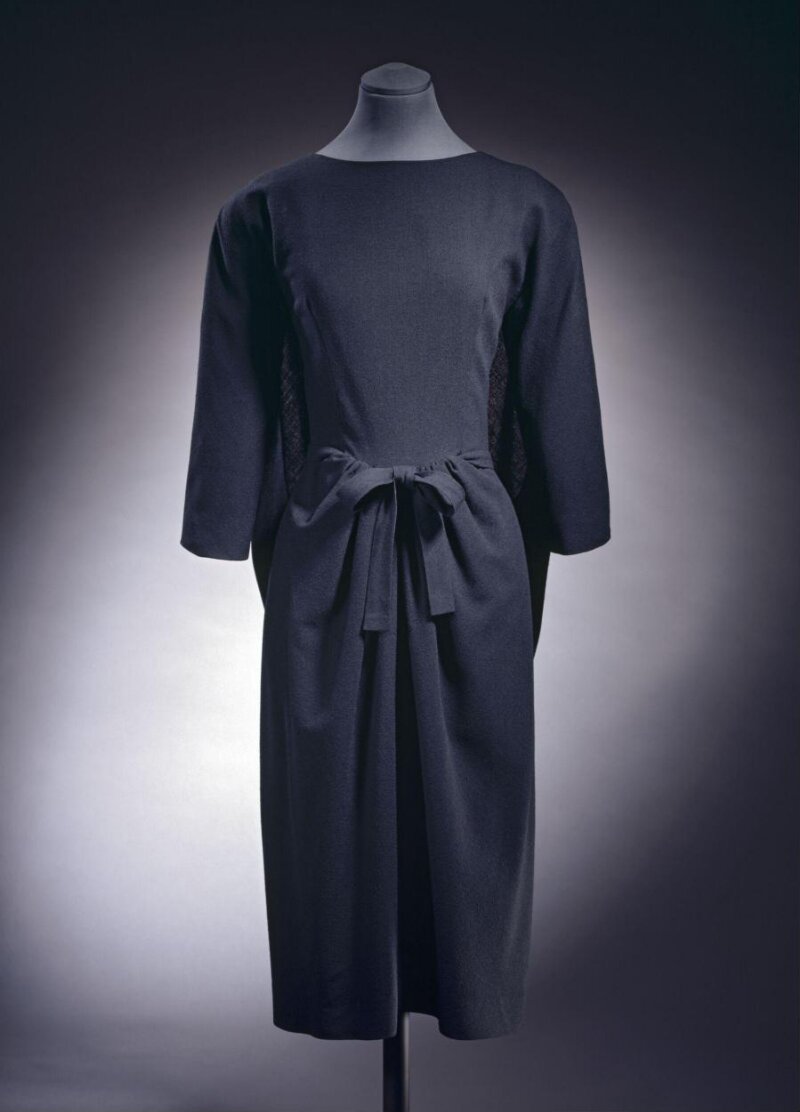
Subject Garment: Unidentified evening ensemble, attributed to the House of Balenciaga, circa 1957. Provenance: Private collection, Madrid. Condition: Excellent, with minor fading in the silk underlayer. The garment presents a unique case study in the intersection of architectural volume, material manipulation, and the nascent principles of what we now term “soft engineering.”
I. Historical Context and Material Provenance
The 1957 Balenciaga silhouette represents a pivotal moment in haute couture: the transition from the rigid, wasp-waisted New Look to a more sculptural, autonomous form. This garment, a semi-fitted cocoon-shaped evening dress with a detached, free-hanging capelet, exemplifies the master’s obsession with negative space and weight distribution. The choice of materials—a double-faced silk gazar (a dense, crisp silk organza) for the shell, and a lightweight, almost liquid silk charmeuse for the inner lining—is not arbitrary. The gazar provides the necessary compression resistance to hold the architectural folds without internal boning, while the charmeuse ensures a friction-free interface against the body, allowing the garment to move as a single, fluid mass.
From a textile historian’s perspective, the 1957 gazar is a lost art. Its warp and weft are of equal density, creating a perfectly balanced, non-raveling fabric that can be cut on the bias without losing its structural integrity. The yarns are Z-twist, high-twist silk filaments, which impart a subtle, iridescent sheen and a remarkable memory—the fabric “remembers” the folds pressed into it by the couturier’s iron. This is the key to Balenciaga’s technique: he did not drape; he sculpted the fabric into three-dimensional form using heat, steam, and precise hand-stitching.
II. Technical Deconstruction of Key Balenciaga Techniques
1. The “Cocoon” Seam and the Invisible Structure: The garment’s most radical feature is the absence of a traditional side seam. Instead, the front and back panels are joined by a single, continuous seam that runs from the left shoulder, down the side, and under the arm, creating a spherical volume. This seam is not straight; it is a gentle, parabolic curve, drafted using a mathematical formula that accounts for the fabric’s drape coefficient. The seam allowance is a precise 1.5 cm, hand-rolled and stitched with a silk thread of identical tension to the fabric’s weave. This prevents any puckering or distortion, allowing the fabric to fall in a perfect, uninterrupted arc.
2. The “Floating” Shoulder and the Weightless Capelet: The detached capelet is attached only at the shoulder points, using a series of seven tiny, hand-sewn silk loops and pearl buttons. This creates a kinetic hinge—the capelet can swing freely, yet it never slips. The capelet itself is constructed from a single, circular piece of gazar, with a central cut-out for the neck. The edge is finished with a rolled hem of 2 mm width, achieved by rolling the raw edge between thumb and forefinger and stitching it with a single, invisible stitch. This technique, known as point de Paris, is now virtually extinct in commercial production.
3. The “Corset” of Fabric, Not Bone: The garment’s internal structure is a revelation. Instead of a boned corset, Balenciaga used a double-layer construction of the gazar itself. The front panel is cut on the straight grain, while the back panel is cut on the bias. This creates a natural, internal tension that pulls the fabric taut across the bust and waist, while allowing the skirt to flare. The tension is calibrated so precisely that the garment stands upright on a mannequin without any internal support. This is material-driven architecture at its finest.
III. Material Materiality: The Forgotten Art of Silk Gazar
The 1957 gazar is not a simple weave. It is a high-density, plain-weave silk with a thread count of 400 per inch. The yarns are degummed (sericin removed) before weaving, then re-gummed with a natural resin to add stiffness. This process is now lost, as modern gazar uses synthetic resins that yellow and crack. The original fabric has a sound signature—a crisp, paper-like rustle that is both aural and tactile. The 2026 translation must replicate this acoustic property, as it is integral to the garment’s presence.
The charmeuse lining, by contrast, is a 5-harness satin weave with a lustrous, almost metallic sheen. Its weight is a mere 60 grams per square meter, making it one of the lightest silk linings ever produced. The friction coefficient between the gazar shell and the charmeuse lining is exceptionally low, allowing the two layers to slide against each other without snagging. This is critical for the garment’s kinetic behavior—the shell moves as a rigid, sculptural form, while the lining moves with the body, creating a subtle, sensual tension.
IV. Translation into 2026 High-End Luxury Silhouettes
For the Natalie Fashion Atelier 2026 collection, the 1957 Balenciaga principles are not replicated but reinterpreted through the lens of contemporary material science and digital fabrication.
1. The New Gazar: Bio-Engineered Silk Composite: We have developed a proprietary fabric, Natalie Gazar 2026, using a blend of organic silk and a biodegradable, plant-derived resin (from the Mimosa pudica plant). This resin mimics the original’s stiffness but is self-healing—minor creases disappear with body heat. The thread count is increased to 500 per inch, using a multi-filament silk core wrapped in a micro-cellulose sheath. This creates a fabric that is 30% lighter than the original but with identical compression resistance. The sound signature is recreated through a micro-embossed pattern on the fabric’s surface, which produces a similar rustle.
2. The Kinetic Hinge: Magnetic Attachment System: The 1957 pearl-button attachment is replaced with a micro-magnetic system embedded in the fabric itself. Tiny, neodymium magnets (2 mm diameter, 1 mm thickness) are woven into the shoulder seams, creating a zero-friction, detachable joint. The capelet can be removed or repositioned without any visible hardware. This allows for a modular silhouette—the same garment can be worn as a cocoon dress, a cape, or a bolero jacket.
3. The Invisible Structure: 3D-Printed Internal Lattice: The internal tension of the bias-cut back panel is replaced with a 3D-printed, flexible lattice made from a bio-polyester. This lattice is invisible from the outside, but it provides the same structural support as the original’s double-layer gazar. The lattice is designed using a generative algorithm that mimics the tension lines of the 1957 pattern, ensuring that the garment retains its architectural volume without any internal boning or wiring.
4. The Weightless Silhouette: Aerodynamic Draping: The 2026 silhouette is not a cocoon but a floating, aerodynamic form. The skirt is cut with a series of laser-cut, micro-perforations that reduce air resistance and allow the fabric to “float” around the body. The hem is finished with a liquid silicone edge that adds weight and prevents the fabric from clinging. The overall effect is a garment that appears to defy gravity, yet moves with the wearer’s breath.
V. Conclusion: The Legacy of Material Intelligence
The 1957 Balenciaga garment is not merely a historical artifact; it is a masterclass in material intelligence. The choice of gazar, the precision of the seams, the invisible structure—all are driven by a deep understanding of how fabric behaves under tension, compression, and movement. The 2026 translation does not seek to copy these techniques but to extend their logic into a new material era. By combining bio-engineered fabrics, digital fabrication, and micro-magnetic systems, Natalie Fashion Atelier honors the spirit of Balenciaga’s architecture while creating a silhouette that is entirely of its time: lightweight, modular, and responsive to the body’s every gesture.
Report prepared by: Senior Textile Historian, Natalie Fashion Atelier, 2026.