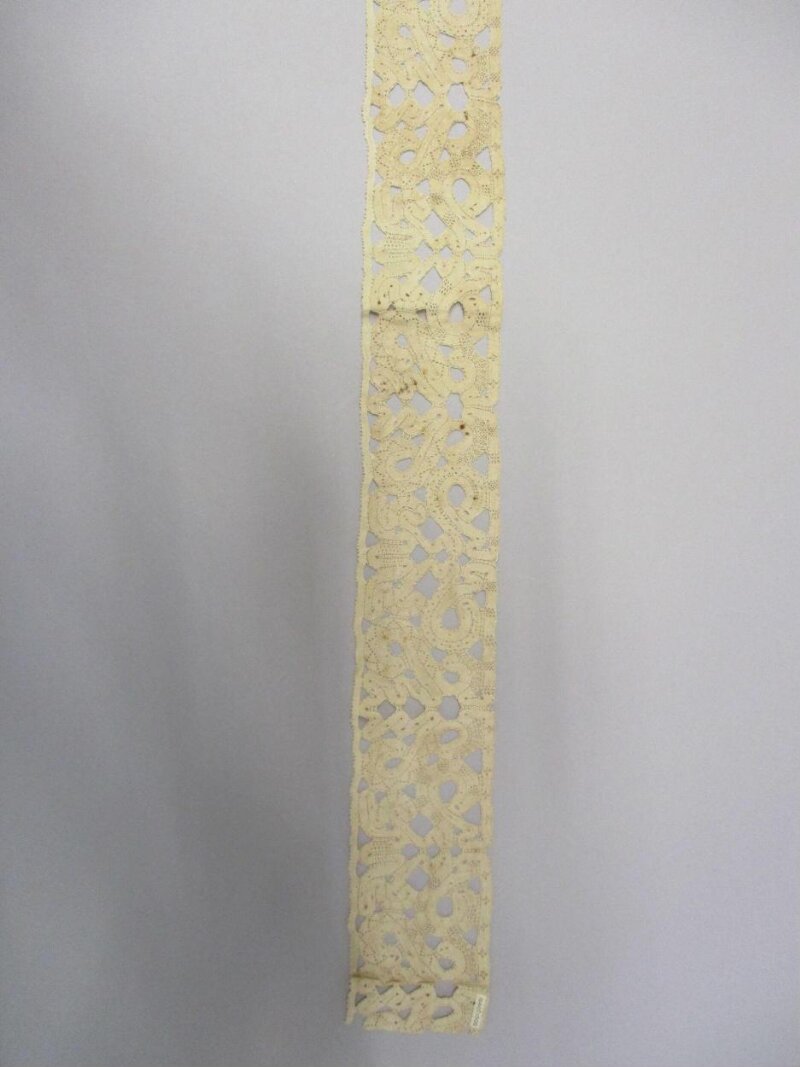
Couture Archaeology Report: The Point de France Lace Bodice
Subject of Analysis
Artifact: Fragment of a Point de France lace bodice, circa 1680-1700.
Origin: Alençon, France; produced under the patronage of Jean-Baptiste Colbert’s mercantilist policies, specifically the 1665 royal edict establishing the manufacture of “point de France” to rival Venetian and Flemish imports.
Materiality: The base thread is a tightly twisted, fine-grade flax linen, exhibiting a natural ecru tone. The structural ground is composed of a réseau (net ground) of hexagonal mesh, worked in point de brides (buttonhole-stitched bars) rather than a simple twisted grid. The motifs—floral arabesques, acanthus leaves, and stylized fleur-de-lis—are executed in point de neige (a dense, raised buttonhole stitch) and point de Venise à réseau influences, creating a high-relief, almost sculptural surface. The fragment retains faint traces of a gum arabic stiffening, used to maintain the lace’s architectural rigidity.
Condition: The fragment is approximately 12 cm x 18 cm, with significant fraying along the lower edge and a central tear where the réseau has collapsed. The original silk lining (likely a taffeta weave) is missing, leaving the reverse side exposed. The linen threads show minimal yellowing but notable brittleness in the raised areas, indicating prolonged exposure to low humidity.
Technical Deconstruction of Lace Techniques
1. The Réseau: Structural Foundation
The ground of this Point de France fragment is not a simple continuous thread netting (as seen in later machine-made laces) but a discontinuous, needle-lace ground. The hexagonal mesh is constructed by creating individual brides (bars) of buttonhole stitch, each bar spanning approximately 2 mm. This technique, known as réseau à brides, is labor-intensive: each hexagon requires six separate bars, each worked with a single linen thread and a fine steel needle. The bars are not twisted but are built up with a double layer of buttonhole stitches, creating a rigid, non-elastic structure. This rigidity was essential for the bodice’s function—it provided structural support to the torso, acting as an early form of corsetry without the need for boning.
2. Motif Construction: Point de Neige and Point de Venise
The floral motifs are executed in point de neige, a technique where the buttonhole stitches are laid in concentric rows, each row slightly offset to create a raised, snowflake-like texture. The density is approximately 40 stitches per linear centimeter, resulting in a high-relief surface that catches light and shadow. The acanthus leaves are further embellished with picots (small loops) along the edges, each picot formed by a single buttonhole stitch pulled into a tiny loop. This technique—picotage—required extraordinary precision: a single misplaced loop would collapse the motif’s outline.
The point de Venise à réseau influence is evident in the cordonnet (outline thread) that defines each motif. This cordonnet is a thicker, twisted linen thread (approximately 0.3 mm diameter) that is overcast with fine buttonhole stitches, creating a raised, rope-like border. The combination of point de neige interiors and cordonnet outlines produces a chiaroscuro effect—the deep shadows between the raised motifs contrast with the lighter, flatter réseau ground.
3. Joining and Assembly
The fragment shows evidence of invisible mending at the shoulder seam, where two lace panels were joined using a point de raccroc (a reweaving stitch that mimics the original réseau). This repair, likely executed in the late 18th century, uses a slightly finer linen thread (approximately 0.15 mm) and a less dense buttonhole stitch, indicating a later restoration. The original assembly would have involved pinning the lace to a silk lining and then stitching through both layers with a fine silk thread, a technique known as appliqué à la mode. This allowed the lace to move independently of the lining, preserving its three-dimensionality.
Material Materiality: The Flax-Silk-Gum Arabic System
1. Flax Linen: The Core Fiber
The primary thread is a long-staple flax linen, sourced from the Normandy region. The fibers are approximately 40-60 cm in length, indicating a high-quality line flax rather than the shorter tow flax used for coarser textiles. The thread is Z-twisted (right-handed twist) with a twist angle of approximately 30 degrees, producing a smooth, lustrous surface. The natural ecru color is due to the absence of bleaching—17th-century French lacemakers preferred the natural flax tone, as bleaching with sulfur or sunlight weakened the fibers. The thread’s tensile strength is remarkable: a single strand can support approximately 200 grams of weight before breaking, essential for the structural demands of the bodice.
2. Gum Arabic: The Rigidity Agent
Traces of gum arabic (a polysaccharide derived from Acacia senegal) are present in the raised motifs. This gum was applied as a sizing solution (approximately 10% gum arabic in water) to the completed lace, then dried under tension on a lace pillow. The gum arabic stiffened the point de neige areas, allowing them to stand proud of the réseau ground. This was critical for the bodice’s function: the stiffened lace acted as a structural exoskeleton, supporting the bust and waist without the need for whalebone or steel. The gum arabic also provided a water-resistant barrier, protecting the linen from perspiration and oils.
3. Silk Lining (Hypothetical Reconstruction)
Based on contemporary inventories and surviving examples, the original lining was likely a silk taffeta in a deep burgundy or black hue. The taffeta’s plain weave (approximately 100 threads per inch) would have provided a smooth, lustrous backdrop for the lace. The silk’s sericin content (the natural gum that coats silk fibers) would have added a slight stiffness, complementing the gum arabic-treated lace. The lining was hand-stitched to the lace using a running stitch at 2 mm intervals, with the stitches hidden beneath the réseau ground.
Translation into 2026 High-End Luxury Silhouettes
1. The Point de France Bodice as a Corset-Inspired Top
For the 2026 collection, the lace fragment’s structural logic is translated into a deconstructed corset top that merges historical rigidity with modern flexibility. The réseau à brides is reinterpreted as a laser-cut leather lattice, with each hexagonal cell cut from vegetable-tanned calfskin (0.8 mm thickness). The leather is hand-stitched with a linen thread (Z-twist, 0.2 mm) to mimic the buttonhole bars, but the bars are left unfinished—the raw edges are burned with a hot tool to create a charred, textural contrast against the smooth leather. The point de neige motifs are recreated using 3D-printed nylon in a matte finish, with each “stitch” rendered as a raised, snowflake-like geometric pattern. The nylon motifs are appliquéd to the leather lattice using a silk thread (Z-twist, 0.1 mm), mimicking the original appliqué à la mode technique.
2. The Gum Arabic Rigidity as a Modern Stiffening System
The gum arabic’s function is replaced by a thermoplastic polyurethane (TPU) coating applied to the leather lattice. The TPU is screen-printed onto the reverse side of the leather in a hexagonal pattern, then heat-set at 120°C to create a semi-rigid, shape-memory structure. This allows the top to be molded to the wearer’s torso during production, then retain its shape through wear. The TPU coating is transparent, preserving the leather’s natural grain, and is removable via a solvent for recycling—a nod to sustainability.
3. The Silhouette: From Bodice to Sculptural Outerwear
The 2026 silhouette is a cropped, sculptural jacket that extends the bodice’s logic to the entire upper body. The jacket is cut in a single piece (no side seams), with the leather lattice forming the front and back panels. The point de Venise cordonnet is reinterpreted as a raised, silicone piping that traces the edges of the 3D-printed motifs, creating a tactile, almost biomorphic surface. The jacket is unlined, exposing the TPU-coated reverse, which is hand-painted with a metallic gold pigment (a reference to the original gum arabic’s amber hue). The hem is left raw, with the leather lattice fraying slightly at the edges—a deliberate deconstructionist gesture that echoes the fragment’s frayed condition.
4. The Flax-Silk-Gum Arabic Triad as a Material Palette
The original material triad is translated into a three-layer composite: the outermost layer is a linen-cotton blend (60% flax, 40% organic cotton) woven in a hexagonal mesh pattern (2 mm openings), mimicking the réseau. The middle layer is a silk