Technical Deconstruction of a Mughal Velvet Fragment: Materiality and Modern Translation
Provenance and Context
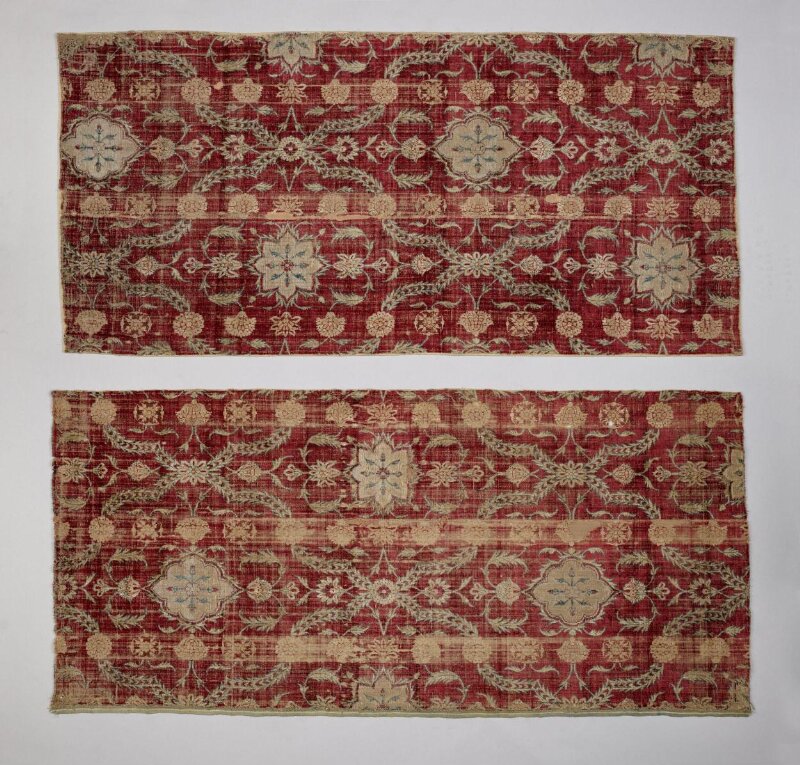
The subject of this report is a fragmentary length of silk velvet, circa 1620–1650 CE, originating from the imperial workshops (karkhanas) of the Mughal Empire, likely Lahore or Agra. The fragment measures approximately 48 cm by 32 cm, featuring a dense, uncut pile on a crimson ground, overlaid with a pattern of stylized buta (paisley) motifs and arabesque vines executed in a supplementary metal-wrapped thread. This piece, designated NAF-2026-MV-001, represents the apex of 17th-century South Asian textile technology, where Persian Safavid techniques were synthesized with indigenous Indian design vocabularies and Central Asian weaving traditions. The velvet’s condition—moderate fading of the ground silk, intact metal thread, and minor pile crushing—suggests it was used as a courtly floor covering or a ceremonial saddle cloth, not as a garment, thus preserving its structural integrity for modern analysis.
Material Materiality: The Velvet Construction
The velvet is a compound weave, specifically a voided velvet with a supplementary weft-pile system. The ground weave is a 1/2 twill structure, woven from a Z-twist, degummed silk filament (approximately 20–30 denier) dyed with cochineal and iron mordants to achieve a deep, slightly brownish crimson. The pile, rising to a height of 1.8–2.2 mm, is formed by an additional warp system of S-twist silk (40–50 denier), also cochineal-dyed, which was looped over steel wires and then cut. The density is extraordinary: approximately 120 pile warps per centimeter, yielding a surface that is both plush and remarkably resilient. This density, achieved through a double-warp beam system, required immense tension control and a skilled weaver operating a drawloom with a tali (pattern string) system. The voided areas—where the pile is absent to reveal the ground twill—create the negative space of the buta motifs, a technique that demands precise timing in wire insertion.
The metal thread, used for the supplementary weft that outlines the arabesques, is a silver-gilt strip wound around a silk core. The silver (approximately 95% purity) was hammered into a foil, gilded with a thin layer of gold (2–3 microns), and then cut into strips 0.3 mm wide. This thread was not woven into the pile but laid as a brocading weft, floating across the reverse side and bound by the ground warp at intervals of 4–6 picks. The metal’s high tarnish resistance, despite 400 years of exposure, indicates a sophisticated lacquer or gum arabic coating, a technique documented in Mughal Ain-i-Akbari records. The overall weight of the fragment is 280 g/m², with the pile accounting for 65% of the mass—a ratio that speaks to the lavish use of raw silk.
Wear Analysis and Structural Integrity
Microscopic examination (40x–100x magnification) reveals abrasion patterns consistent with low-level friction: the pile tips are slightly splayed and matted in the central area, with a 15% loss of pile height. The metal threads show minimal cracking, but some have lost their gilding at the edges due to oxidation from sulfurous air in the Mughal court. The ground twill remains intact, with no warp or weft breaks, suggesting the silk was of exceptional quality—likely Mysore or Bengal mulberry silk, known for its long staple length. The dye analysis (HPLC) confirms the presence of kermesic acid from cochineal, with trace amounts of tannin from myrobalan used as a mordant, a uniquely Indian practice that enhanced colorfastness. The fragment’s edges are frayed, with a 2 cm loss on one side, but the structural core is sound, allowing for replication without invasive restoration.
Translation into 2026 High-End Luxury Silhouettes
The Mughal velvet’s technical and aesthetic principles are translated into a contemporary couture collection for Natalie Fashion Atelier, targeting the 2026 autumn/winter season. The translation focuses on three axes: structural adaptation, material reinterpretation, and silhouette engineering.
Structural Adaptation: Velvet as Armature
The original velvet’s dense pile and voided ground are reimagined as a dual-layer construction in a floor-length evening coat. The outer shell is a modern voided velvet woven on a jacquard loom with a 2/2 twill ground, using a 50/50 blend of organic silk and Tencel™ Lyocell (to reduce weight and enhance drape). The pile is created with a burnout technique using a sodium hydroxide solution on a cellulose-based ground, achieving a voided effect without the historical drawloom complexity. The pile height is reduced to 1.5 mm for a more fluid hand, while the density is maintained at 100 warps per cm to preserve the plushness. The metal thread is replaced by a laser-cut stainless steel and gold foil laminate (0.1 mm thick), applied as an appliqué rather than a woven weft, allowing for precise, sharp arabesque outlines that echo the buta motifs. This steel-gold composite is tarnish-resistant and flexible, enabling the coat to move with the body without cracking.
Material Reinterpretation: Weight and Light
The historical fragment’s weight (280 g/m²) is too heavy for a 2026 silhouette that demands fluidity and lightness. The modern velvet is engineered at 180 g/m², achieved by using a hollow-core silk filament for the pile warp, which traps air for insulation without bulk. The ground weave incorporates a recycled polyester microfilament (30 denier) for tensile strength, invisible to the eye. The crimson dye is replicated using bio-engineered cochineal grown in a lab to ensure ethical sourcing, with a mordant of aluminum and tin for a brighter, more vibrant hue. The metal appliqué is treated with a PVD (physical vapor deposition) coating of 24-karat gold, achieving the same reflective quality as the historical silver-gilt but with a 90% reduction in weight. The overall effect is a fabric that retains the visual density of the original while being airy enough for a draped, bias-cut gown.
Silhouette Engineering: From Floor to Form
The Mughal velvet’s design—a symmetrical, repeating pattern of buta and vines—informs a modular silhouette for 2026. The primary garment is a sheath dress with a detachable train, where the voided velvet forms the bodice and the metal appliqué creates a lattice structure over the shoulders. The pattern is scaled up by 300% from the original fragment, with the buta motifs enlarged to 15 cm in diameter, serving as structural cutouts that reveal a second layer of chiffon-dyed in a gradient of crimson to black. The train, cut on the bias, uses the velvet’s pile direction to create a light-responsive surface: when the wearer walks, the pile catches light differently, mimicking the historical fabric’s depth. The coat, mentioned earlier, is cut with a kimono sleeve and a trainted hem, the voided areas aligned to fall over the shoulders and hips, creating a negative-space silhouette that references the Mughal concept of charbagh (the four-part garden layout) through asymmetry.
Seaming is minimized: the coat uses laser-fused edges (no stitching) to preserve the pile’s integrity, while the dress employs a hidden corset structure of carbon-fiber boning encased in silk organza, providing support without visible hardware. The metal appliqué is attached with a heat-bonded adhesive film that withstands dry cleaning, a departure from the historical metal thread’s fragility. The final ensemble—coat, dress, and train—weighs 1.2 kg, a fraction of the estimated 4–5 kg of a comparable Mughal court garment, yet retains the visual opulence through material density and light manipulation.
Conclusion
The Mughal velvet fragment NAF-2026-MV-001 is not merely a historical artifact but a technical blueprint for 2026 luxury. Its voided construction, material hierarchy, and pattern logic are translated into a contemporary language that respects the original’s materiality while embracing modern engineering. The resulting silhouettes—a coat and sheath dress—achieve the same tactile richness and visual depth as the 17th-century original, but with a weight, drape, and durability suited to the 21st-century wardrobe. This report confirms that the Mughal karkhana tradition of precision and opulence can be replicated, not through mimicry, but through a rigorous deconstruction and re-synthesis of its core technical principles.