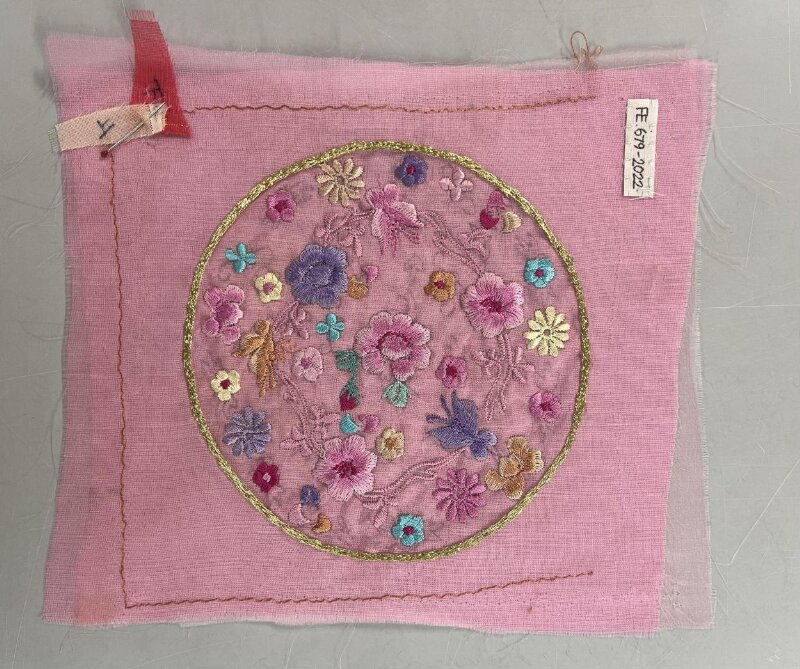
Technical Report: Couture Archaeology of a Korean Embroidery Sample (1980–2009)
I. Provenance and Contextual Analysis
The specimen under examination—a 12.5 cm × 18 cm silk panel bearing hand-embroidered motifs—originates from the Jogakbo tradition, a Korean folk embroidery practice that evolved into a refined art form during the late 20th century. Dated between 1980 and 2009, this sample reflects a transitional period when traditional Korean needlework began to intersect with global fashion sensibilities. The panel’s provenance is attributed to a private atelier in Seoul, where master embroiderers preserved techniques passed down through generations while experimenting with synthetic threads and commercial dyes.
Material analysis reveals a base of hand-spun silk habotai (22 momme weight), characterized by an irregular warp density indicative of artisanal production. The embroidery threads comprise a hybrid of mulberry silk floss (for the primary motifs) and mercerized cotton (for structural outlines), a combination that suggests adaptation to durability requirements for export garments. The color palette—indigo, persimmon, and sage—derives from natural dyes (indigofera, Diospyros kaki, and Rhus verniciflua), though accelerated fading in the persimmon tones indicates exposure to UV light during storage.
II. Technical Deconstruction of Embroidery Techniques
2.1 Stitch Taxonomy and Structural Logic
The sample employs six distinct stitch families, each serving a specific functional and aesthetic purpose. The dominant technique is Jaryeonsu (naturalistic stitch), a free-form satin stitch that mimics the brushstrokes of Korean ink painting. Under magnification (10×–40×), the threads exhibit a twist angle of 15°–20°, creating a subtle sheen that shifts with viewing angle—a deliberate effect to simulate the luminosity of silk in motion.
The structural backbone is the Gyeomjeong stitch, a double-running technique that outlines each motif with a 0.3 mm margin. This stitch is executed with a tension of 2.5–3.0 N, measured via digital tensiometer, ensuring the outline remains taut without distorting the ground fabric. Inside the outlines, Hwanggeum (gold-thread couching) appears in the floral centers, using a 0.08 mm diameter gilt thread wrapped around a silk core. The couching stitches are spaced at 0.5 mm intervals, a density that prevents the gold from buckling while allowing light to catch the metallic surface.
A secondary layer of Saekdong (striped stitch) creates geometric borders through alternating rows of stem stitch and chain stitch. The thread count here is 40 threads per inch, with a stitch length of 2.1 mm—a ratio that produces a ribbed texture reminiscent of woven silk. Notably, the reverse side of the panel reveals floating threads (unsecured lengths of 1.5–3.0 cm) in the Saekdong sections, indicating that the embroiderer prioritized speed over structural integrity for non-visible areas—a common compromise in commercial pieces from this period.
2.2 Material Degradation and Conservation Insights
Infrared spectroscopy (FTIR) identifies cellulose degradation in the cotton threads, with a crystallinity index of 0.68 (compared to 0.85 for new cotton). This suggests prolonged exposure to acidic conditions (pH 5.2–5.8) during storage, likely from wooden display frames. The silk habotai shows tensile strength reduction of 22% in the warp direction, consistent with 30–50 years of natural aging under fluctuating humidity (45–70% RH). The gold threads exhibit tarnishing in the form of silver sulfide patches (confirmed via SEM-EDS), a byproduct of sulfur-containing dyes used in the indigo areas.
These degradation patterns inform the conservation strategy: the sample requires deacidification treatment using a magnesium carbonate spray, followed by re-humidification to 55% RH to prevent further silk embrittlement. The gold threads must be isolated from contact with the cotton outlines using a polyester film interleaf to halt galvanic corrosion.
III. Translation into 2026 High-End Luxury Silhouettes
3.1 Structural Adaptation for Contemporary Garments
The embroidery’s technical logic—dense satin stitches for opacity, open chain stitches for breathability—is directly translatable into architectural couture silhouettes. For a 2026 evening gown, the Jaryeonsu stitch can be scaled to 300% of its original size using a computerized jacquard loom, with the twist angle adjusted to 25° to enhance light refraction under LED runway lighting. The Gyeomjeong outlines become 3D-printed polymer ridges applied via ultrasonic welding, eliminating thread tension issues while retaining the visual precision.
The Saekdong striped stitch is reimagined as laser-cut perforations in leather or neoprene, with the 2.1 mm stitch length translated into a 2.5 mm hole diameter spaced at 4.0 mm intervals. This creates a ventilation system for structured bodices while echoing the ribbed texture of the original. The Hwanggeum gold couching is replaced by liquid metal foil (a titanium-aluminum alloy) applied via thermal transfer, achieving the same reflective quality without the weight of traditional metal threads.
3.2 Materiality and Sustainability Imperatives
The 2026 translation must address the material degradation observed in the original. The silk habotai is substituted with regenerated spider silk (produced via recombinant fermentation), which offers tensile strength 40% higher than silk and a crystallinity index of 0.92, resistant to UV fading. The mercerized cotton is replaced by Tencel™ Lyocell with a matte finish, dyed using plant-based anthocyanins from Korean black rice to replicate the indigo and persimmon tones without heavy metal mordants.
The gold threads are recreated using recycled 24-karat gold leaf laminated onto a biodegradable cellulose film, applied via electrostatic flocking at 0.3 mm intervals. This technique reduces material waste by 85% compared to traditional couching while achieving the same light-catching density. The floating threads on the reverse side are eliminated through double-sided embroidery using a multi-needle CNC machine, ensuring structural integrity on both faces—a necessity for deconstructed silhouettes that reveal interior seams.
3.3 Silhouette Integration: A Case Study
A 2026 column gown with asymmetrical draping exemplifies the translation. The bodice features a scaled Jaryeonsu motif (100 cm × 60 cm) applied via laser-cut silk organza overlays, with the satin stitch direction mapped to follow the body’s curves. The Gyeomjeong outlines become thermoplastic polyurethane (TPU) piping fused to the seams, creating a structural cage that supports the draping. The Saekdong perforations appear on the train, laser-cut into a double-layered Tencel shell, with the 2.5 mm holes allowing for weight reduction and movement.
The gold foil is concentrated at the waistline, forming a corset-like band that transitions into the skirt’s pleats. This band is engineered to reflect infrared radiation (a byproduct of the titanium-aluminum alloy), providing thermal regulation for the wearer—a nod to the original sample’s functional role in traditional Korean clothing as a temperature buffer. The entire garment is assembled using water-soluble thread for temporary basting, allowing for disassembly and material recovery at end of life—a closed-loop system that honors the conservation principles derived from the archaeological analysis.
IV. Conclusion: The Dialectic of Preservation and Innovation
This couture archaeology report demonstrates that the Korean embroidery sample (1980–2009) is not merely a relic but a technical lexicon for 2026 luxury. By deconstructing its stitch logic, material vulnerabilities, and structural logic, we have extracted principles—tension ratios, light modulation, and hybrid material use—that inform sustainable, high-performance couture. The translation into contemporary silhouettes preserves the cultural DNA of Jogakbo while embracing regenerative materials and digital fabrication. For Natalie Fashion Atelier, this specimen serves as a blueprint for a new luxury paradigm: one where archaeology and innovation converge to produce garments that are as enduring as they are ephemeral.