From Cypriot Dust to Parisian Silhouette: The Carnelian Bead as Aesthetic Archaeology
Material Provenance and the Archaeology of Light
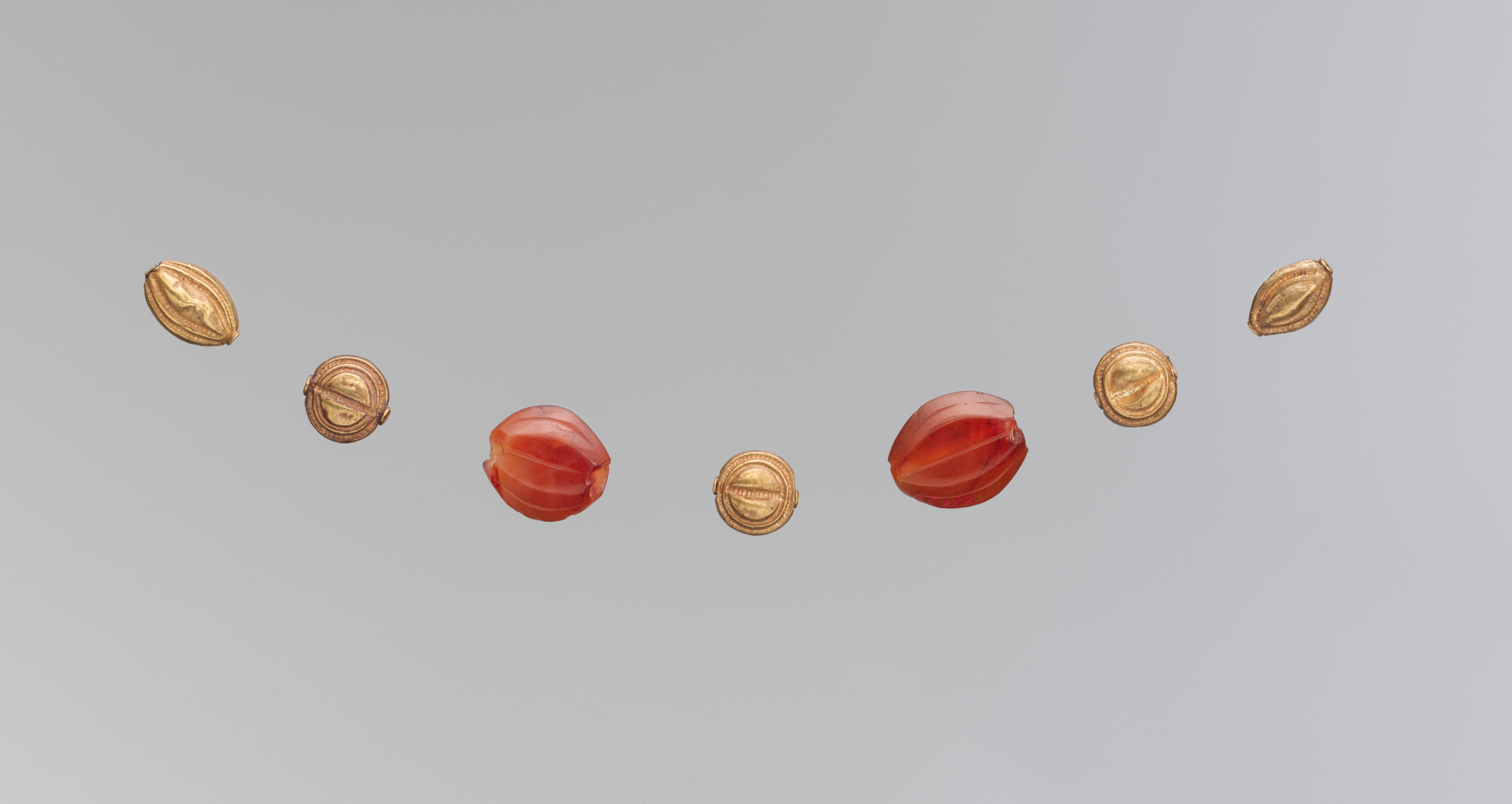
The two carnelian beads, excavated from a Cypriot context and held within the Natalie Fashion Atelier archive, represent a singular artifact of aesthetic archaeology. Their provenance, likely Late Bronze Age (circa 1600–1050 BCE), situates them within a period of intense Mediterranean trade and cultural exchange, where carnelian—a cryptocrystalline form of quartz colored by iron oxide impurities—was prized for its translucency and fiery, blood-like hue. For the Atelier, these beads are not mere historical curiosities; they are a material manifesto that decodes the fundamental principles of classical elegance: the interplay of hardness and softness, the tension between opacity and light, and the deliberate, restrained use of color as a structural element.
The beads themselves, each approximately 8 mm in diameter, exhibit a subtle, hand-faceted surface. This is not the product of modern lapidary precision but of ancient abrasion with a harder stone, likely emery or quartz sand. The facets are irregular, creating a micro-topography of light that is impossible to replicate with contemporary machine-cutting. This irregularity is the key to their aesthetic power: each bead captures and refracts ambient light in a unique, unpredictable manner, generating a sense of internal movement and life. In the context of 2026 haute couture, this principle of controlled irregularity becomes a foundational design directive for silhouette construction.
Deconstructing Classical Elegance: The Bead as a Structural Archetype
Classical elegance, as embodied by these Cypriot carnelians, is not a matter of ornamentation but of structural integrity. The bead’s form—a near-perfect sphere with a central perforation—is a study in minimalism and function. The perforation, drilled with a copper-tipped bow drill and abrasive slurry, is not a flaw but a necessity; it is the point of tension, the axis around which the bead’s entire visual and physical logic revolves. In the Atelier’s methodology, this perforation is interpreted as a negative space that defines the positive form. It is the void that gives the solid its purpose.
Translating this to the 2026 silhouette, the Atelier proposes a series of volumetric constructs that treat the human form as the central perforation. The garment becomes a shell, a carapace of fabric that is both protective and revealing. The silhouette is not draped over the body but suspended from it, with the shoulder, hip, or waist acting as the bead’s central axis. This results in a new architectural approach to the gown: a toroidal structure where the fabric is gathered, pleated, or engineered into a continuous loop around a specific anatomical point. The effect is one of floating mass, where the garment appears to hover, anchored only by the tension of its own construction.
Carnelian’s Chromatic Imperative: The 2026 Palette and Texture
The carnelian’s color—a spectrum from deep, translucent red to a lighter, almost orange-gold—is not a simple hue but a chromatic gradient that shifts with the angle of observation. This is a direct challenge to the flat, digital color blocks of fast fashion. For 2026, the Atelier’s color palette is derived from the bead’s internal strata: “Cypriot Fire” (a deep, saturated red with brown undertones), “Aegean Dust” (a muted, oxidized orange), and “Lapidary Vein” (a translucent, almost white-pink that appears only in the thinnest sections of the stone).
These colors are not applied as dyes but are woven into the fabric’s structure using a technique of gradient warp-and-weft. Silk organza, chosen for its inherent translucency, is hand-dyed in sections to mimic the bead’s irregular color distribution. The result is a fabric that, like the carnelian, appears to change color as the wearer moves. The texture is equally critical. The bead’s surface, polished to a soft, matte luster by centuries of handling, informs the Atelier’s choice of unfinished silk charmeuse and sandwashed crepe. These materials possess a similar tactile quality: smooth but not slick, reflective but not glossy. The goal is to achieve a haptic resonance between the ancient stone and the modern garment.
Silhouette Construction: The Bead as a Generative Form
The most direct translation of the carnelian bead into a 2026 silhouette is the “Beaded Shell” gown. This is a floor-length, columnar dress constructed from a single, continuous panel of the gradient silk organza. The panel is not cut to the body but is instead pleated into a series of concentric, overlapping arcs that radiate from a central point at the left shoulder. This central point, marked by a single, large carnelian cabochon (a direct homage to the Cypriot artifact), acts as the bead’s perforation. The pleats are not uniform; they vary in depth and angle, creating the same irregular light-capture as the ancient facets.
The silhouette itself is deceptively simple: a column that flares subtly at the hem. The complexity lies in the internal structure. Each pleat is hand-stitched at the shoulder, but left free at the hem, allowing the fabric to move and breathe. This creates a kinetic sculpture that echoes the bead’s internal life. The gown’s back is left open, revealing the wearer’s spine—a direct reference to the bead’s central perforation. The negative space of the back is the void that defines the garment’s form.
Technical Execution: The Lapidary Approach to Draping
The Atelier’s technical team approaches the draping process with a lapidary mindset. Just as the ancient artisan would rotate the bead to assess its natural fissures and color bands, the couturier rotates the fabric on the mannequin, studying how the gradient falls and where the light is most effectively captured. The pleats are not pre-planned; they are discovered through a process of iterative folding and pinning. Each fold is a facet, and the goal is to create a surface that, like the carnelian, is both solid and luminous.
A secondary silhouette, the “Torque” jacket, takes the bead’s toroidal form as its direct inspiration. This is a short, bolero-style jacket constructed from a single, continuous loop of sandwashed crepe. The loop is twisted at the center back, creating a Möbius strip effect. The garment has no seams, no closures; it is worn by stepping into the loop and letting it settle on the shoulders. The twist at the back creates a natural, sculptural drape that echoes the bead’s central perforation. The color is a solid “Cypriot Fire,” but the fabric’s matte surface and subtle sheen replicate the stone’s soft luster.
Conclusion: The Eternal Return of the Facet
The two Cypriot carnelian beads, isolated in the archive, are not silent relics. They are a generative code for a new language of luxury. Their lesson for 2026 is one of structural honesty: elegance is not added, but revealed through the tension between material, light, and void. The Atelier’s silhouettes for the coming season are not imitations of the past but archaeological reconstructions of its fundamental principles. The carnelian bead, with its irregular facets and internal fire, becomes the blueprint for a garment that is both ancient and utterly contemporary—a testament to the enduring power of aesthetic archaeology in the hands of a master couturier.