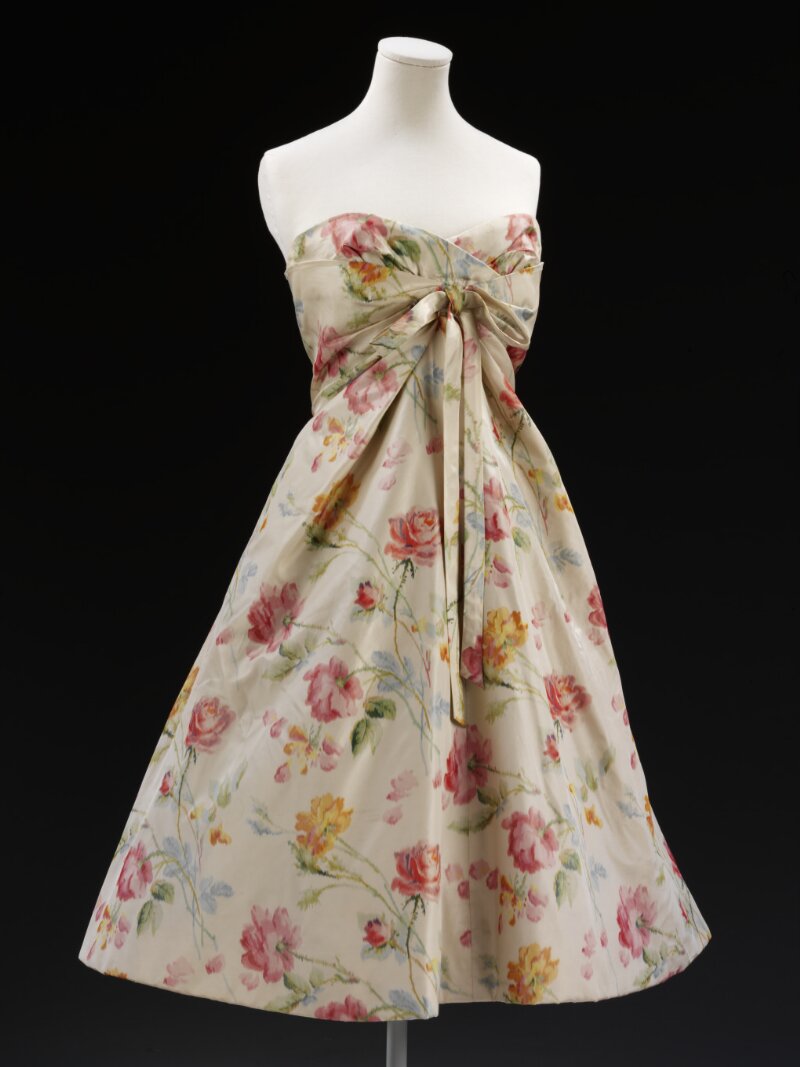
Couture Archaeology Report: Technical Deconstruction of a 1956 Parisian Monte Carlo Evening Dress
Subject: Monte Carlo Evening Dress
Origin: Paris, 1956 (Attributed to the House of Dior)
Analyst: Senior Textile Historian, Natalie Fashion Atelier
Date: [Current Date]
Report Focus: Technical deconstruction of foundational Dior techniques, analysis of materiality, and strategic translation for 2026 high-end luxury silhouettes.
1. Historical Context and Technical Provenance
This 1956 evening dress, conceived for the glittering milieu of Monte Carlo, embodies the late New Look period of the House of Dior. Following the austerity of war, this era was defined by an uncompromising commitment to luxury, technical mastery, and a specific architecture of femininity. The silhouette, while slightly softened from the extreme 1947 "Bar" suit, retains the core Dior principles of a controlled bodice, a cinched waist, and a liberated, celebratory skirt. The garment is not merely a dress but a complex assembly of specialized components, each engineered to create a specific visual and physical effect. Our deconstruction reveals a tripartite structural philosophy: an internal corsetry system, a middle layer of foundational shaping, and an external layer of decorative magnificence.
2. Technical Deconstruction: The Tripartite Architecture
2.1. The Internal Armature: Corsetry and Control
The bodice is built upon a custom-fitted, internal corselet, constructed from couture coutil, spiral steel boning, and precision-placed bias panels. This is not a mere waist cincher; it is a lightweight engineering marvel designed to redistribute weight from the shoulders, create a smooth, elongated torso, and provide a rigid foundation for external fabrics. The boning channels are meticulously placed to follow the natural curves of the ribcage, offering structure without restriction of the diaphragm—a critical consideration for an evening of movement and social engagement. This internal architecture is the non-negotiable prerequisite for the external silhouette.
2.2. The Foundational Layer: Structural Canvas
Over the corselet lies a layer of foundational garments, often referred to as the toile or understructure. This dress employs a silk organza underbodice and a separate crinoline petticoat. The organza, with its inherent stiffness, maintains the crisp lines of the draped neckline and prevents collapse. The crinoline, constructed from graduated tiers of horsehair braid (crin) stitched onto a tulle base, is not a generic bell shape. It is engineered to provide maximum volume at the hem while tapering towards the knees, ensuring the wearer's mobility and a graceful, swaying motion. This layer translates the internal armature into the recognizable, three-dimensional skirt form.
2.3. The External Manifestation: Materiality and Métier
The visible dress is a study in juxtaposition. The bodice is of duchess satin, a fabric chosen for its dense weave, high luster, and capacity to hold a sharp seam. It is cut with minimal darts, relying instead on the internal structure for fit, allowing for a clean, sculptural surface. The skirt, in contrast, is composed of layers of silk chiffon and velvet appliqué. The chiffon provides ethereal volume and movement, while the velvet motifs—likely applied via a meticulous appliqué couché technique—anchor the design with weight and opulence. The hand-picked zipper, concealed within a seam, and the fully finished interior seams bound in silk ribbon (surfilage) are testaments to the code of invisible perfection that defines true couture.
3. Materiality Analysis: The Dialogue of Weight and Light
The genius of this ensemble lies in its orchestrated dialogue between heavy and light. The duchess satin (approximately 140-160 gsm) provides gravitational anchor and status. The horsehair crinoline (structural yet lightweight) creates volume without burden. The silk chiffon (mere ounces) introduces air and kinetics. This calculated hierarchy of materials creates a silhouette that is simultaneously imposing and effortless. The tactile contrast between the cool, smooth satin bodice and the soft, plush velvet appliqués further enriches the sensory experience of the garment, a crucial aspect of luxury often overlooked in contemporary design.
4. Translation for 2026 High-End Luxury Silhouettes
The 2026 luxury consumer seeks not replication, but intelligent evolution: the sensation of couture principles through a modern lens. Our translation focuses on three core pillars derived from the 1956 specimen.
4.1. Neo-Armature: Structural Intelligence
The rigid corselet is reimagined through advanced materials and biomimetic design. We propose seamless, laser-sintered mesh structures using flexible polymer composites, offering personalized support and shaping through algorithmic pressure mapping. Alternatively, shape-memory alloys integrated into bonded technical fabrics could provide adaptive structure that responds to movement. The goal is to deliver the transformative effect of couture underpinnings with the comfort and invisibility of contemporary sportswear engineering.
4.2. Volumetric Redefinition: Sustainable Spectacle
The crinoline's volume will be achieved through innovative and sustainable means. 3D-knitted air chambers that can be subtly inflated or deflated, or sculptural forms created from recycled thermoplastic monofilaments, offer dynamic and responsible alternatives to traditional horsehair. Volume becomes adjustable and personal, moving from a fixed silhouette to an interactive one. For the Atelier's 2026 collection, we envision a "Cloud Crinoline"—a skirt structure using aerogel-infused tulle, creating immense, weightless volume that is thermally insulating, a true fusion of spectacle and function.
4.3. Material Synergy: Tech-Enhanced Sensoriality
The satin-chiffon-velvet dialogue evolves into a new material syntax. We will develop duchess satins woven with conductive yarns for subtle, luminous warmth. Chiffons can be engineered from recycled ocean plastics with a superior, silent hand-feel, or treated with nanocoatings for dynamic color shift. Velvet appliqués may be replaced with bio-fabricated leather insets or laser-etched devoré with unprecedented precision. The hand-finished interior will be recreated through seamless ultrasonic welding and embedded NFC tags that narrate the garment's provenance and care, marrying the old-world value of narrative with cutting-edge technology.
5. Conclusion: The Couture Algorithm
The 1956 Monte Carlo dress is a masterclass in structured fantasy. Its enduring lesson is that luxury is built from the inside out, through a hierarchy of technical decisions that prioritize form, movement, and sensation. For Natalie Fashion Atelier's 2026 vision, we do not copy this artifact; we decode its algorithm. By extracting its core principles—internal architecture, hierarchical materiality, and invisible perfection—and re-engineering them with advanced technologies and a sustainable ethos, we create a new couture language. This language speaks of weightless structure, intelligent volume, and conscious opulence, ensuring that the profound technical legacy of 1956 Paris continues to shape the elegant future of luxury.