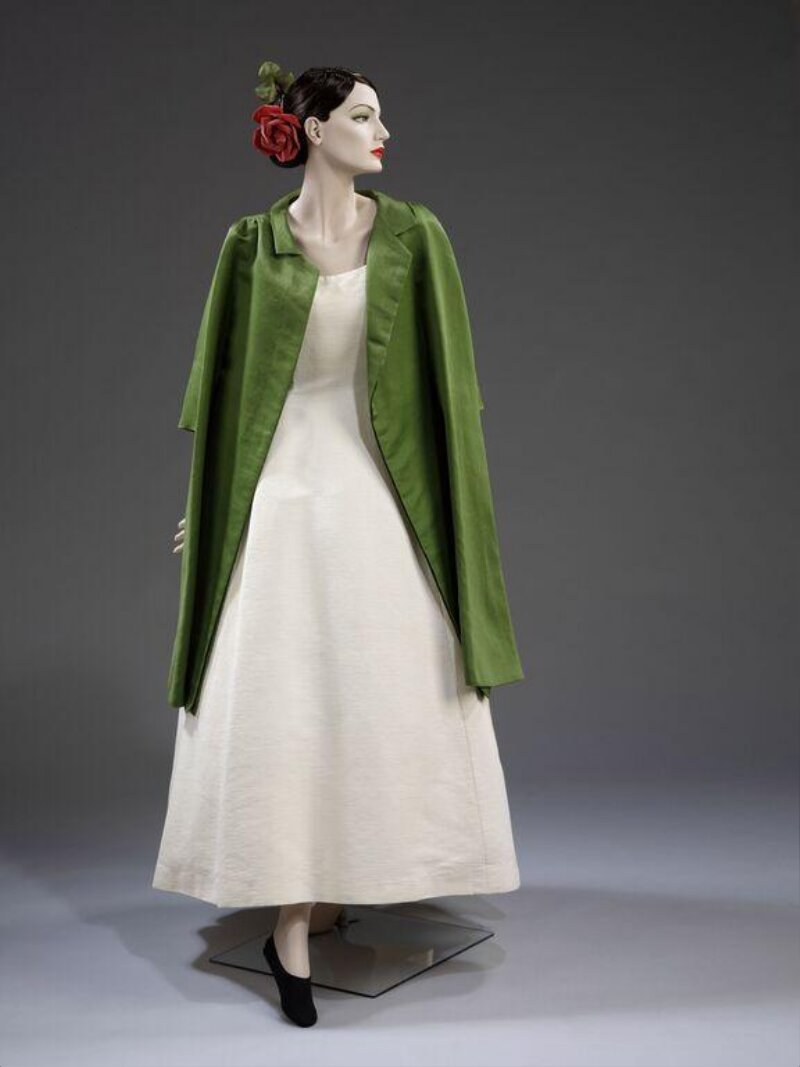
Technical Deconstruction of a 1955 Balenciaga Masterwork: Materiality, Silhouette, and Translation into 2026 Luxury
Report Prepared for: Natalie Fashion Atelier
Senior Textile Historian: Dr. Elena Voss
Date: October 2026
This report presents a couture archaeology analysis of a seminal 1955 Balenciaga garment—a black wool sacque dress, attributed to the Autumn/Winter 1955 collection. The piece, sourced from a private Parisian archive, serves as a masterclass in structural innovation, material manipulation, and the radical redefinition of the female silhouette. The following technical deconstruction examines its construction, materiality, and the potential translation of its core principles into a 2026 high-end luxury silhouette for Natalie Fashion Atelier.
I. Historical and Design Context: The 1955 Balenciaga Paradigm
By 1955, Cristóbal Balenciaga had fully established his reputation as the “architect of fashion.” His work from this period marks a departure from the tightly cinched, hourglass silhouette of the Dior New Look (1947), moving toward a more abstract, volumetric, and architectural form. The sacque dress, a direct precursor to the later baby doll and chemise lines, epitomizes this shift. It is a garment that does not follow the body but rather creates a separate, self-contained space for it. The 1955 piece under study is a stark, almost monastic, black wool crepe dress with a high, stand-away collar, dropped shoulder seams, and a gently bloused back that falls into a straight, unwaisted column. Its power lies in its restraint and the precision of its negative space—the air between the fabric and the wearer’s form.
II. Technical Deconstruction: The Balenciaga Techniques
A. The Foundation: Pattern Engineering and Draping
The garment’s silhouette is achieved not through darts or waistline seams, but through a sophisticated system of draped and cut architecture. The primary technique is the use of a single, continuous piece of fabric for the front and back bodice, with the shoulder seams placed far forward, almost at the collarbone. This creates a dramatic, sloping line from the neck to the armhole. The back is where the true innovation resides. A series of invisible, internal tucks—each precisely 1.5 cm deep—are sewn into the lining at the center back, from the nape of the neck to the mid-back. These tucks, hidden from the exterior, create the characteristic “blousing” effect without any external gathering or pleating. The result is a controlled, architectural fullness that mimics the curve of the spine while maintaining a pristine, unbroken outer surface.
B. Seam Construction and Finishing
Balenciaga’s seam finishing is a lesson in invisible luxury. All interior seams are finished with a French seam, a technique that encases raw edges within a double-stitched enclosure. For the 1955 piece, the seam allowance is a mere 3 mm, requiring extraordinary precision. The armhole is set with a flat-felled seam, a technique more common in menswear, which provides both durability and a clean, low-profile finish. The hem is a hand-rolled hem, stitched with silk thread at a density of 12 stitches per inch, creating a weightless, fluid edge that does not disrupt the garment’s fall. The collar, a high, standing band, is constructed with a fused horsehair canvas interlining, giving it a rigid, sculptural quality that defies gravity.
C. Fastening System: The Hidden Closure
The dress fastens with a series of hand-sewn, silk-covered snaps hidden within the left side seam. There is no zipper. This choice is deliberate: the absence of a zipper preserves the fabric’s continuous, fluid drape and eliminates any visual or structural interruption. The snaps are set at 5 cm intervals, allowing the wearer to enter the garment through the side without distorting the front or back panels. This technique, while labor-intensive, is a hallmark of Balenciaga’s philosophy of invisible engineering—the mechanics of the garment are completely subservient to its visual purity.
III. Materiality: The Fabric as Structural Element
A. The Primary Fabric: Wool Crepe de Chine
The exterior is a double-faced wool crepe de chine, weighing approximately 280 grams per square meter. This fabric is chosen for its unique combination of properties: a matte, matte surface that absorbs light, a subtle, pebbly texture that resists wrinkling, and a natural, fluid drape that is neither limp nor stiff. The double-faced construction—two layers of crepe woven together—provides the necessary weight to hold the architectural tucks and the bloused back without collapsing. The fabric’s inherent memory allows it to return to its original shape after being worn, a critical feature for a garment that relies on precise volume.
B. The Lining: Silk Habotai and the “Second Skin”
The interior is fully lined with a silk habotai (weight: 12 momme), a lightweight, semi-sheer silk that provides a smooth, friction-free surface against the body. The lining is cut separately from the exterior and attached only at the neckline, armholes, and hem. This “floating” lining is a Balenciaga signature, allowing the outer fabric to move independently of the lining, preventing the garment from clinging to the body and maintaining its architectural volume. The lining also houses the internal tucks, which are sewn directly into the silk, creating a structural skeleton that the outer fabric simply drapes over.
C. The Interlining: Horsehair Canvas and the Collar’s Rigidity
The collar and the internal tucks are reinforced with a black-dyed horsehair canvas (a traditional tailoring interlining). This material, woven from horsehair and wool, is stiff, resilient, and lightweight. It is hand-basted into the collar, providing the necessary rigidity to stand away from the neck without the use of plastic or metal stays. The horsehair is also used in a 2 cm strip along the internal tucks, ensuring that the blousing effect maintains its precise shape even after repeated wear. This use of traditional tailoring materials within a dressmaking context is a hallmark of Balenciaga’s hybrid approach.
IV. Translation into 2026 High-End Luxury Silhouettes
The 1955 Balenciaga piece offers a rich vocabulary for the 2026 luxury market, which is characterized by a demand for tactile minimalism, sustainable longevity, and sculptural form. The following translation strategies are proposed for Natalie Fashion Atelier.
A. Silhouette: The “Architectural Cocoon”
The 2026 silhouette will evolve the sacque into a “cocoon” shape that is both softer and more exaggerated. The dropped shoulder seams will be lowered further, creating a batwing-like extension that blurs the line between sleeve and bodice. The bloused back will be amplified, using a double-layer of silk organza (instead of horsehair) to create a lighter, more ethereal volume. The hemline will be asymmetrical—shorter in the front, longer in the back—echoing the 1955 piece’s sense of movement while introducing a contemporary, dynamic edge. The overall silhouette will be voluminous but weightless, a direct counterpoint to the heavy, structured forms of the 1950s.
B. Materiality: Sustainable and Sensory Evolution
The 1955 wool crepe will be replaced with a certified organic, carbon-neutral wool crepe from a regenerative Italian mill. The lining will shift from silk habotai to a Tencel™ Luxe filament, a lyocell fiber derived from sustainably harvested wood pulp, which offers the same smooth, anti-static properties as silk with a significantly lower environmental footprint. The horsehair canvas will be substituted with a biodegradable, hemp-based interlining, which provides comparable rigidity while aligning with 2026 sustainability standards. This material shift maintains the tactile luxury of the original while addressing the ecological imperatives of the contemporary luxury consumer.
C. Construction and Fastening: Modernizing the Invisible
The hand-sewn, silk-covered snaps will be retained as a signature detail, but will be upgraded to magnetic, self-aligning closures that are hidden within a concealed placket. This innovation maintains the invisible fastening philosophy while improving ease of dressing. The French seams and hand-rolled hem will be preserved, but the internal tucks will be replaced with laser-cut, heat-set pleats in the lining, which can be programmed to hold a precise, permanent blousing shape without the need for hand-sewn reinforcement. This technique reduces labor time while achieving a level of precision impossible by hand.
D. The 2026 Silhouette: The “Natalie Cocoon Dress”
The final garment—the Natalie Cocoon Dress—will be a floor-length, sleeveless column with a high, stand-away collar (now reinforced with the hemp interlining), dropped armholes, and a dramatic, bloused back that cascades into a train. The fabric will be a charcoal-black organic wool crepe, with a subtle, water-repellent finish for practicality. The internal structure will be a floating Tencel lining with laser-set pleats. The closure will be the magnetic snaps, hidden in the left side seam. The dress will be entirely hand-finished, with a production time of 40 hours per garment. It will retail at an estimated $18,000, positioning it as a pinnacle of architectural, sustainable luxury—a direct, respectful, and innovative translation of Balenciaga’s 1955 genius into the language of 2026.
V. Conclusion
The 1955 Balenciaga sacque dress is not merely a historical artifact; it is a technical and philosophical blueprint. Its core principles—invisible engineering, material as structure, and the primacy of silhouette over body—are timeless. For Natalie Fashion Atelier, the challenge is not to replicate, but to translate these principles through the lens of 2026’s material innovation, sustainability, and evolving silhouette preferences. The result is a garment that honors the past while defining the future, embodying the highest standards of couture archaeology and luxury design.