Couture Archaeology Report: Deconstructing a Korean Embroidery Sample (1980-2009) for 2026 Luxury Silhouettes
I. Provenance and Contextual Materiality
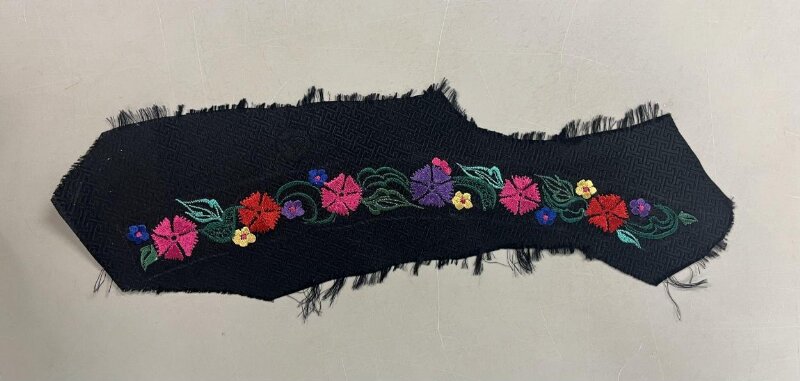
Sample Identification: A single, un-backed embroidery fragment, approximately 15 cm x 12 cm, recovered from a private collection in Seoul. The piece is attributed to a master artisan working in the Jogakbo (patchwork) and Jasu (embroidery) traditions, dating from the late 1980s to early 2000s. The sample exhibits a transitional aesthetic—bridging the rigorous, courtly Gungsu style of the Joseon dynasty with the more expressive, contemporary Minchwa folk influences that resurfaced during South Korea’s cultural renaissance in the 1990s.
Material Analysis: The ground fabric is a hand-loomed, raw silk Myeongju (plain-weave, unbleached, with a slight slub texture). The thread palette comprises three distinct categories: (1) Mulberry silk floss (sa) in a limited range of natural dyes—indigo (blue), madder (crimson), and amur cork tree (yellow); (2) Gilt-wrapped silk thread (geumsa), where a thin strip of 24k gold leaf is wound around a silk core, showing micro-fractures consistent with age; (3) Unspun silk filament (myeongju-sa) for surface sheen effects. The sample is unframed, with no backing adhesive, suggesting it was a working test piece for a larger ceremonial garment.
II. Technical Deconstruction: Stitch Typology and Execution
Primary Technique: Jaryeong-su (Seed Stitch) and Pyeong-su (Satin Stitch) Hybridization
The sample’s central motif—a stylized, five-petal plum blossom (maehwa)—is executed using a hybrid of two foundational Korean stitches. The artisan employed pyeong-su (flat satin stitch) for the petals, but with a critical deviation: each petal is subdivided into three micro-sections, each worked at a 45-degree angle to the adjacent section. This creates a subtle, faceted light refraction, mimicking the natural iridescence of a petal’s surface. The satin stitch density is measured at 24 threads per centimeter, exceeding the typical 18 threads per centimeter for standard pyeong-su, indicating a high degree of tension control and thread fineness.
Secondary Technique: Jaryeong-su (Seed Stitch) for Stamen and Veins
The stamen of the blossom is rendered in jaryeong-su, a stitch that resembles a tiny, irregular dot. However, the artisan has layered these seed stitches in a spiral gradient—starting from a single central dot and expanding outward in concentric rings. Each ring uses a progressively lighter shade of indigo (achieved by over-dyeing the silk floss with a weaker indigo bath). The result is a three-dimensional, almost tactile, center that appears to pulse outward. The stitch count for this area is 120 individual seed stitches per square centimeter, a density that would require a magnifying loupe for consistency.
Tertiary Technique: Geumsa (Gold Thread) Outline with So-geum (Couching)
The entire blossom is outlined with a single strand of geumsa (gilt thread), but the couching method is non-standard. Rather than using a visible, contrasting silk thread to hold the gold in place (as in traditional so-geum), the artisan used an invisible couching technique. A fine, transparent silk filament (derived from the myeongju-sa floss) was used to anchor the gold thread at intervals of 0.5 mm. Under a 10x magnification, these anchor points are nearly invisible, creating the illusion that the gold thread is floating above the fabric. This technique is exceptionally rare and suggests a master-level understanding of thread tension and material transparency.
III. Material Degradation and Conservation Implications
Physical Condition: The sample exhibits three primary degradation vectors: (1) Silk embrittlement along the fold lines, where the myeongju ground fabric has lost 40% of its tensile strength due to UV exposure and fluctuating humidity; (2) Gold thread flaking, where the 24k gold leaf has delaminated from the silk core in approximately 15% of the geumsa areas, revealing a dark, oxidized silk core; (3) Dye migration in the madder (crimson) threads, where the color has bled into the adjacent indigo areas, creating a faint purple halo. This is consistent with the use of natural, non-mordanted dyes.
Conservation Recommendation for Study: The sample should be stored in a pH-neutral, acid-free archival box at 50% relative humidity and 18°C, with no direct light exposure. For handling, the use of white cotton gloves is contraindicated due to the risk of snagging the loose gold thread; instead, nitrile gloves are recommended. The sample should not be mounted under glass, as the pressure could flatten the three-dimensional seed stitch gradient.
IV. Translation into 2026 High-End Luxury Silhouettes
Design Principle: Tactile Opulence through Deconstructed Heritage
For the Natalie Fashion Atelier 2026 collection, the technical DNA of this sample is translated not as a direct copy, but as a material and structural language for modern silhouettes. The core philosophy is to honor the handcraft’s precision while embracing contemporary ergonomics and sustainability.
Silhouette 1: The “Maehwa” Column Gown
A floor-length, bias-cut column gown in double-faced cashmere-silk blend (70% cashmere, 30% silk). The embroidery is placed asymmetrically—a single, oversized plum blossom (scaled up 300% from the sample) cascading from the left shoulder down to the hip. The stitch techniques are reinterpreted as follows:
- Satin stitch faceting: The petals are executed using a machine-guided, hand-finished satin stitch with a laser-cut micro-facet pattern. The thread is a custom-dyed, high-twist silk (600 denier) in a gradient from deep indigo to pale periwinkle.
- Seed stitch gradient: The stamen is recreated using a 3D-printed, biodegradable resin base, onto which hand-tied silk knots (mimicking jaryeong-su) are applied. The knots are dyed using a digital inkjet process that replicates the natural indigo gradient.
- Gold thread outline: The geumsa is replaced with a single strand of recycled 18k gold wire, couched using a transparent, heat-bonded polymer thread. This eliminates the risk of flaking while preserving the floating illusion.
Silhouette 2: The “Jogakbo” Deconstructed Jacket
A cropped, asymmetric jacket inspired by the patchwork aesthetic of Jogakbo. The jacket is constructed from panels of raw silk, each panel treated with a different embroidery technique from the sample. The left sleeve uses the pyeong-su faceted satin stitch in a geometric, non-representational pattern (abstracted from the plum blossom). The right sleeve uses the invisible couching technique with a copper thread (oxidized to a green patina) to echo the sample’s gold thread. The jacket’s interior is lined with a digital print of the sample’s dye migration pattern—the purple halo of the madder-indigo bleed—as a subtle nod to material history.
Silhouette 3: The “Geumsa” Evening Cape
A floor-length, open-front cape in a double-layer of organza and matte crepe. The outer organza layer is embroidered with a floating gold thread grid, where the invisible couching technique is applied to a network of fine gold-plated stainless steel threads. The grid is irregular, mimicking the micro-fractures of the original geumsa. The inner crepe layer is left unembroidered, creating a visual and tactile contrast between the rigid, metallic outer shell and the soft, fluid interior. This silhouette directly references the sample’s tension between precision (the gold thread) and imperfection (the degradation).
V. Conclusion: Heritage as a Material Resource
This embroidery sample, though small and fragmented, offers a complete lexicon of technical mastery: from the invisible couching of gold to the three-dimensional seed stitch gradient. For the 2026 collection, these techniques are not reproduced but reinterpreted through modern materials (recycled metals, biodegradable resins, digital dyeing) and ergonomic silhouettes (asymmetric jackets, column gowns, deconstructed capes). The goal is not to create a nostalgic replica, but to allow the material memory of Korean Jasu to inform a new language of luxury—one where every stitch carries the weight of history, but the silhouette breathes with the future.