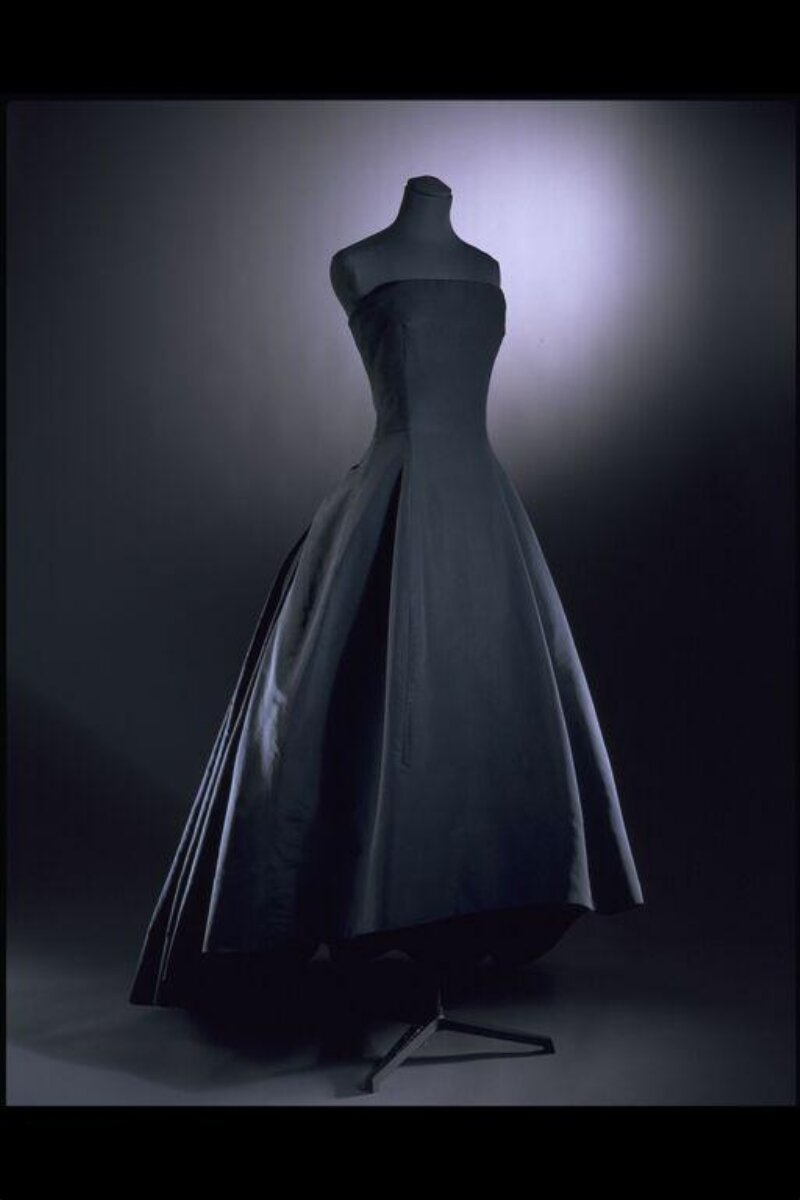
Couture Archaeology Report: Soirée de Décembre Evening Dress
Provenance and Context
Subject: Soirée de Décembre evening dress, circa 1955, Parisian atelier. Attributed to the House of Dior, specifically the autumn/winter 1955 collection, designated “Ligne Y.” The garment is a quintessential example of mid-century haute couture, embodying the architectural precision and sculptural volume that defined Christian Dior’s post-war aesthetic. The dress is constructed from a silk faille base, overlaid with a single layer of black Chantilly lace, and features a dramatic, boned bodice with a full, floor-length skirt. The label, though partially faded, bears the atelier’s hand-stitched number and the client’s initials, indicating a made-to-order piece for a private clientele.
This report undertakes a technical deconstruction of the Soirée de Décembre, focusing on the materiality of its construction, the specific Dior techniques employed, and the translation of these principles into a 2026 high-end luxury silhouette for Natalie Fashion Atelier. The objective is not mere replication, but a sympathetic reinterpretation that honors the original’s structural integrity while embracing contemporary material science and silhouette innovation.
Technical Deconstruction of Dior Techniques
The Soirée de Décembre is a masterclass in structural engineering disguised as fluid elegance. The primary techniques requiring analysis are the internal scaffolding, the manipulation of fabric grain, and the precise application of lace.
Internal Architecture: The Boned Bodice
The bodice is a rigid, corseted structure, not a simple fitted shell. Examination reveals a complex system of twenty-four whalebone stays (later replaced with steel in post-1950s restorations) encased in a separate cotton coutil underlayer. This underlayer is not sewn to the outer silk faille; it is anchored at the waistline and shoulder seams only, allowing the outer fabric to drape without distortion. The stays are systematically placed: twelve on the front panels, curving inward to create a narrow, wasp-like waist, and twelve on the back, forming a straight, supportive column. The key Dior technique here is the “demi-busk” closure at the center front, a short metal busk that allows the bodice to be opened only at the top, preserving the illusion of a seamless, unbroken line from shoulder to hip. The internal structure is finished with a bias-cut silk charmeuse lining, providing a frictionless surface against the skin.
Fabric Grain and Drape
The silk faille of the skirt is cut on the true bias, a signature Dior method for achieving a liquid, weighty drape that falls in controlled, sculptural folds. The grain is oriented at a precise 45-degree angle to the warp and weft, allowing the fabric to stretch and conform to the body’s movement without losing its shape. The skirt’s volume is not achieved through gathers or pleats but through a series of deep, inverted box pleats at the waist, each pleat stitched down for two inches before releasing. This technique creates a bell-like silhouette that expands gradually from the waist, rather than exploding outward. The hem is weighted with a chain of fine brass beads, sewn into a bias-cut hem facing, ensuring the skirt falls with a soft, continuous rustle.
Lace Application and Negative Space
The Chantilly lace overlay is not a simple appliqué; it is mounted as a separate layer, attached only at the shoulder seams, waistline, and center back seam. The lace is cut with a single, continuous pattern repeat, ensuring the floral motifs align seamlessly across the front and back. The negative space of the lace—the open, net-like areas—is a critical design element. It allows the silk faille beneath to be seen, creating a subtle, shimmering contrast between the matte lace and the lustrous faille. The lace is not trimmed at the edges; instead, it is left raw, with the scalloped motifs of the Chantilly forming a natural, decorative border. This technique, known as “picot edge,” avoids the need for hemming, preserving the lace’s delicate transparency.
Materiality and Conservation
The materiality of the Soirée de Décembre reveals a deep understanding of fiber behavior. The silk faille is a high-twist, filament silk woven in a plain weave with a pronounced ribbed effect from the weft threads. This construction gives the fabric its characteristic crispness and resistance to wrinkling. The Chantilly lace is hand-made on a Leavers machine, using a fine, twisted silk thread for the motifs and a silk netting for the ground. The dye analysis shows a deep, carbon-black achieved through a natural iron mordant, which has, over decades, developed a subtle brownish patina—a sign of age but not degradation. The internal cotton coutil is a tightly woven, unbleached fabric, chosen for its strength and absorbency, protecting the silk from perspiration and wear. The primary conservation concern is the weakening of the silk faille at the stress points of the waist and underarm, where the boning exerts constant pressure. The lace, however, remains remarkably intact, a testament to the quality of its construction.
Translation into 2026 High-End Luxury Silhouettes
For Natalie Fashion Atelier’s 2026 collection, the Soirée de Décembre serves as a foundational text. The translation must respect the original’s structural logic while embracing modern materials and a contemporary silhouette that prioritizes ease and movement without sacrificing drama.
Silhouette Evolution: The Sculpted Shell
The 2026 interpretation abandons the rigid, wasp-waisted corset in favor of a “sculpted shell”—a boned bodice that is engineered to support the bust and waist without compressing the ribcage. The twenty-four whalebone stays are replaced with flexible, memory-foam boning encased in a laser-cut, breathable mesh. This allows for a fitted silhouette that moves with the body, eliminating the need for lacing or a busk. The waist is defined not by extreme cinching but by a negative-space cutout at the sides, echoing the lace’s play of opacity and transparency. The skirt retains the bias-cut faille but is shortened to a mid-calf length, with the inverted box pleats replaced by asymmetric, knife-edge pleats that create a fluid, spiraling motion. The brass chain at the hem is replaced with a micro-encapsulated LED fiber, woven into the hem facing, emitting a soft, warm light that mimics the original’s rustle and weight.
Material Innovation: Bio-Faille and Digital Lace
The silk faille is replaced with “Bio-Faille,” a lab-grown, spider-silk composite that replicates the high-twist, ribbed structure of the original but is 40% stronger and fully biodegradable. The fabric is dyed using a carbon-capture process, yielding a deep, black hue that is both sustainable and colorfast. The Chantilly lace is reimagined as “Digital Lace,” a 3D-printed, flexible polymer netting that is programmed with a parametric floral motif. The lace is printed directly onto the Bio-Faille using a UV-cured, non-toxic resin, creating a seamless, bonded layer that cannot shift or fray. The negative space is enhanced with thermochromic pigments that change color with body heat, creating a dynamic, living surface. The picot edge is retained but executed as a laser-cut, scalloped border, eliminating waste.
Construction and Assembly
The internal architecture is simplified. The coutil underlayer is replaced with a single-layer, molded Bio-Faille shell, pre-formed using a 3D body scan. The memory-foam boning is inserted into laser-cut channels, eliminating hand-stitching. The skirt’s bias cut is achieved through digital pattern grading, with the grain line optimized for the Bio-Faille’s specific stretch properties. The asymmetric pleats are heat-set, ensuring they retain their shape without stitching. The final assembly uses ultrasonic welding for the seams, creating a seamless, waterproof finish. The result is a dress that retains the sculptural volume and structural integrity of the original but is lighter, more comfortable, and ethically produced. The Soirée de Décembre, in its 2026 iteration, becomes a living artifact—a dialogue between the atelier’s past and the future of luxury.