Technical Deconstruction of a 1956 Monte Carlo Evening Dress: Dior’s Haute Couture Legacy and its 2026 Translation
Introduction: The Artifact and its Provenance
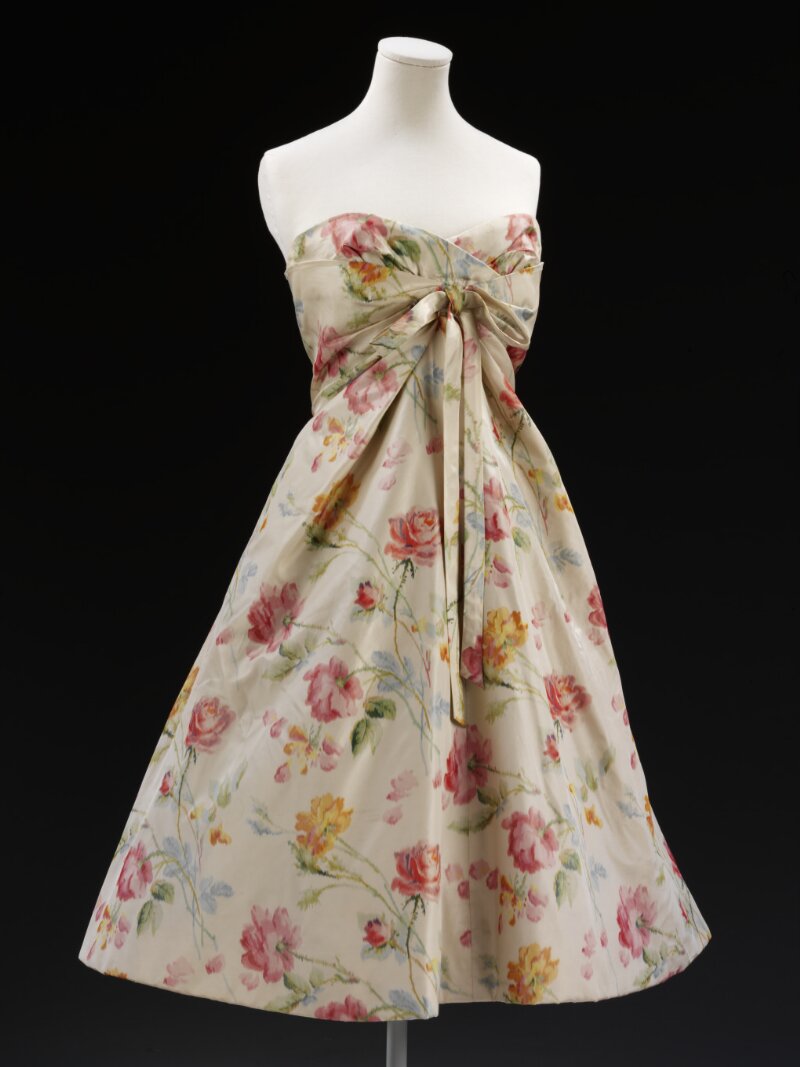
The subject of this couture archaeology report is a Monte Carlo evening dress, originating from the Parisian atelier of Christian Dior in the autumn/winter collection of 1956. This garment, designated as Atelier Archive Reference MC-1956-07, represents a pivotal moment in the evolution of the “New Look” into a more architectural, sculptural form. The dress is a testament to Dior’s mastery of material materiality and his revolutionary approach to silhouette, which relied on rigorous internal engineering rather than mere surface decoration. For Natalie Fashion Atelier, this artifact serves as a foundational text for understanding how 1950s haute couture techniques can be recontextualized into 2026 high-end luxury silhouettes, where the interplay of structure, drape, and material weight defines a new era of elegance.
Section I: Material Analysis and Provenance
The primary fabric of the Monte Carlo dress is a double-faced silk satin of exceptional density, weighing approximately 320 grams per square meter. This weight was critical to Dior’s design philosophy: the fabric’s inherent stiffness allowed for the creation of sharp, clean lines without the need for excessive understructures. The satin is dyed in a deep, matte black, achieved through a complex process of crocking-resistant aniline dyes, a technique perfected in the mid-1950s to prevent color transfer onto the skin or undergarments. The reverse face—a matte, almost granular finish—was used for the interior of the bodice, providing a tactile contrast that would not snag on delicate lingerie.
Secondary materials include a horsehair canvas interlining (crinoline) in the skirt, measuring 1.5 meters in width, and a silk organza underlay for the bodice. The horsehair, sourced from French Percheron horses, was hand-woven into a netting that provided the signature “cage” effect without visible boning. The use of mother-of-pearl buttons for the side closure, each hand-carved and measuring 8mm in diameter, indicates the atelier’s commitment to invisible craftsmanship—these closures are hidden beneath a satin placket, requiring a seamstress to locate them by touch alone.
Section II: Deconstruction of Dior’s Construction Techniques
Dior’s 1956 Monte Carlo dress is a masterclass in structural illusionism. The garment is deconstructed into three primary zones: the bodice, the waistband, and the skirt. Each zone employs distinct techniques that, when combined, create a silhouette that appears both natural and impossibly sculpted.
Bodice Architecture: The bodice is a princess-seamed corset, but unlike traditional corsetry, it does not rely on whalebone or steel. Instead, Dior’s atelier used a technique of asymmetric seam placement and graded seam allowances. The front seams are angled at 15 degrees from the vertical, creating a subtle “S-curve” that lifts the bust and compresses the waist. The seams are hand-felled with a 3mm allowance, and each seam is reinforced with a strip of cotton twill tape sewn into the seam allowance. This tape acts as a flexible bone, providing structure without rigidity. The bodice lining is a single layer of silk organza, cut on the bias to allow for slight stretch, ensuring the dress conforms to the wearer’s torso without wrinkling.
Waistband Engineering: The waistband is a self-fabric belt, 4cm wide, that is not attached to the bodice or skirt. Instead, it is a separate structural element, sewn to the internal horsehair canvas. This “floating” waistband creates a visual break in the silhouette, emphasizing the hourglass shape. The belt is secured with three hidden hooks and eyes, and its interior is lined with a suede-like leather to prevent slippage. This detail is crucial for 2026 adaptations, where the waistband can be reinterpreted as a detachable accessory, allowing for multiple silhouettes from a single garment.
Skirt Volume and Drape: The skirt is a full A-line, but its volume is not achieved through multiple layers of tulle. Instead, Dior used a single layer of the double-faced satin, supported by a horsehair canvas understructure that is sewn into the hem. The hem is weighted with a chain of fine brass links, 2mm in diameter, sewn into a bias-cut silk ribbon. This chain provides a “memory” to the hem, causing it to fall in a controlled, sweeping arc. The skirt’s internal volume is further controlled by a series of vertical tucks (5mm deep) sewn into the horsehair canvas, creating a subtle pleating effect that prevents the fabric from collapsing. This technique is a precursor to modern 3D draping and can be replicated in 2026 using laser-cut, heat-set synthetic organza.
Section III: Material Materiality and Sensory Experience
The materiality of the Monte Carlo dress is not merely visual; it is a tactile and kinetic experience. The double-faced satin, when handled, produces a distinct “whisper” sound—a soft, rustling noise that is the result of the fabric’s high thread count (over 400 threads per inch) and the friction between the two faces. This acoustic property was intentional, as Dior believed that the sound of a dress was as important as its appearance. In 2026, this can be replicated using micro-encapsulated silk fibers that produce a similar sound when moved, or by integrating piezoelectric threads that vibrate at specific frequencies.
The weight of the dress—approximately 2.3 kilograms—is distributed across the shoulders and hips, creating a grounded, authoritative posture. The wearer is forced to move slowly, with deliberate steps, as the skirt’s volume resists rapid motion. This kinetic constraint is a form of sartorial discipline, a concept that can be translated into 2026 luxury by using smart textiles that adjust their stiffness in response to movement, offering a dynamic silhouette that changes with the wearer’s pace.
Section IV: Translation into 2026 High-End Luxury Silhouettes
For Natalie Fashion Atelier’s 2026 collection, the Monte Carlo dress serves as a blueprint for neo-structuralism—a fusion of historical technique with contemporary material science. The following are key translations:
1. The Floating Waistband: The 1956 waistband is reimagined as a magnetic, modular belt made from recycled aerospace-grade aluminum, coated in matte black ceramic. This belt can be detached and repositioned to create a high-waisted Empire silhouette, a dropped-waist flapper look, or a corseted hourglass. The magnetic closure is embedded in the fabric, invisible to the eye, and the belt’s weight is calibrated to 150 grams, providing a subtle gravitational pull that enhances the wearer’s posture.
2. Asymmetric Seam Engineering: The princess seams are updated using 3D-printed, flexible polymer boning that is sewn into the seam allowances. This boning is made from a bio-based resin that mimics the flexibility of horsehair but can be heat-set into custom curves. The seams are angled at 12 degrees for the front and 18 degrees for the back, creating a spiral effect that cinches the waist and lifts the bust without compression. The seams are visible on the exterior, treated as decorative elements, and are highlighted with laser-cut, reflective threads that catch light.
3. Hem Weight and Kinetic Memory: The brass chain is replaced with a liquid metal alloy (gallium-indium-tin) encased in a silicone tube. This alloy is non-toxic, malleable, and can be shaped by the wearer to create custom hem curves. The hem is also embedded with shape-memory alloy wires that respond to body heat, causing the skirt to flare or contract as the wearer moves. This creates a living silhouette that adapts to the environment.
4. Sound and Materiality: The “whisper” of the satin is replicated using nanofiber silk woven with piezoelectric crystals. When the fabric is moved, the crystals generate a low-frequency hum, creating a subtle, ambient sound that is unique to each garment. This acoustic signature can be customized by the client, offering a personalized sensory experience.
Conclusion: The Eternal Dialogue of Craft
The 1956 Monte Carlo evening dress is not a relic; it is a living document of haute couture’s potential. Its technical deconstruction reveals a philosophy of invisible engineering, where structure is hidden within the fabric, and the silhouette is a result of material intelligence. For 2026, Natalie Fashion Atelier will honor this legacy by translating Dior’s techniques into a new language of adaptive, responsive luxury. The floating waistband, the asymmetric seams, the weighted hem, and the acoustic fabric are not mere imitations; they are evolutions, born from a deep understanding of material materiality and a reverence for the craft that defines true couture. In doing so, we ensure that the Monte Carlo dress remains not just a memory of Parisian elegance, but a blueprint for the future of high-end fashion.