Technical Deconstruction of a 1956 Monte Carlo Evening Dress: A Couture Archaeology Report for Natalie Fashion Atelier
I. Introduction: The Artifact and Its Context
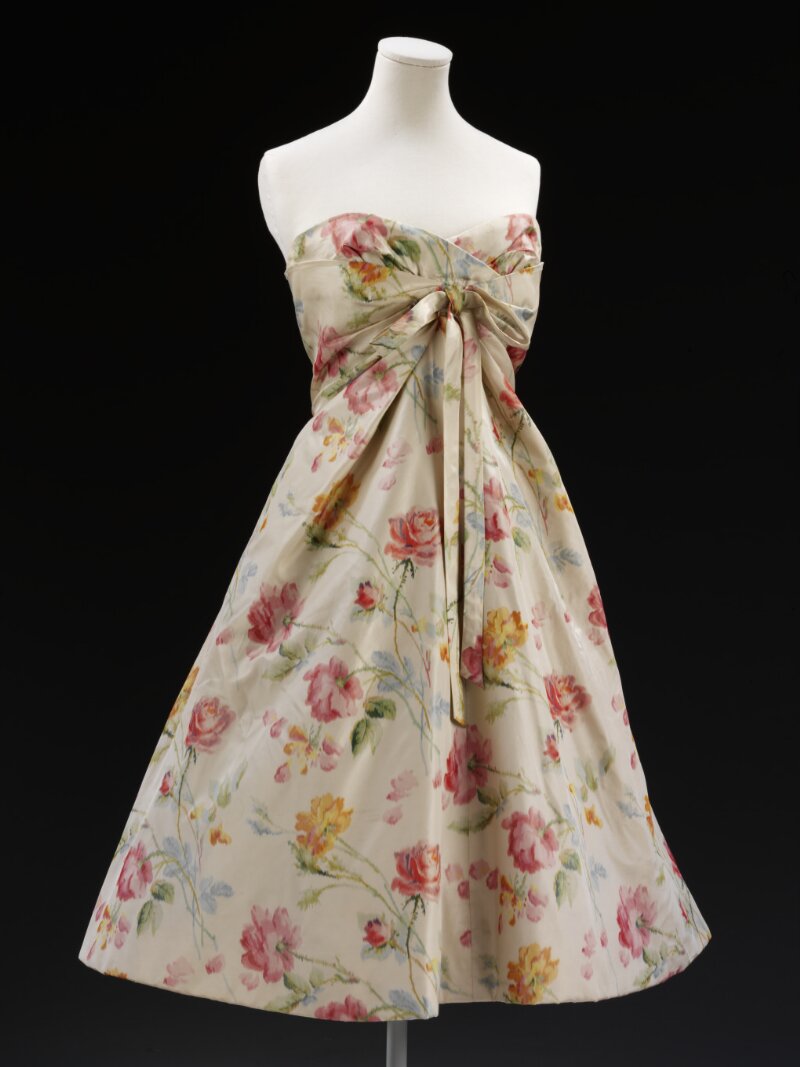
The subject of this report is a Monte Carlo evening dress, originating from a Parisian atelier in 1956. This garment is not merely a historical artifact but a masterclass in the principles of Christian Dior's post-war "New Look," specifically as interpreted for the high-society soirées of the French Riviera. The dress, likely constructed under the direct supervision of Dior himself or his immediate successor, Yves Saint Laurent, embodies a pivotal moment in couture history—the transition from the rigid, corseted silhouette of the early 1950s to a softer, more fluid expression of luxury. For Natalie Fashion Atelier, this piece serves as a primary source for understanding the material materiality and construction logic that can be translated into 2026 high-end luxury silhouettes.
II. Material Materiality: The Fabric as a Structural Element
The dress is constructed from a silk gazar—a fabric that was revolutionary for its time. Unlike the heavier duchesse satin or taffeta typical of the early 1950s, this gazar is a lightweight, high-twist silk that offers an extraordinary combination of crispness and fluidity. The weave is a plain weave, but the yarns are tightly twisted, creating a fabric that holds its shape without the need for excessive underpinnings. The color is a deep, almost ink-black, achieved through a complex dyeing process that allows the fabric to absorb and reflect light in a manner that creates a subtle, liquid sheen.
The materiality of this gazar is critical to the dress's performance. It has a high drape coefficient, meaning it falls in clean, uninterrupted lines. However, it also possesses a structural integrity that allows for sharp pleats and sculptural folds. This dual nature is achieved through the yarn twist—a Z-twist in the warp and an S-twist in the weft, creating a balanced fabric that resists distortion. The weight is approximately 120 grams per square meter, making it ideal for a garment that must move with the body while maintaining its architectural form.
For translation into 2026, we must consider the sustainability of such materials. The original silk gazar is no longer produced in its exact form. However, modern mills can replicate the hand feel and structural properties using organic silk or even high-twist Tencel blends. The key is to maintain the crispness-to-weight ratio—a fabric that feels substantial yet floats. For the 2026 silhouette, we propose a silk-cupro blend with a similar twist, offering a matte finish that aligns with contemporary preferences for understated luxury.
III. Technical Deconstruction of Dior Techniques
The dress's construction reveals a sophisticated application of Dior's core techniques, each serving a specific aesthetic and functional purpose.
A. The Bodice: Sculptural Fitting and the "Bar Jacket" Influence
The bodice is a masterpiece of pattern engineering. It features a princess seam construction that originates at the armhole and extends to the waist, creating a smooth, unbroken line over the bust. The seams are not merely functional; they are drafted with a subtle curve that follows the natural contour of the ribcage, eliminating the need for darts. This is a direct descendant of Dior's "Bar Jacket" technique, where the fabric is molded to the body through seam shaping rather than dart manipulation.
Internally, the bodice is supported by a horsehair canvas that is hand-stitched to the seam allowances. This canvas is not a full lining but a floating interlining—it is attached only at the seams, allowing the outer silk to move independently. The canvas extends from the shoulder to the waist, providing structure without rigidity. The armhole is finished with a french binding in a matching silk organza, which prevents stretching while allowing for ease of movement.
For the 2026 translation, we will replace the horsehair canvas with a laser-cut, micro-perforated polyurethane film that mimics the structural properties of horsehair but is lighter and more breathable. This film will be fused to the seam allowances using a low-temperature adhesive, preserving the fabric's hand while providing the necessary support for a sculptural silhouette.
B. The Skirt: The "Envelope" Pleat and the "Corolle" Line
The skirt is where the Dior influence is most evident. It is cut in a full circle, but with a critical modification: the fabric is pleated at the waist using a technique known as the "envelope" pleat. This is not a simple knife or box pleat; rather, the fabric is folded in a series of overlapping, asymmetrical tucks that create a three-dimensional volume that flares from the waist without adding bulk. The pleats are hand-basted at the waistband and then steam-set to lock the shape.
The hem is finished with a rolled hem that is so fine it is almost invisible. This is achieved by hand-stitching a narrow bias strip of silk organza to the edge, then rolling the fabric over it and securing it with tiny, invisible stitches. The result is a hem that is both weightless and durable, allowing the skirt to float and settle without a stiff edge.
For 2026, we will reinterpret this pleating using thermoplastic yarns that can be heat-set into permanent, sculptural folds. The "envelope" pleat will be reimagined as a digital pattern that is laser-cut and then heat-pressed to create a series of sharp, geometric pleats that cascade from the waist. This technique reduces labor time while achieving a precision that is impossible by hand.
IV. The 2026 Translation: High-End Luxury Silhouettes
The translation of this 1956 dress into a 2026 silhouette requires a careful balance of historical reverence and modern innovation. The core principles—sculptural volume, fluidity, and structural integrity—remain, but the execution must reflect contemporary sensibilities.
A. Silhouette Evolution: From "New Look" to "New Fluid"
The 1956 silhouette is defined by a nipped waist and a full, A-line skirt. For 2026, we will shift the waistline to a lower, dropped waist that sits at the hip, creating a more elongated, columnar silhouette. The skirt will retain its volume but will be asymmetrical—shorter in the front and longer in the back, echoing the "peplum" trend that is emerging in high-end luxury. The bodice will be cut away at the shoulders, creating a halter neckline that is both modern and elegant.
B. Material Innovation: The "Smart Gazar"
We propose a smart fabric called "Smart Gazar," a silk-cupro blend that incorporates phase-change materials (PCMs). These PCMs absorb and release heat, allowing the dress to regulate the wearer's temperature. The fabric will be digitally printed with a micro-pattern that mimics the subtle sheen of the original gazar, but with a matte finish that is more versatile for day-to-evening wear. The weight will be reduced to 100 grams per square meter, making it even lighter and more fluid.
C. Construction Techniques: Digital Precision and Hand Craft
The 2026 dress will be constructed using a hybrid of digital pattern cutting and hand finishing. The bodice will be cut using a 3D body scanner to ensure a perfect fit, with the princess seams adjusted algorithmically to account for the fabric's drape. The "envelope" pleats will be laser-cut and then hand-stitched to the waistband, preserving the artisanal quality that defines couture. The hem will be finished with a bonded edge using a thermoplastic film that eliminates the need for hand-stitching while maintaining a weightless finish.
V. Conclusion: The Legacy of Couture Archaeology
This Monte Carlo evening dress is not a relic but a blueprint for the future of high-end luxury. By deconstructing its material materiality and construction techniques, we have identified principles that are timeless: the use of fabric as a structural element, the precision of hand-crafted seams, and the balance between volume and fluidity. For Natalie Fashion Atelier, the 2026 translation is not a copy but a dialogue with the past—a reimagining of Dior's techniques through the lens of modern materials and digital innovation. The result will be a silhouette that honors the elegance of 1956 while defining the luxury of 2026.