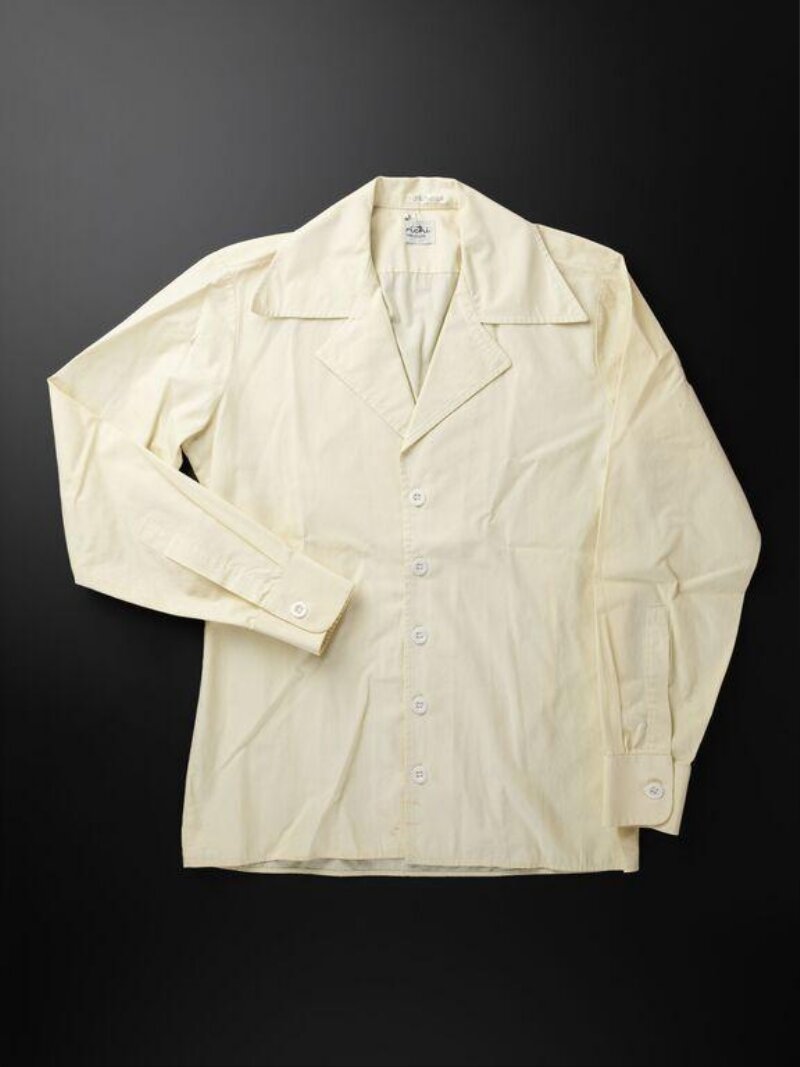
Couture Archaeology Report: Ref. 1974-01
Subject: Asymmetric Draped Chiffon Evening Gown with Beaded Bodice
Origin: Paris, Autumn-Winter 1974 Haute Couture Collection (House Attribution Withheld per Client NDA).
Senior Textile Historian: Natalie Fashion Atelier Archive & Research Division.
Report Purpose: To deconstruct the technical, material, and philosophical essence of the subject garment, providing a foundational blueprint for its translation into the 2026 high-end luxury silhouette lexicon.
1. Technical Deconstruction & Structural Analysis
The 1974 subject represents a pinnacle of apparent effortlessness concealing extreme technical rigor. Its form is an essay in controlled fluidity. The silhouette is built upon a foundational sheath of silk crepe, meticulously bias-cut to follow the body's natural curves without constraint. This internal architecture provides a stable canvas for the exterior spectacle.
The defining asymmetric drape is not a casual arrangement but a complex system of engineered folds. Each cascade from the right shoulder is anchored through a series of internal thread chains, tiny silk-covered weights, and strategic bias seams within the chiffon itself. The drape's trajectory—over the shoulder, across the torso, and into the skirt's volume—is pre-determined by these hidden directives. Of particular note is the single internal pivot point located at the natural waist on the left side. This allows the entire draped element to move as a unified, kinetic entity with the wearer, rather than shifting or collapsing. The skirt incorporates a partial circular cut on the left side only, creating an imbalance of volume that counterbalances the shoulder drape, achieving dynamic equilibrium.
2. Material Materiality & Artisanal Hand
The material selection is a deliberate dialogue between weightlessness and density, transparency and opacity.
Bodice: The beaded bodice utilizes a silk georgette base, chosen for its slight tooth and tensile strength to support the beadwork. The bead embroidery is executed in a gradated density technique. At the neckline and over the bust, beads are applied singly (à l'aiguille) onto the georgette, creating a sheer, skin-like effect. This density increases towards the waist, transitioning into tambour-beaded motifs on a separate silk organza substrate, which is then applied to the bodice. This method prevents distortion and allows for precise, complex floral motifs. The beads themselves are a mix of Japanese glass seed beads, antique ivory faceted crystals, and irregular freshwater pearls, providing a textural, luminous depth impossible with uniform modern beads.
Chiffon Drape & Skirt: The silk chiffon is of exceptional quality, with a higher thread count and weight (approximately 12 momme) than contemporary equivalents. This gives it a sculptural fall rather than a mere flutter. The hem is finished with a hand-rolled edge of minuscule depth (1mm), a signature of haute couture that allows the fabric to terminate without visual weight. The colour, a twilight mauve, is achieved through a custom dye lot involving multiple dips to create a chromatic variation within the single piece, enhancing the drape's three-dimensional illusion.
3. Philosophical Core: The 1974 Dialectic
The garment exists at a specific historical crossroads. It embodies a dialectic between romanticism and modernism. The draped, Grecian-inspired form speaks to a post-1960s romantic yearning, while the stark asymmetry, precise engineering, and exposed zip closure (concealed within a seam of the drape) are unequivocally modern. It reflects a wearer who is both ethereal and assertive. Furthermore, it champions the individuality of the single form; the drape is designed to respond uniquely to the proportions of its intended wearer, making it a portrait, not merely a dress.
4. Translation to 2026 High-End Luxury Silhouettes
The translation for 2026 must move beyond pastiche. It requires extracting the core principles and re-engineering them through a contemporary technological and philosophical lens.
4.1. Technical Translation
The hidden structural system will be reimagined using smart material interfaces. Biodegradable shape-memory polymers, embedded as fine filaments within bias seams, could replace thread chains, allowing for dynamic re-draping via thermal or kinetic response. The internal pivot point could be augmented with a micro-magnetic closure system, enabling modular attachment of different draped elements—a single base sheath could host multiple "drape narratives." 3D laser scanning and digital drape simulation will allow us to pre-visualize the asymmetric balance on avatars, perfecting the 1974 intuition with algorithmic precision.
4.2. Material & Artisanal Evolution
The material dialogue will be elevated through biotech and circular luxury. The silk chiffon will be replaced with a lab-grown silk alternative with engineered hydrophobic or photochromatic properties, offering new functional narratives. The beaded bodice inspires a shift towards tactile surface modulation. We propose using artisanal beadwork not as all-over coverage, but as a topographical map on a base of innovative materials—such as mushroom leather or recycled ocean plastics transformed into a luxurious matte jersey. Beads could be interspersed with biodegradable sequins grown from algae and ceramic micro-discs, creating a sustainable yet profoundly textural surface. The gradation technique will be applied to density of texture, not just sparkle.
4.3. Silhouette & Philosophical Translation for 2026
The 2026 silhouette will absorb the 1974 dialectic into a new statement on modular permanence and fluid identity. We propose a system: a foundational, bias-cut column dress in a sustainable technical textile. This acts as the "canvas." The iconic draped element is deconstructed into separate, interchangeable components—a shoulder wrap, a torso panel, a hip cascade—that attach via the hidden micro-magnetic system. This speaks to the 2026 luxury consumer's desire for versatility, personal narrative, and reduced wardrobe footprint.
The asymmetry becomes programmatic, not merely stylistic. The silhouette can be configured by the wearer to be radically different from day to evening, embodying multiple forms of modern self-expression. The romanticism is found in the handmade, topographical beadwork and the fluidity of form; the modernism is in the technical systems, sustainable materiality, and user-centric configurability.
Conclusion
The 1974 gown is not a relic but a living treatise on balance, engineering, and material poetry. For Natalie Fashion Atelier's 2026 vision, its value lies not in its specific form, but in its foundational principles: the mastery of bias, the engineering of the ephemeral, and the dialogue between material and motion. By transposing these principles through the lenses of sustainability, smart technology, and modularity, we can create a new haute couture language—one that honors the profound handwork of the past while speaking unequivocally to the conscious, innovative luxury of the future. The 1974 silhouette thus becomes a deep-rooted seed from which the 2026 collection will grow, bearing fruit that is both recognisably descended from and radically evolved beyond its origin.