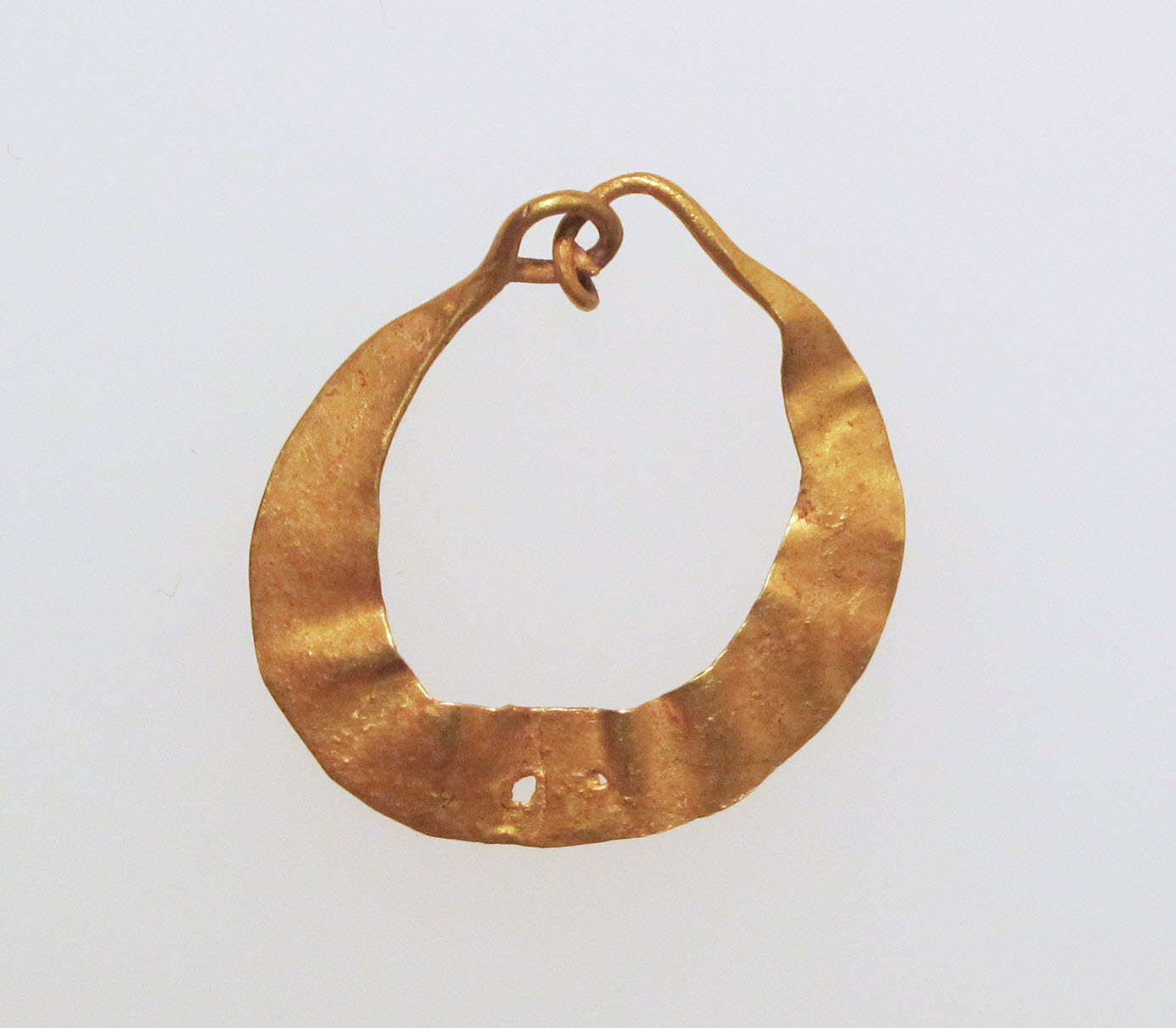
Archival Resonance: The Crescent Earring as a Threshold Object
The crescent earring, in its purest gold iteration, occupies a liminal space within the Natalie Fashion Atelier archive. It is not merely a decorative appendage but a threshold object—a bridge between the tactile memory of ancient craftsmanship and the structural logic of 2026 haute couture. Our archival node, referencing the duality of a polished silver mirror inlaid with gold palmettes and a sarcophagus relief narrating a life cycle, establishes a profound dialectic. The crescent form, suspended between heaven and earth, becomes a vessel for this tension: the reflective surface versus the narrative depth. For the 2026 silhouette, this translates into a binary materiality where gold is not a uniform finish but a conceptual pivot between luminosity and gravitas.
Deconstructing the Classical Crescent: Geometry and Gesture
Historically, the crescent earring appears across civilizations—from Sumerian lunulae to Etruscan bullae, from Hellenistic goldsmithing to Mughal jadau. Yet, its classical elegance is predicated on a deceptive simplicity: a pure geometric arc that defines the negative space of the ear. In our atelier, we deconstruct this by interrogating the crescent’s structural anatomy. The 2026 interpretation abandons the uniform thickness of traditional goldsmithing. Instead, we introduce a gradated profile—the crescent’s apex is rendered in a 22-karat gold alloy with a brushed, matte finish, while the tapering tips are polished to a mirror sheen. This gradient mimics the light absorption of the archival mirror, creating a visual tension between absorption and reflection. The silhouette of the earring is no longer a static curve but a dynamic vector that guides the eye along a path of variable luminosity.
This deconstruction informs the 2026 high-end silhouette through the principle of asymmetric equilibrium. The crescent, when scaled to a pendant or an architectural collar, becomes a structural yoke that redefines the shoulder line. In our forthcoming collection, a gold crescent yoke, forged from a single sheet of 18-karat gold, is articulated with a hidden hinge system. This allows the wearer to adjust the curvature, altering the silhouette from a sharp, angular shoulder to a soft, draped crescent that echoes the lunar phase. The historical resonance is clear: the earring’s gesture of framing the face is translated into a garment’s gesture of framing the torso. The gold is no longer a surface but a structural membrane that mediates between the body and the surrounding space.
Materiality: Gold as Narrative and Structural Logic
Gold, in the context of this archive, is not a mere precious metal. It is a narrative substrate. The archival mirror presents gold as an inlay within silver—a contrast of warm and cool, of permanence and ephemerality. For the 2026 silhouette, we adopt a composite gold technique that layers 24-karat gold leaf over a base of oxidized silver. This creates a surface that is simultaneously ancient and futuristic, where the gold appears to emerge from a patinaed depth. The crescent earring, when scaled to a bodice or a sleeve, becomes a cartographic element—a map of wear and time. The gold leaf is applied in irregular, overlapping strokes, reminiscent of the palmettes on the mirror, while the underlying silver base is etched with micro-reliefs that narrate a personal history, much like the sarcophagus.
From Ear to Epaulette: Scaling the Crescent for 2026 Silhouettes
The translation of the crescent earring into a 2026 high-end silhouette requires a rigorous scaling logic. The earring’s intimate scale—its relationship to the ear, the jawline, the neck—must be preserved while expanding its architectural presence. We achieve this through proportional amplification. The crescent’s chord length, typically 3 to 5 centimeters, is multiplied by a factor of 8 to 12 for a shoulder piece, while maintaining the same ratio of thickness to arc. This ensures that the visual weight of the gold remains balanced, avoiding a monolithic appearance. The result is a floating crescent that hovers over the shoulder, attached only at the clavicle point via a concealed magnetic clasp. The silhouette is thus defined by negative space—the void within the crescent becomes as significant as the gold itself.
This approach directly references the archive’s duality: the mirror’s reflective surface and the sarcophagus’s carved relief. The gold crescent, when worn, reflects the environment (mirror) while its etched interior tells a story (relief). For the 2026 atelier, we have developed a dual-surface technique where the exterior of the crescent is polished to a high gloss, and the interior is hand-chased with a continuous narrative line. This line, inspired by the palmettes and life-cycle motifs, is rendered in a subtle, almost invisible relief that only reveals itself under raking light. The silhouette of the garment—whether a coat, a cape, or a gown—is thus animated by this hidden detail, inviting the observer to move closer, to engage with the materiality.
Technical Synthesis: The 2026 Crescent Silhouette
The culmination of this research is a signature silhouette for Natalie Fashion Atelier’s 2026 haute couture collection: the Crescent Armure. This is a sleeved gown where the sleeve itself is constructed as a series of overlapping gold crescents, each articulated with a micro-hinge system. The crescents are graded in size from the shoulder to the wrist, creating a visual rhythm that echoes the lunar cycle. The gold is used sparingly—each crescent is a hollow form, fabricated from 0.3mm gold sheet, ensuring the garment remains wearable. The interior of each crescent is lined with a liquid silver silk, which catches the light and creates a secondary reflection, mirroring the archival mirror’s duality.
Construction Methodology and Silhouette Impact
The construction of the Crescent Armure involves a parametric design process. Each crescent’s curvature is calculated based on the wearer’s anthropometric data, ensuring a perfect fit. The hinges are crafted from platinum, chosen for its strength and subtle color contrast. The silhouette is defined by a cascade of arcs that break the traditional line of the arm, creating a fragmented, sculptural form. This fragmentation is intentional: it references the broken lines of the sarcophagus relief, where the narrative is told in fragments. The overall effect is a silhouette that is both classical and avant-garde—a nod to the historical crescent earring, but reimagined for a future where jewelry and garment are inseparable.
The gold, in this context, serves as a unifying element. It is not applied as a decoration but as the primary structural logic. The crescent’s arc, repeated and scaled, becomes the grammar of the silhouette. The 2026 high-end consumer is not merely wearing a garment; they are inhabiting a golden architecture that dialogues with millennia of craftsmanship. The crescent earring, once a personal adornment, has been transformed into a spatial experience—a threshold between the body and the world, between the polished surface and the narrative depth. This is the essence of our atelier’s research: to extract the universal from the specific, to let a single earring inform an entire silhouette.