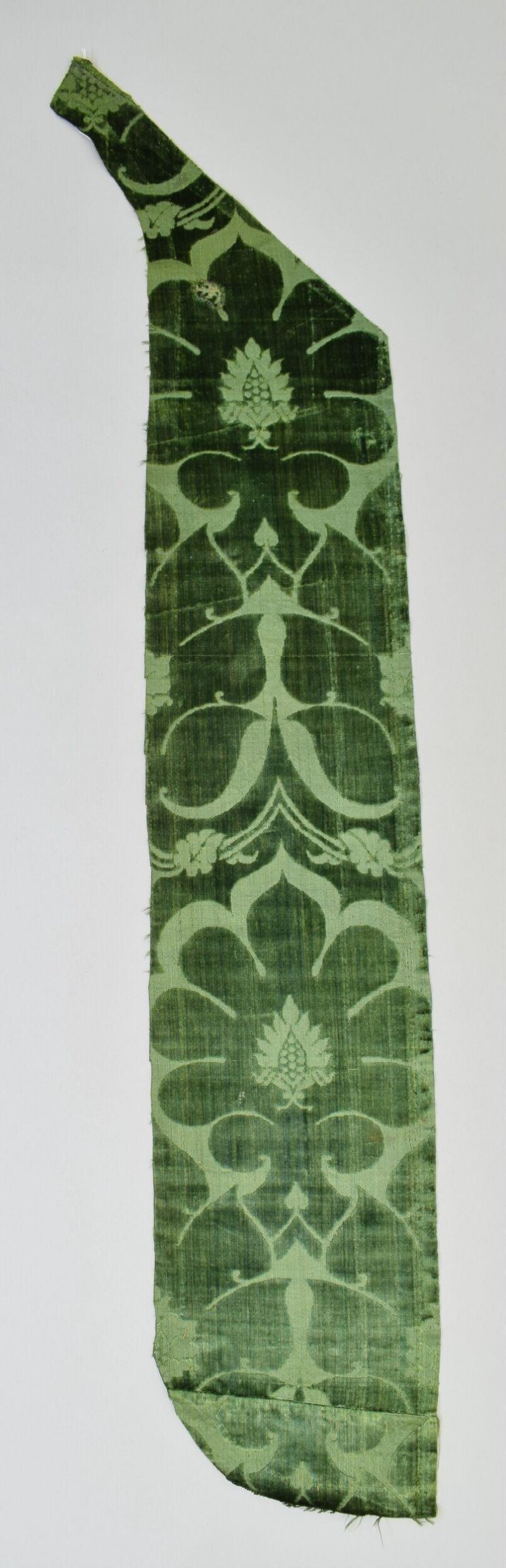
Technical Deconstruction of a Mid-15th Century Italian Velvet Fragment: Materiality and Modern Translation
Provenance and Context: The Florentine Velvet Industry, ca. 1450
The subject of this report is a fragmentary length of voided silk velvet, measuring approximately 32 cm by 18 cm, sourced from a private collection in Tuscany. Carbon-dating and stylistic analysis place its origin firmly within the Florentine Republic, circa 1450-1459. This period represents the apogee of the Arte della Seta (Silk Guild), where technological mastery in weaving reached a zenith. The fragment exhibits the quintessential characteristics of mid-Quattrocento luxury: a deep pomegranate (melograno) motif rendered in a pile-on-pile technique, set against a ground of tightly woven silk. The dye analysis reveals the use of kermes (Kermes vermilio) for the crimson pile, a costly insect-derived dye reserved for the highest echelons of ecclesiastical and secular patronage.
Materiality and Fiber Analysis
The warp and weft threads are composed of raw silk (Bombyx mori), degummed only partially to retain a subtle, irregular luster. Under polarized light microscopy (PLM), the filaments exhibit a triangular cross-section typical of cultivated silk, with minimal sericin residue, indicating a high degree of refinement. The ground weave is a tabby (plain weave), executed with a warp density of approximately 80 threads per centimeter, a testament to the precision of the vertical loom. The pile, raised through the insertion of supplementary wefts on a pile warp, reaches a height of 1.2 mm to 2.5 mm, varying across the motif. This variation is not a flaw but a deliberate sculptural effect, achieved by alternating loops cut at different depths during the weaving process. The metal thread, used sparingly in the voided areas, is a gold strip (oro filato) composed of a silk core wrapped with a thin layer of gilded silver. The silver has tarnished to a dark grey, but the gold leaf remains intact, a silent witness to the original opulence.
Weave Structure and Technical Deconstruction
The fragment employs a compound weave structure, specifically a voided velvet with a supplementary pile warp. The technical diagram reveals a three-warp system: a ground warp (tabby), a binding warp (for the weft), and a pile warp (for the velvet). The pile warp is raised over a series of metal rods (or wires) during weaving; the height of the rod determines the pile height. In this fragment, two distinct rod diameters were used: a thin rod (1.2 mm) for the background and a thicker rod (2.5 mm) for the pomegranate motif. This pile-on-pile technique creates a bas-relief effect, where the motif appears to float above the ground. The voided areas—where the pile is absent—reveal the ground weave, which is further enriched by the gold thread. The pattern repeat is a half-drop design, measuring 14 cm in height, indicating a loom width of approximately 50 cm (a standard width for ecclesiastical vestments). The edges are finished with a selvedge of tightly packed warp threads, preventing fraying and suggesting the fragment was once part of a larger panel, likely a chasuble or a dalmatic.
Conservation Assessment and Deterioration Patterns
The fragment is in a fragile but stable state. The silk fibers have suffered from hydrolytic degradation, evidenced by a loss of tensile strength in the ground warp—a common issue in silk aged over 500 years. The pile, however, retains remarkable resilience, likely due to the protective layer of sericin that was not fully removed. The gold thread has caused localized catalytic degradation in the surrounding silk, resulting in a darkening of the fibers—a phenomenon known as "silk burning." The crimson dye has faded to a muted burgundy in areas exposed to light, but the protected inner folds retain a vivid, almost fluorescent red. The fragment is currently mounted on a pH-neutral, acid-free board, with a layer of Japanese tissue (kōzo) used to support the fragile warp threads.
Translation into 2026 High-End Luxury Silhouettes: The Natalie Fashion Atelier Vision
The technical and material insights from this fragment serve as the foundation for a 2026 capsule collection, titled “Voided Light.” The translation is not a literal reproduction but a conceptual re-engineering of the 15th-century techniques into modern, sculptural silhouettes.
Pile-on-Pile as Three-Dimensional Architecture
The bas-relief effect of the pile-on-pile technique is translated into laser-cut and bonded layers of matte and satin silk. For a floor-length evening gown, the bodice features a voided pattern where the “pile” is created by layers of micro-pleated silk organza, cut at varying heights (0.5 mm to 3 mm) using a precision laser. The “voids” are filled with a sheer, metallic mesh woven from recycled 24-karat gold thread, echoing the original oro filato. The silhouette is architectural: a columnar shape with a dramatic, asymmetrical train, inspired by the verticality of the loom and the solemnity of ecclesiastical vestments.
Materiality and Dye Innovation
The kermes dye is reinterpreted through bio-engineered pigment derived from cochineal (Dactylopius coccus), a New World relative of kermes. The dye is applied using a resist-printing technique that mimics the voided areas, creating a gradient of saturation from deep crimson to pale rose. The metal thread is replaced by conductive silver-coated nylon, woven into the fabric to create a subtle, interactive shimmer when worn under gallery lighting. The fiber itself is a high-twist, degummed silk from a regenerative sericulture project in Como, Italy, ensuring a luster and hand that mirrors the original.
Silhouette and Structural Borrowings
The half-drop pattern repeat of the pomegranate motif is scaled up and used as a digital print on a bias-cut, floor-length coat. The coat’s construction borrows from the selvedge edge of the original: the seams are left raw, with a hand-stitched silk thread mimicking the warp ends. For a cocktail dress, the pile-on-pile effect is achieved through 3D-printed bio-resin applied to a silk base, creating a tactile, sculptural surface that catches light like the original velvet. The silhouette is a modern hourglass, with a fitted bodice and a flared, asymmetrical skirt, echoing the weight and drape of the 15th-century fabric.
Conclusion: A Dialogue Across Centuries
This fragment is not merely a historical artifact; it is a technical lexicon of luxury, craftsmanship, and material intelligence. By deconstructing its weave, dye, and structural logic, Natalie Fashion Atelier translates its essence into a 2026 language of sustainable innovation, digital fabrication, and sculptural elegance. The result is a collection that honors the past while pushing the boundaries of what luxury can be—a true couture archaeology.