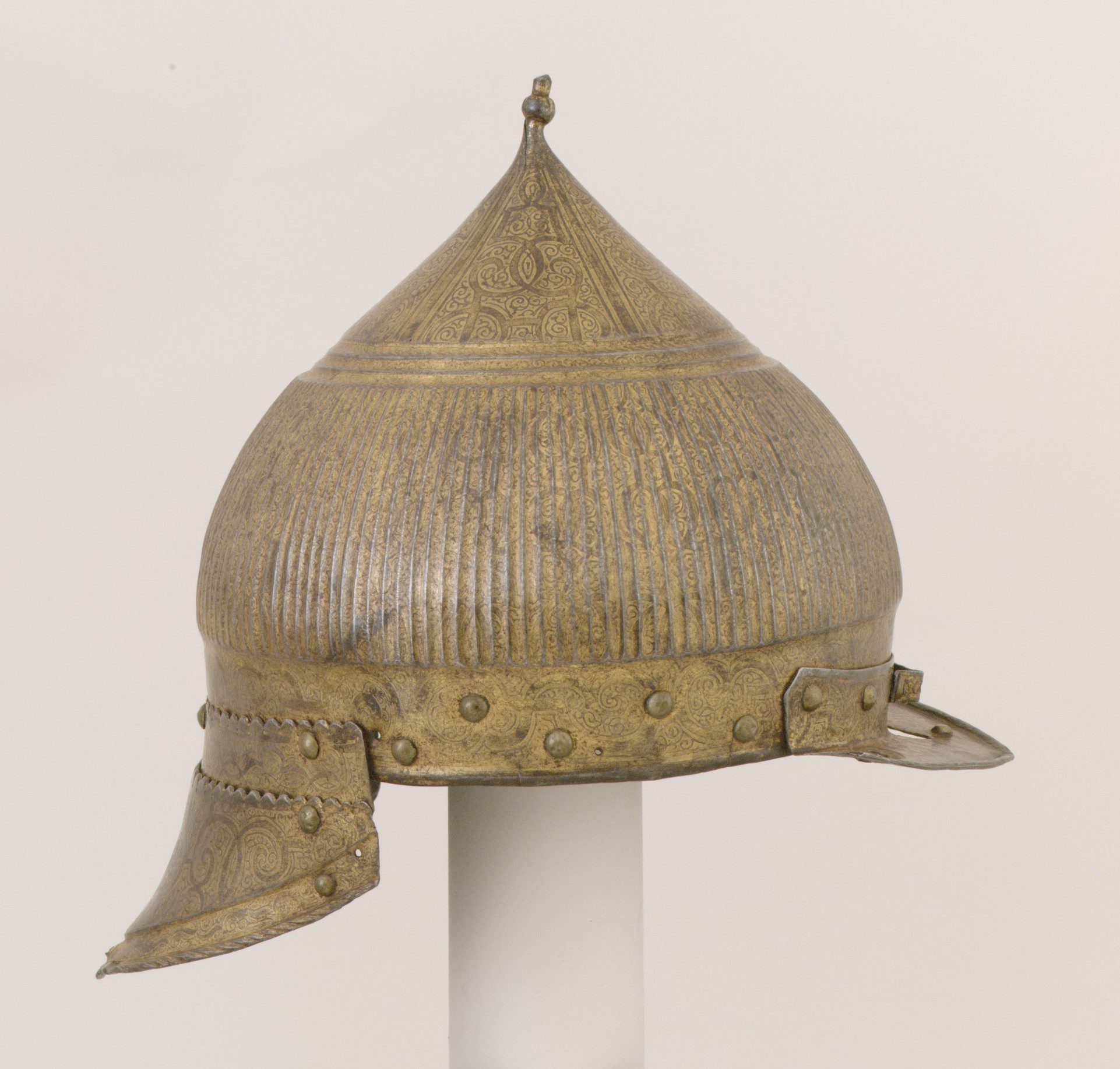
Deconstructing the Zischägge: An Aesthetic Archaeology of Steel, Gold, and Brass for 2026
The burgonet in the oriental fashion, known as the Zischägge, represents a singular moment in the history of defensive armor where martial function met an almost theatrical orientalism. For Natalie Fashion Atelier, this artifact—a German interpretation, likely from Nuremberg, of a Persian-inspired helmet—is not merely a historical curiosity. It is a masterclass in the tension between austere protection and ornamental excess. The 2026 luxury silhouette, as we envision it, must be forged from this same dialectic: a structure that guards the form while simultaneously adorning it with the weight of history. This research artifact deconstructs the Zischägge’s materiality—steel, gold, brass—to extract a lexicon of form, texture, and silhouette that will define the coming season.
I. The Armature of Austerity: Steel as Structural Drape
The Zischägge’s foundational material is steel, cold-forged into a dome that follows the natural curve of the skull. In the context of 2026 haute couture, steel is not worn; it is translated into a structural language of compression and release. The helmet’s rigid, unyielding crown informs a silhouette where the upper torso is encased in sculpted, architectural forms.
We observe the skull-piece of the Zischägge: a single, hammered hemisphere. This translates into a high, closed neckline that acts as a steel collar, framing the face with an almost severe purity. The 2026 interpretation will feature boned, resin-infused silk that mimics the patina of aged steel—a deep, gunmetal grey with a matte, almost dusty finish. The silhouette is monolithic, a column from the jawline to the shoulder, creating a powerful, protective base. This is the armature of austerity, a foundation upon which ornament is layered.
Further, the visored peak of the Zischägge, which projects forward to shield the eyes, becomes a cantilevered shoulder or a sculptural lapel. In the 2026 silhouette, this translates to a sharp, forward-thrusting line that breaks the verticality of the body. It is a gesture of defiance, a shield against the gaze. The steel’s rigidity is preserved in the cut: zero-give tailoring using micro-ceramic threads woven into a double-faced wool, creating a surface that resists drape and holds its own geometry. This is not fabric that flows; it is fabric that stands.
II. The Gilding of Power: Gold as an Accent of Authority
Where steel provides the structure, gold provides the narrative. On the Zischägge, gold is not applied liberally; it is used in etched bands and gilded rivets, tracing the seams and edges of the helmet. This is a crucial lesson for 2026: gold is not a surface, but a line of demarcation.
The gilded brass comb that runs from the brow to the nape of the neck on the Zischägge is our primary reference. In the 2026 silhouette, this becomes a continuous, raised seam of gold-lamé thread, embroidered directly onto the steel-grey silk. It traces the spine of the garment, from the back of the neck to the hem, creating a vertical axis of power. This is not decoration; it is a structural and symbolic spine, a line of strength that organizes the entire form.
Furthermore, the gilded brass rosettes that secure the helmet’s cheek-pieces inspire a new vocabulary of functional jewelry. In our 2026 collection, these will manifest as articulated gold-plated brass grommets that serve as both closures and pivot points. They will appear at the shoulder, the hip, and the wrist, allowing the rigid steel-inspired fabric to be cinched or released, creating a dynamic silhouette that can shift from a closed, protective form to an open, revealing one. The gold is the hinge of the garment, the point where structure becomes movement.
III. The Patina of History: Brass as a Textural Counterpoint
The third material, brass, is the most complex. In the Zischägge, brass is often found in the rivets and scales of the articulated neck-guard (the gorget). It is a material of utility and aging, developing a deep, dark patina over centuries. For the 2026 silhouette, brass is the textural anchor, the element that prevents the collection from becoming sterile or purely sculptural.
We extract the articulated scale of the gorget. This becomes a lattice of overlapping brass-toned sequins, hand-set onto a sheer, black silk tulle. These are not shiny, new sequins; they are oxidized and distressed, chemically treated to mimic the verdigris and tarnish of a museum piece. This texture is applied to the undersides of sleeves or the inner lining of a jacket, visible only in motion—a secret history revealed when the wearer moves.
The brass also informs the weight of the silhouette. The Zischägge’s brass fittings are heavy, grounding the helmet. In the 2026 garment, this translates to internal weighting using brass chain-links sewn into the hems. This creates a gravity-defying drape where the fabric falls with a deliberate, slow heaviness, as if resisting the air itself. The silhouette becomes magnetic, pulled toward the earth, a counterpoint to the upward thrust of the gold spine. The brass is the memory of the forge, the weight of time.
IV. Synthesis: The 2026 Silhouette as a Forged Object
The final silhouette for 2026, derived from the Zischägge, is not a costume. It is a forged object for the body. It begins with a rigid, high-collared base in matte, steel-grey fabric, establishing a powerful, protective foundation. From this base, a single, gilded seam rises along the spine, tracing the line of authority. The silhouette is then articulated by brass-toned, oxidized scales that appear at the shoulders and hips, offering a textural counterpoint of age and utility.
The key architectural elements are:
The Cantilevered Peak: A sharp, forward-projecting shoulder or lapel, derived from the visor, creating a silhouette of defensive elegance.
The Articulated Spine: A continuous line of gold-lamé embroidery that structures the back, a vertical axis of power.
The Patinated Underlayer: A secondary skin of oxidized brass scales, visible only through movement or deliberate exposure, a secret history.
The Weighted Hem: Internal brass chains that give the garment a slow, deliberate fall, grounding the silhouette in the materiality of history.
This is a silhouette of controlled power. It is not soft, not flowing, but composed. It borrows the Zischägge’s fundamental paradox: a tool of war that is also a masterpiece of aesthetic intent. For Natalie Fashion Atelier, the 2026 collection will not merely reference the past; it will reforge it, using steel, gold, and brass as a grammar for a new, armored elegance.