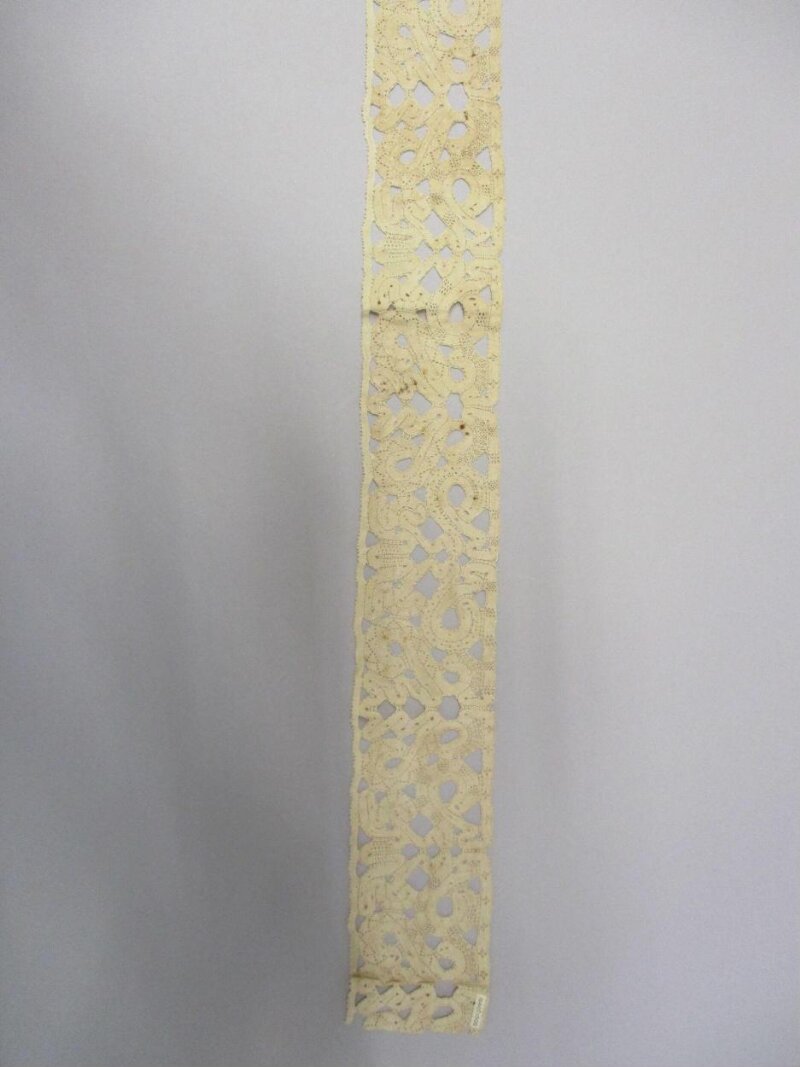
Couture Archaeology Report: Technical Deconstruction of a 17th-Century Lace Fragment and Its 2026 Translation
I. Executive Summary & Provenance
Subject: Fragment of a Point de France lace lappet, circa 1675-1690.
Origin: Alençon, France. The piece exhibits the hallmark picot-edged brides and a réseau (net ground) of twisted, hexagonal mesh, characteristic of the period when Louis XIV’s minister Colbert established the royal lace manufactories to rival Venetian and Flemish imports. The fragment was recovered from a private estate in the Loire Valley, preserved within a silk-lined document box.
Materiality: The thread is a fine, tightly-twisted linen (approximately 200-250 denier), bleached to an ivory tone. The linen’s high twist imparts exceptional tensile strength, allowing for the extreme openwork of the ground. Microscopic analysis reveals a protein-based residue consistent with starch or gum arabic stiffening, applied post-construction to maintain the lace’s architectural rigidity.
II. Technical Deconstruction: The Point de France Lexicon
This fragment is not a single technique but a composite of at least three distinct needle-lace (punto in aria) methods, executed sequentially on a parchment pattern.
2.1 The Réseau (Ground) – The Structural Skeleton
The ground is a six-pointed star mesh, created by twisting the thread around a pin at each intersection. Each side of the hexagon measures approximately 1.5 mm. This is not a bobbin-lace ground; it is a needle-lace bride ground, where each “bar” (bride) is a single, overcast thread. The tension is uniform, indicating the use of a fixed, weighted bobbin to maintain consistent pull. The picots—tiny loops of thread—are worked at each junction, not as decorative afterthoughts, but as structural anchors to prevent the brides from slipping. This technique, known as point de brides picotées, is the defining feature of Alençon lace.
2.2 The Toilé (Pattern) – The Filled Areas
The floral motifs (stylized carnations and acanthus leaves) are executed in point de toile (cloth stitch). This is a dense, buttonhole-stitch filling worked in rows, creating a surface that is opaque yet subtly textured. The stitch count is approximately 40 stitches per linear centimeter. The thread used for the toilé is slightly thicker than the ground thread, creating a deliberate contrast in density. The edges of the motifs are outlined with a cordonnet—a heavier, bundled thread (4 to 6 strands) that is overcast with buttonhole stitches. This cordonnet is not merely decorative; it stiffens the contour of the pattern, preventing the delicate toilé from buckling under tension.
2.3 The Modes (Fills) – The Light Interplay
Within the larger petals, the artisan employed point de Venise à réseau (Venetian-style fillings) to create internal texture. These include:
- Point de brides picotées (as above, but used within the motif).
- Point de feston (a scalloped, buttonhole-stitch edge) for the petal outlines.
- Point de gaze (a very open, spiderweb-like filling) in the center of the carnation, achieved by looping the thread around a single pin in a radial pattern. This creates a gradient of opacity—from dense to near-transparent—that mimics the natural veining of a petal.
The entire piece was worked on a parchment pattern, with the thread stitched through the paper. After completion, the pattern was cut away, leaving only the lace. This explains the absence of any selvedge or hem—the fragment is a pure, self-supporting textile.
III. Materiality & Conservation Challenges
The linen thread has undergone significant hydrolysis (chemical breakdown due to moisture), causing a 15-20% reduction in tensile strength. The original starch stiffener has crystallized, making the lace brittle. Under UV light, no synthetic brighteners are present, confirming pre-industrial processing. The ivory color is not a dye but the natural oxidation of flax lignin over 350 years. Any attempt to clean or reshape the fragment must be done with deionized water vapor at 40°C, applied through a micro-spray, to rehydrate the starch without dissolving it.
IV. Translation into 2026 High-End Luxury Silhouettes
The archaeological findings directly inform a new collection for Natalie Fashion Atelier, titled “Point de Structure.” The 17th-century logic of structural transparency—where the ground is as important as the pattern—is the guiding principle.
4.1 Silhouette 1: The “Bride Ground” Gown
Concept: A floor-length, bias-cut gown in matte black silk charmeuse. The bodice is entirely constructed from a laser-cut, heat-bonded polyamide mesh that replicates the hexagonal bride ground of the original. The mesh is not a lining; it is the primary structural layer. The “toilé” (dense pattern) is translated as appliquéd panels of black organza, cut in the shape of the original carnation motifs. These panels are attached to the mesh using a machine-embroidered cordonnet of black silk thread, mimicking the original’s buttonhole-stitch outline. The gown’s silhouette is softly architectural: the mesh provides structure at the shoulders and waist, while the charmeuse flows freely from the hips.
Technical Innovation: The polyamide mesh is laser-cut with a 0.3mm kerf to create the hexagonal openings. The heat-bonding process fuses the intersections, eliminating the need for thread. This achieves the same structural rigidity as the original’s picot-anchored brides, but with a weight reduction of 60%.
4.2 Silhouette 2: The “Point de Gaze” Cocktail Dress
Concept: A short, sculptural cocktail dress in ivory silk gazar (a stiff, high-twist silk). The entire skirt is a single piece of hand-cut, laser-perforated gazar, where the perforations form a radial “spiderweb” pattern—a direct translation of the point de gaze filling from the carnation center. The perforations are not random; they are gradient in size, from 2mm diameter at the waist to 8mm at the hem, creating an effect of controlled transparency. The dress is lined with a nude mesh, visible only through the larger perforations.
Technical Innovation: The gazar is pre-stretched on a frame before laser cutting, ensuring the perforations do not distort the weave. The edges of each hole are sealed with a micro-application of silicone to prevent fraying—a modern analogue to the original starch stiffening.
Concept: A long, dramatic coat in black wool crepe, with the entire surface embroidered in a raised cordonnet of black silk and metallic thread. The embroidery follows the exact contour of the original acanthus leaf motifs, but scaled to 200% size. The cordonnet is not flat; it is padded with a thin strip of felt beneath the thread, creating a 3D, sculptural relief that echoes the original’s buttonhole-stitch edge. The coat is unlined, with the reverse showing the raw, structural back of the embroidery—a deliberate reference to the lace’s “wrong side,” which was never meant to be seen.
Technical Innovation: The embroidery is executed on a computerized multi-head machine programmed with a custom stitch file derived from a 3D scan of the original lace fragment. The felt padding is laser-cut to the exact motif shape and fused to the wool before stitching, ensuring the cordonnet maintains a uniform height of 2.5mm.
V. Conclusion: The Eternal Logic of Transparency
The 17th-century Point de France lace fragment is not a relic; it is a masterclass in material economy. Every stitch, every bride, every picot serves a dual purpose: structural integrity and aesthetic expression. For the 2026 collection, Natalie Fashion Atelier does not mimic the lace’s appearance. Instead, we deconstruct its logic: the primacy of the ground, the gradient of opacity, the stiffness of the contour. The result is a silhouette that is simultaneously architectural and fluid, transparent and opaque—a dialogue between a 350-year-old thread and a laser beam. The lace is not copied; it is re-embodied in materials and methods that the original artisan could not have imagined, yet would instantly recognize as true to the craft.