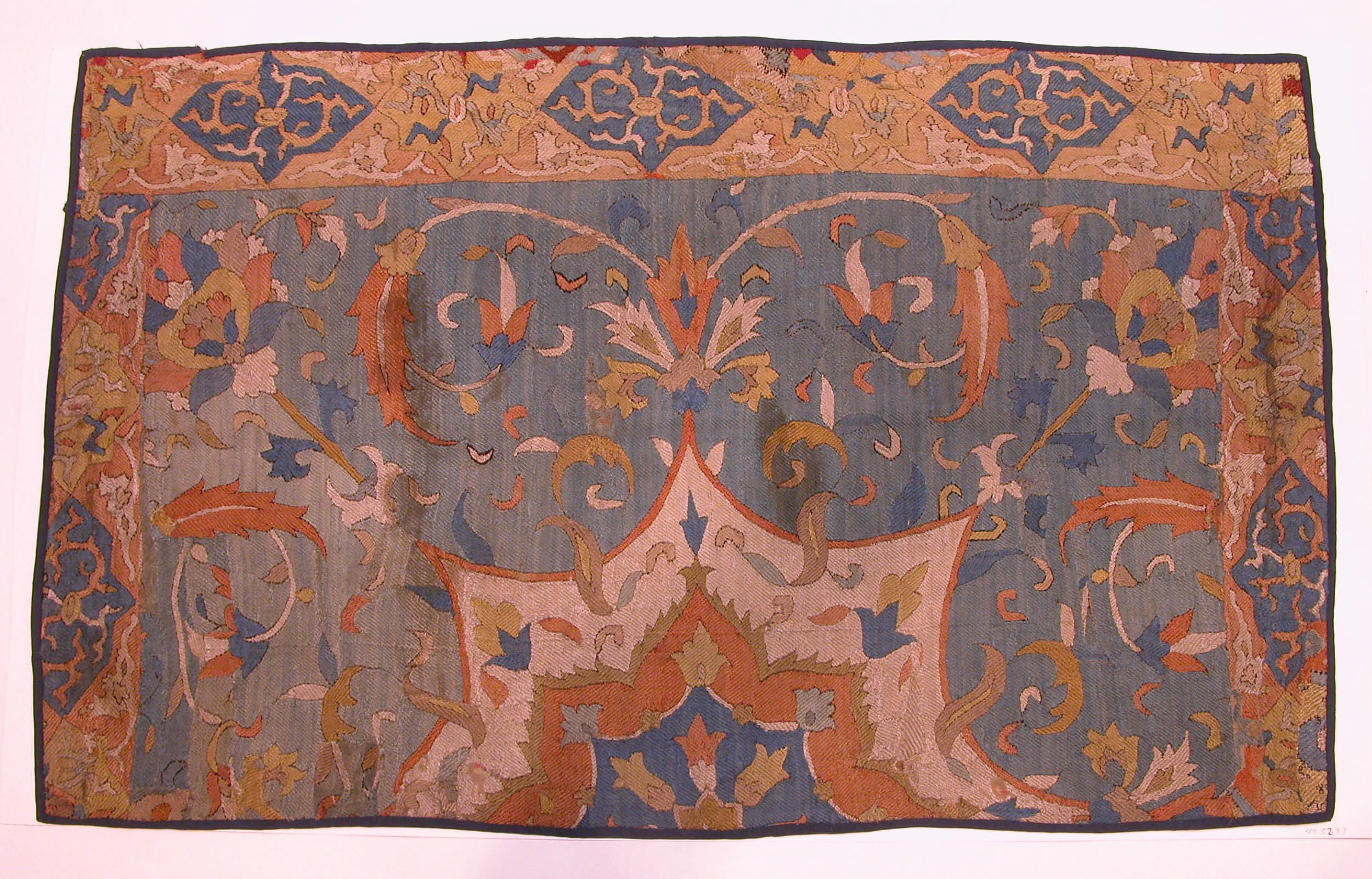
Fragment of a Cover: An Archaeology of Concealed Grandeur
Within the archival silence of the atelier, certain artifacts speak not through their totality, but through their eloquent ruin. This Fragment of a Cover, a dissociated patrimony of undetermined provenance, exemplifies this principle. Its heritage is global precisely because it is untraceable, a nomadic aesthetic freed from specific cultural dogma. Its materiality—a foundational ground of linen meticulously embroidered with silk—presents a dialectic of humility and opulence, structure and fluidity. Isolated from its original context, this fragment ceases to be a mere textile and becomes a pure architectural proposition for the body. Our aesthetic archaeology does not seek to reconstruct its past function, but to extrapolate its inherent principles: the classical elegance born from material contrast, the narrative depth of embroidery, and the sophisticated play between concealment and revelation. These principles form the core lexicon for Natalie Fashion Atelier's 2026 silhouette prophecy, moving beyond retrospection into a future of intelligent, emotionally resonant luxury.
Deconstruction of a Classical Dialectic: Linen & Silk as Architectural Theory
The fragment’s material dichotomy is its first masterclass. Linen, one of the oldest woven textiles, provides a taut, geometric canvas. Its inherent crispness and slight rigidity suggest form, discipline, and a candid honesty. Against this, the silk embroidery performs as a liquid event—a flowing, luminous script that defies the grid of the warp and weft. This is not mere decoration; it is a volumetric intervention. The raised threads of silk chenille or passing thread create a topography of their own, casting micro-shadows and capturing light in a manner that flat fabric cannot. This dialogue between the structured ground and the organic, eruptive embellishment informs a 2026 silhouette philosophy we term "Structured Fluidity". Forthcoming collections will manifest this through gowns with severe, linen-inspired tailoring in the bodice—sharp, almost architectural bustiers or columnar sheaths—that then dissolve into skirts or trains where the silk embroidery escapes its confines. The embroidery itself becomes the fabric, growing in density and dimension to create fluid, cascading forms that appear to generate from within the structure itself.
The Embroidery as Cartography and Silhouette Generator
Isolated from its original whole, the embroidery on the fragment must be read as an autonomous map. Its motifs, perhaps floral or geometric, are partially lost to the frayed edge, inviting completion not in replication, but in ideation. This incomplete narrative is critical for 2026, where luxury demands personal interpretation and a sense of discovery. Technically, this informs a move towards "asymmetric cartography" in embellishment. Instead of all-over, symmetrical patterns, embroidery will be deployed as a directional force on the silhouette. It may begin as a dense, three-dimensional cluster at one hip, mapping a path across the torso with diminishing intensity, or flow from a single shoulder down the arm like a sculptural vine. The embroidery’s role shifts from surface application to silhouette sculptor. By using varying densities and techniques—from delicate *satin stitch* to pronounced *stumpwork*—the embroidery itself will manipulate the drape and movement of the underlying fabric, creating intentional distortions and elegant, unpredictable volumes that are unique to each piece.
From Concealment to Strategic Revelation: The 2026 Silhouette Syntax
The very nature of a "cover" implies a function of veiling, of modest enclosure. Yet, the luxury of the materials and the artistry of its execution betray a deeper purpose: the act of covering becomes an act of ceremonious presentation. This paradox is the cornerstone of a modern, Parisian sensibility—elegance that is felt rather than displayed overtly. For 2026, this translates into silhouettes that master the grammar of revelation. The linen, with its opaque, matte integrity, will be used in high-necklines, long sleeves, and full-length skirts, establishing a premise of severe coverage. The silk embroidery, then, acts as the aperture. Through strategic placement, the embroidered areas will be executed on sheer silk georgette or organza bases, or will be meticulously cut away (a technique inspired by the fragment’s own frayed *lacuna*), creating windows to the skin. The body is not exposed, but framed by the artistry of the needle. A gown may feature a fully covered back that is entirely a masterpiece of silk embroidery, only for the design to incorporate a central spine of open-work or a sheer panel, mapping the vertebrae with elegant discretion.
Conclusion: The Fragment as Future Prototype
This linen and silk fragment, in its isolated glory, is a complete manifesto for the coming era. It teaches that true luxury resides in intelligent contradiction: raw and refined, structured and soft, concealed and revealed. For Natalie Fashion Atelier's 2026 collections, these lessons materialize as a silhouette language of architectural dresses softened by organic, topographic embroidery; of severe lines interrupted by fluid, embroidered cascades; and of a modesty that heightens sensuality through meticulous, artistic framing. The fragment’ global, context-less heritage liberates us to create a new, non-specific patrimony—one where the craftsmanship of the past directly informs the emotional and technical complexity of future desire. The cover is lifted, not to discard what was hidden, but to re-veil the body in the profound elegance of considered contradiction.