Deconstructing the Classical Silhouette: An Aesthetic Archaeology of Plate 8, “French Nobility at Church”
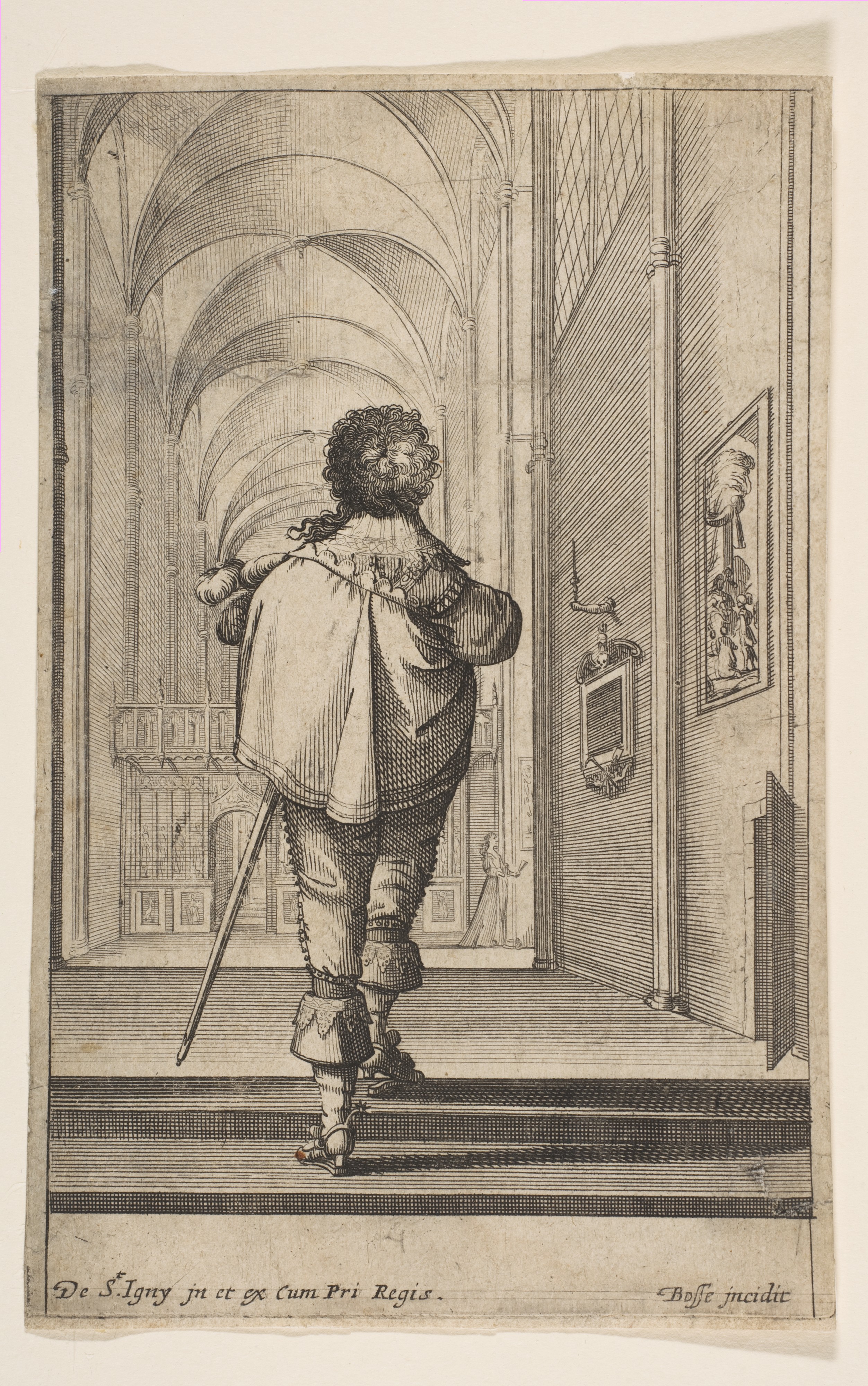
The visual artifact under examination—Plate 8 from the series “French Nobility at Church”—presents a singular, arresting composition: a gentleman, viewed from behind, in the act of entering a sacred space. This is not a portrait of a face, but a portrait of posture, of fabric, and of the unspoken dialogue between the human form and its architectural environment. For the Head Curator of Natalie Fashion Atelier, this etching is not merely a historical document; it is a masterclass in the theatricality of the back, a study in how volume, drape, and the fall of light can articulate status and intention without a single facial expression. This research artifact will deconstruct the classical elegance of this image and articulate its direct technical application to the 2026 luxury silhouette, focusing on the principles of architectural draping, negative space, and static dynamism.
I. The Subject as Sculpture: Posture and the Unseen Gaze
The gentleman’s back is the primary narrative device. His posture is one of deliberate, unhurried grace. The shoulders are set, not rigidly, but with a structural confidence that suggests a lifetime of tailored expectation. The head is slightly inclined, not in submission, but in a gesture of private reverence, creating a subtle cervical curve that breaks the vertical line of the spine. This is not a passive figure; he is a protagonist in a private ritual.
Technical Implication for 2026: The 2026 silhouette must abandon the tyranny of the front-facing garment. We will design for the secondary gaze. The back of a jacket, a coat, or a gown must become a sculptural canvas. This means engineering shoulder seams that arc backwards, creating a subtle wing-like projection that frames the nape of the neck. The armhole placement will be recalibrated to allow for a 15-degree posterior shift in the sleeve head, forcing the fabric to fall in a continuous, uninterrupted plane from the shoulder blade to the hem. This is not a jacket; it is a portable architectural niche.
II. Materiality of the Etching: Line, Light, and the Illusion of Volume
The etching medium is paramount. The artist has not used color; he has used line density. The folds of the gentleman’s coat are rendered with a series of parallel, hatched lines that create a tactile topography. The light source is implied, falling from the church’s unseen interior, casting the back of the figure into a chiaroscuro of fabric. The deepest shadows are at the waist, where the coat is cinched, and at the hem, where it brushes the ground. The lighter areas—the upper back, the shoulders—are left almost bare, suggesting a lustrous, stiff silk that catches the light.
Technical Implication for 2026: This etching dictates a monochromatic materiality for 2026. We will work with a single, rich hue—noir absolu, gris de lin, or bleu de Prusse—but the surface texture will be the true palette. The fabric must be engineered to absorb and reflect light in the same manner as the etched lines. This requires a double-faced jacquard with a matte, brushed outer face and a satin-finish inner face. The drape will be controlled by a micro-pleating technique applied to the interior of the garment, creating a permanent, subtle topography that mimics the hatched lines of the etching, visible only in motion or under directional light. The waist will be defined not by a belt, but by a structural interlining of horsehair canvas and fine steel boning, creating a corseted back that is invisible from the front, a secret of construction.
III. The Silhouette: From Etching to 2026 Haute Couture
The silhouette of the gentleman is deceptively simple. It is a single, continuous volume from the shoulders to the hem, with a subtle, almost imperceptible narrowing at the waist. This is not the exaggerated hourglass of the 19th century, nor the sharp, angular lines of the 20th. It is a liquid obelisk, a form that is both massive and fluid. The coat’s hem is not straight; it curves gently at the back, following the natural arc of the body’s movement, creating a train of fabric that is both functional and ceremonial.
The 2026 Silhouette: The “Obelisk Back”
We will translate this into a three-piece architectural coat for the 2026 collection. The construction is as follows:
- The Shoulder Yoke: A single, seamless piece of the double-faced jacquard, cut on the bias to fall from the acromion to the mid-scapula. This creates a liquid, unbroken plane that echoes the etching’s light-catching upper back.
- The Body Panel: Two panels, cut on the straight grain, seamed at the center back with a flat-felled seam that is visible only from a 45-degree angle. The waist is suppressed by a series of 1cm darts that radiate from the center back seam, creating a subtle, structured hourglass without any visible waistline interruption.
- The Hem Train: The coat’s hem is extended by 15cm at the center back, creating a gentle, asymmetrical sweep that mimics the etching’s curved hem. This train is weighted with a fine chain of oxidized silver sewn into the hem, ensuring it falls with a gravity-defying precision.
IV. The Context of Heritage: Global and Timeless
The “French Nobility at Church” series, while specific in its cultural origin, speaks to a universal language of power and reverence. The gentleman’s back is not French; it is archetypal. It represents the dignity of the private moment, the architecture of the self when no one is watching. This is the heritage we claim—not a national heritage, but a global heritage of posture. The 2026 client does not need to be French to understand the quiet authority of a perfectly cut back.
Technical Implication for 2026: The garment must be culturally neutral in its form but technically absolute in its execution. The interior construction will be a homage to the etching’s hidden complexity. The seams will be bound in silk organza, the hem will be hand-rolled, and the button closure (a single, hidden button at the nape) will be a hand-carved horn in a matte finish. The garment is a secret archive of craftsmanship, visible only to the wearer and the tailor.
V. Conclusion: The 2026 Silhouette as an Etching in Motion
Plate 8 is not a static image; it is a frozen moment of entry. The 2026 silhouette must capture this static dynamism. The garment must appear as if it is perpetually in the act of moving forward, of entering a space. The back must be the most compelling part of the silhouette, a narrative of departure and arrival. For Natalie Fashion Atelier, this is not a trend; it is a re-affirmation of the power of the unseen. The 2026 collection will be a series of architectural backs, each one a plate from an unwritten history of nobility, etched in fabric and light.