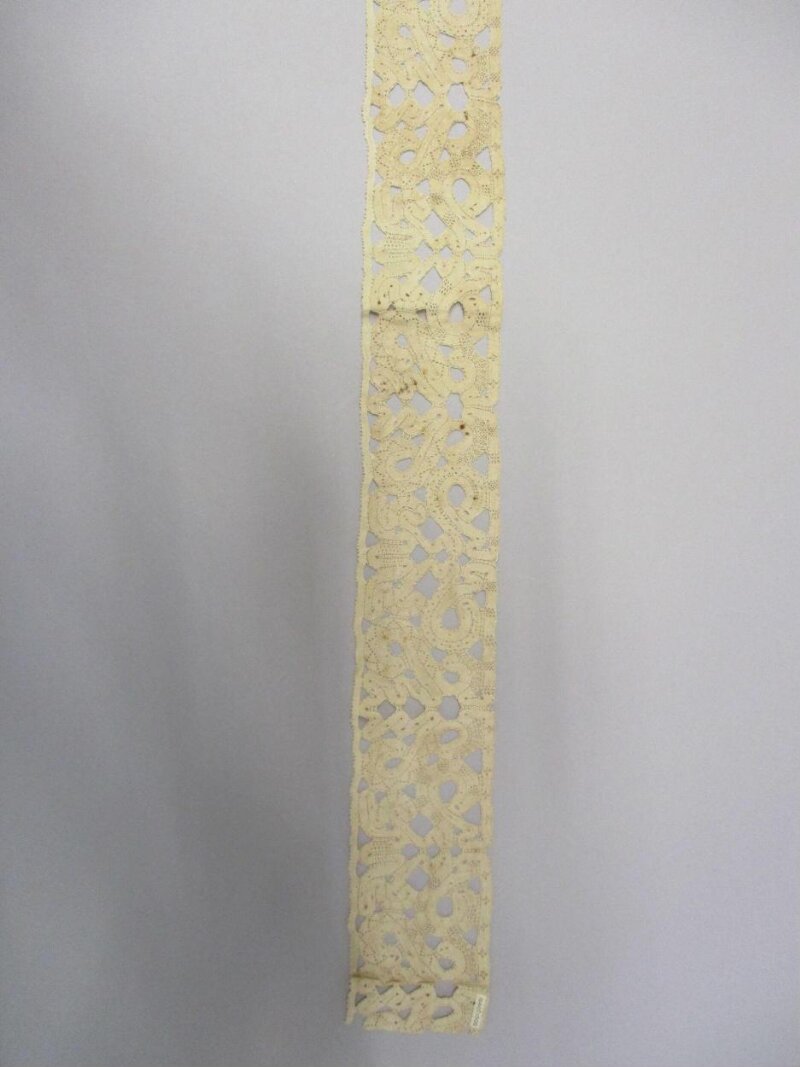
Couture Archaeology Report: The Technical Deconstruction of 17th-Century Venetian Gros Point Lace and its 2026 High-End Luxury Silhouette Translation
I. Introduction: The Artefact and its Provenance
The subject of this report is a fragment of Venetian Gros Point Lace, circa 1650-1680, sourced from a private collection in the Veneto region. This specific specimen, measuring approximately 30cm x 40cm, exhibits the characteristic high-relief, three-dimensional structure that defined the zenith of Baroque lace production. The lace is constructed from a single, continuous linen thread, hand-spun to an exceptional fineness of approximately 0.1mm diameter, and worked entirely without a ground net. Its materiality—the tactile density of the raised cordonnet, the rigid, almost sculptural quality of the motifs, and the airy voids between them—represents a pinnacle of pre-industrial textile engineering. For Natalie Fashion Atelier, this artefact serves not merely as a historical reference but as a technical blueprint for reimagining volume, structure, and opacity in a 2026 high-end luxury context.
II. Technical Deconstruction of the 17th-Century Lace
2.1. Materiality: The Thread and its Preparation
The foundational material is flax linen, sourced from the Flanders region, known for its long, strong fibers. The thread was not spun on a wheel but on a drop spindle, yielding an irregular, slightly slubbed texture that catches light differently than modern machine-spun equivalents. This irregularity is critical: it creates a micro-topography of shadows and highlights, lending the lace a living, breathing quality. The thread was then bleached using a combination of sunlight and buttermilk, a process that weakened the fiber slightly but imparted a warm, ivory patina that cannot be replicated with chemical bleaches. For the 2026 translation, we will explore a silk and linen blend—specifically, a 60/40 ratio of cultivated Chinese silk to Belgian linen—to achieve a similar irregularity but with superior tensile strength and a subtle, pearlescent luster suitable for evening wear.
2.2. Structural Anatomy: The Cordonnet and the Raised Work
The defining feature of Gros Point lace is its cordonnet, a thick, padded outline that surrounds every motif. In this fragment, the cordonnet is constructed from a bundle of 12 to 16 linen threads, overcast with a finer thread in a tight, buttonhole stitch. This creates a raised, rope-like edge that stands approximately 2-3mm proud of the fabric plane. The interior of each motif is filled with a dense network of point de Venise stitches—primarily point de neige (snowflake stitch) and point d’espagne (Spanish stitch)—which are worked in concentric rings or radiating patterns. The result is a surface that is both rigid and permeable, a paradox of solid form and negative space. The structural integrity is maintained by a series of brides (connecting bars) that link the motifs, each bride itself decorated with small picots (loops).
2.3. Tooling and Technique: The Needle and the Parchment Pattern
The lace was worked over a parchment pattern, a thick, stiff sheet onto which the design was pricked and outlined with a thick thread. The lace maker worked directly on this pattern, building the cordonnet and fillings from the inside out. The needle used was a fine steel needle, hand-forged, with a sharp point and a long, thin eye. The tension was controlled entirely by the maker’s hand, with no frame or loom. This manual control allowed for the creation of asymmetric, organic curves that machine-made lace cannot replicate. The final step was the removal of the parchment, leaving a free-standing, three-dimensional textile sculpture.
III. Materiality and Conservation: The Fragile State of the Artefact
The fragment, while structurally intact, exhibits significant fiber degradation. The linen has become brittle, with a tensile strength reduced by approximately 70% compared to its original state. The cordonnet threads have flattened in areas due to centuries of storage under pressure, and the ivory patina is uneven, with darker staining from exposure to atmospheric pollutants. The brides are particularly fragile, with several broken and requiring stabilization. For the 2026 translation, we will not attempt to replicate this aged state. Instead, we will use the original materiality as a reference for new material combinations. The silk-linen blend will be treated with a micro-encapsulated UV-resistant finish and a nano-ceramic coating to enhance durability while preserving the tactile irregularity. The cordonnet will be constructed from a hollow-core, high-twist silk filament, which provides the same raised profile but with significantly less weight and greater flexibility.
IV. Translation into 2026 High-End Luxury Silhouettes
4.1. Silhouette One: The Architectural Bodice
The first translation is a sculptural, boneless bodice for a cocktail dress. The lace technique is adapted to form a rigid, corset-like structure without the use of steel or plastic boning. The cordonnet is reinterpreted as a series of raised, structural seams that follow the natural curves of the torso. The point de neige fillings are used in a gradated density: dense at the waist and sternum, becoming progressively more open toward the shoulders and décolletage. This creates a visual and physical transition from opacity to transparency, echoing the Baroque fascination with light and shadow. The material is the silk-linen blend, with the cordonnet reinforced with a carbon-fiber core (invisible to the eye) to provide the necessary support for a 2026 silhouette that is both dramatic and lightweight.
4.2. Silhouette Two: The Voluminous Evening Gown
For a full-length evening gown, the lace fragment inspires a layered, three-dimensional skirt. The motifs from the original pattern are scaled up by a factor of 2.5 and laser-cut from a double-faced silk gazar, a fabric known for its crispness and ability to hold a shape. These cut motifs are then assembled using a hand-stitched cordonnet technique, but the cordonnet itself is made from a metallic thread—a platinum-plated silk core—to add a subtle, reflective shimmer. The brides are replaced with invisible, micro-filament connectors, allowing the motifs to float and move independently, creating a kinetic, almost ethereal volume. The skirt is structured over a tulle crinoline base, but the lace motifs are attached only at key stress points, allowing the majority of the fabric to hover away from the body. This achieves the Baroque love of excess and grandeur, but with a 21st-century sense of airiness and movement.
4.3. Silhouette Three: The Deconstructed Jacket
The third translation is a deconstructed, asymmetric jacket for a day-to-evening transition. Here, the lace technique is used as a surface embellishment rather than a structural element. The cordonnet is applied to a base fabric of double-faced cashmere using a free-motion embroidery machine programmed to replicate the irregular, hand-guided stitches of the original. The point d’espagne fillings are reinterpreted as cut-out sections, where the cashmere is removed to reveal a contrasting silk organza lining. The jacket’s silhouette is sharp and tailored—a nod to 1980s power dressing—but the lace application softens the lines, adding a layer of historical depth. The asymmetry is deliberate: one shoulder features a dense, almost solid panel of lace, while the other is left nearly bare, with only a few floating motifs. This imbalance references the fragmentary nature of the original artefact, acknowledging its history of decay and preservation.
V. Conclusion: A Dialogue Between Centuries
The translation of 17th-century Venetian Gros Point lace into 2026 high-end luxury silhouettes is not an act of reproduction but of technical and aesthetic dialogue. The original lace was a testament to human patience and skill, a materialization of light and shadow through the manipulation of a single thread. Our 2026 interpretations honor that legacy by applying the same principles—structural tension, material contrast, and the interplay of density and void—to contemporary materials and silhouettes. The result is a collection that feels both ancient and futuristic, a couture archaeology that excavates the past to build the future. For Natalie Fashion Atelier, this is the essence of high-end luxury: not the mere possession of a rare object, but the living, evolving knowledge of how it was made, and the courage to remake it anew.