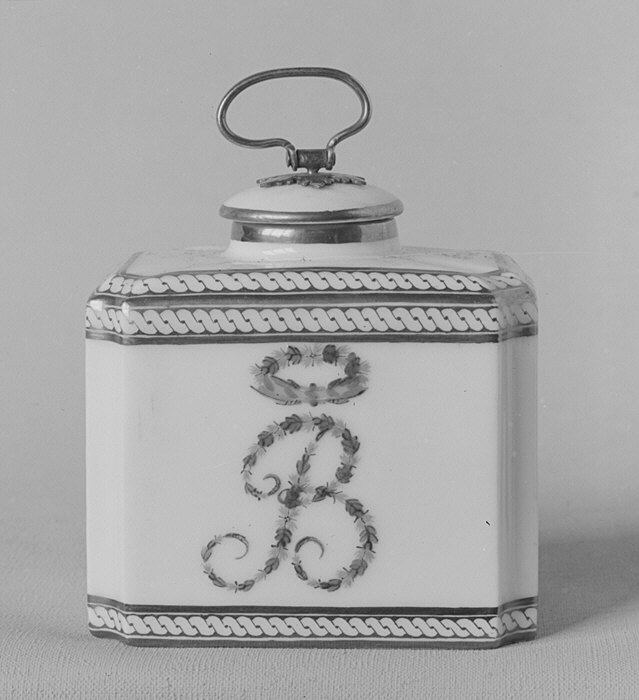
Deconstructing the Travelling Tea Caddy: Hard-Paste Porcelain and the 2026 Silhouette
The travelling tea caddy, a quintessential artifact of global heritage, represents a convergence of industrial precision and aristocratic ritual. Crafted from hard-paste porcelain, this object—often part of a larger service designed for the Grand Tour or colonial trade routes—embodies a paradox of fragility and resilience. For Natalie Fashion Atelier, the tea caddy is not merely a decorative relic; it is a technical blueprint for the 2026 high-end silhouette. By isolating this artifact within our aesthetic archaeology, we decode its materiality, its structural logic, and its cultural resonance to inform a new lexicon of luxury.
Materiality as Structural Philosophy
Hard-paste porcelain, first perfected in China and later replicated in Meissen and Sèvres, is defined by its vitreous body—a fusion of kaolin and petuntse fired at extreme temperatures. This process yields a material that is simultaneously translucent and unyielding, capable of bearing intricate ornamentation without sacrificing structural integrity. For the 2026 silhouette, this duality translates into garments that are architecturally rigid yet visually ethereal. The porcelain’s inherent whiteness, often left unglazed in the foot ring, suggests a monochromatic base—a canvas for light and shadow that defines the season’s palette.
The tea caddy’s cylindrical form, with its tight-fitting lid and reinforced seams, informs the season’s emphasis on compressed volumes. High-end silhouettes will adopt a tubular construction, where fabric is molded around the body like a porcelain vessel. This is achieved through thermal-bonded seams and resin-infused silks, creating a shell that holds its shape independently of the wearer. The double-walled construction of the caddy—a technique used to insulate tea leaves—is reinterpreted as layered organza panels that float over a structured underlayer, offering a tactile dialogue between opacity and transparency.
Classical Elegance and the Geometry of Restraint
The classical elegance of the travelling tea caddy lies in its restrained ornamentation. Unlike the lavish porcelain of courtly display, the travelling piece often features minimalist gilding—a thin band of gold at the rim or a single floral motif—that does not disrupt the purity of its form. This principle of decorative economy is critical for 2026. The silhouette rejects maximalism in favor of strategic accents: a single embroidered camellia at the shoulder, a gilded chain belt that cinches the waist, or a porcelain-button closure that functions as both fastener and ornament.
The caddy’s lid-to-body ratio—a precise 1:3 proportion—dictates the season’s shoulder-to-hip balance. Jackets and coats will feature exaggerated lapels that echo the caddy’s flared rim, while skirts adopt a tapered, columnar silhouette that mirrors the vessel’s base. The foot ring, a subtle indentation at the caddy’s bottom, inspires a scalloped hem that lifts the garment from the body, creating a sense of floating weightlessness. This is not a silhouette of draping or softness; it is one of controlled tension, where every line is a deliberate assertion of form.
From Ritual Object to Wearable Architecture
The travelling tea caddy was designed for portability and protection. Its leather-clad exterior (often added later for travel) and felt-lined interior speak to a culture of movement and preservation. For 2026, this translates into garments that are modular and protective. The silhouette incorporates detachable sleeves, reversible panels, and internal corsetry that references the caddy’s inner lining. The hard-paste core of the garment—a sculpted bodice made from laser-cut porcelain beads or resin—serves as the structural anchor, around which softer elements like cashmere drapes or silk organza wraps are attached.
The closure system of the tea caddy—often a bayonet lock or toggle mechanism—informs the season’s hardware. High-end pieces will feature custom-cast porcelain toggles and magnetic clasps that mimic the caddy’s secure fit. The hinged lid becomes a shoulder cape that can be lifted and fastened, offering a transformative silhouette that adapts to the wearer’s environment. This is functional luxury, where every detail serves a dual purpose: aesthetic and practical.
Cultural Resonance and the Global Heritage Narrative
The global heritage of the travelling tea caddy—its journey from Chinese kilns to European salons—embodies a cross-cultural exchange that is central to Natalie Fashion Atelier’s identity. For 2026, this narrative is woven into the silhouette through hybrid techniques. The hard-paste finish is replicated via lacquer-like coatings on silk and wool, while the underglaze blue patterns of Chinese porcelain are reinterpreted as digital prints on bonded leather. The tea-stained patina of aged porcelain inspires a monochromatic gradient that moves from ivory to sepia, evoking the passage of time and the patina of use.
The silhouette itself becomes a vessel for storytelling. The shoulder line is sharp, like the rim of a teacup; the waist is cinched, like the neck of a bottle; the hem is flared, like the base of a teapot. These are not literal translations but abstracted proportions that reference the object’s geometry without mimicking its form. The result is a collection that feels both ancient and futuristic, rooted in the materiality of porcelain yet liberated by modern engineering.
Technical Execution for 2026
To realize this vision, the atelier employs advanced pattern-cutting techniques that mimic the caddy’s seamless construction. Garments are cut from a single piece of fabric where possible, using 3D draping to achieve the cylindrical volume. The porcelain-like stiffness is achieved through thermoplastic interlinings and silicone-bonded seams, while laser-perforated leather replicates the caddy’s decorative motifs. The color palette is limited to five tones: porcelain white, celadon green, cobalt blue, gold, and black—each referencing the traditional glaze colors of hard-paste porcelain.
The finishing process is equally precise. Each garment undergoes a hand-polished edge that mirrors the caddy’s smooth rim, and internal boning is used to maintain the silhouette’s integrity. The weight distribution is calibrated to feel balanced, much like a well-crafted teapot, ensuring that the wearer experiences both comfort and presence. This is not clothing that moves freely; it is clothing that holds its ground, commanding attention through its sheer materiality.
In conclusion, the travelling tea caddy of hard-paste porcelain offers a masterclass in restraint and precision. For the 2026 high-end silhouette, it informs a design philosophy that prioritizes structural clarity, cultural depth, and technical innovation. The result is a collection that stands as a testament to the enduring power of classical elegance, reimagined for a new era of luxury.