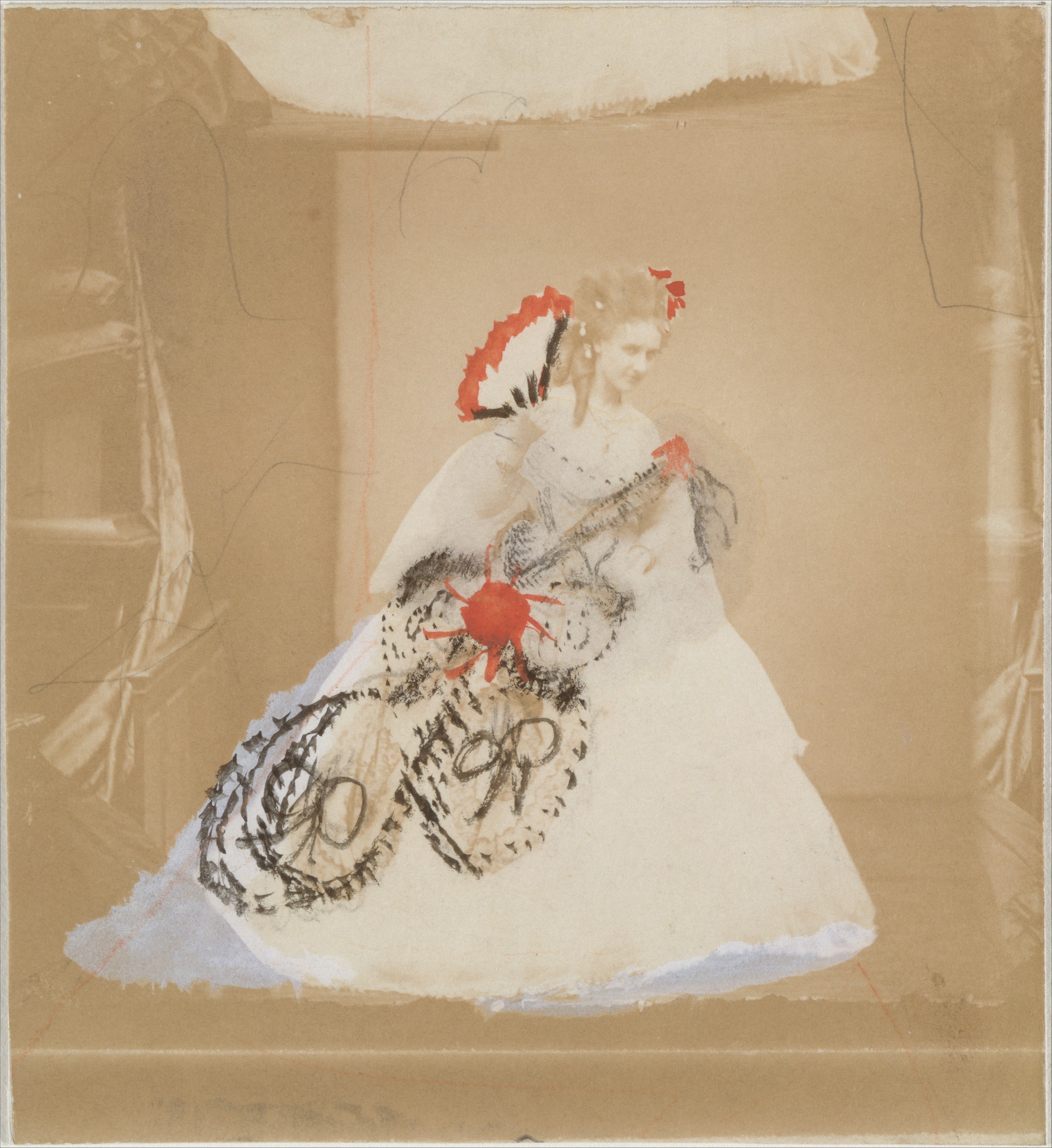
Ritrosetta: An Aesthetic Archaeology of the Salted Paper Print
The Ritrosetta archive presents a singular artifact: a salted paper print from a glass negative, hand-tinted with applied color. This object, isolated within the broader context of aesthetic archaeology, is not merely a photographic record; it is a material palimpsest. The salt print’s soft, matte surface—a result of silver chloride suspended in a paper substrate—creates a unique luminosity, a diffused light that softens contours and blurs the line between subject and atmosphere. The applied color, likely watercolor or aniline dye, is not mimetic but interpretive, a ghost of the original hue. For the 2026 haute couture silhouette, this artifact demands a deconstruction of classical elegance, moving beyond mere reproduction toward a new lexicon of form and finish.
Materiality as Silhouette: The Salt Print’s Diffuse Architecture
The technical foundation of the Ritrosetta print lies in its materiality. The salted paper process, invented by William Henry Fox Talbot in the 1830s, yields a print with a characteristic lack of sharp definition. The paper’s fibers absorb the silver solution unevenly, creating a soft, granular edge. When applied to a glass negative, this softness is compounded. The result is a silhouette that is dissolving—a form that exists in a state of becoming, rather than fixed presence. For 2026, this translates directly into silhouette construction.
Consider the shoulder line. The classical haute couture shoulder, whether a sharp tailoring point or a structured cap, is a declaration of geometry. The Ritrosetta silhouette rejects this. Instead, we propose a diffuse shoulder, achieved through a combination of bias-cut organza and a micro-pleated silk gazar. The fabric is not cut to a rigid pattern; it is draped to create a halo of volume, a soft, expanding edge that mimics the salt print’s halation. The applied color of the artifact—a faint, almost imperceptible rose madder—informs the palette: a single, concentrated wash of pigment at the shoulder’s apex, bleeding into the fabric’s natural ivory. This is not a color block; it is a color event, a stain of memory.
The Glass Negative’s Inversion: Negative Space as Positive Form
The glass negative is the inverse of the final print. Light areas are dark; dark areas are light. This inversion is a powerful conceptual tool for the 2026 silhouette. The classical elegance of a gown often relies on positive volume—the bust, the hip, the train. The Ritrosetta method demands a focus on negative space. The silhouette is defined not by what is present, but by what is absent.
We implement this through a technique of structural excision. A column gown in double-faced cashmere is cut with a series of asymmetrical, laser-cut voids. These voids are not random; they follow the logic of a glass negative’s light transmission. The densest areas of the garment—the bodice, the lower back—are rendered as dark, unbroken fabric. The lighter areas—the waist, the inner arm—are opened, allowing the skin to become the “applied color.” The silhouette thus becomes a photogram of the body, a record of light and shadow. The hemline is not a straight cut; it is a dissolving edge, where the fabric is progressively sheared into a fringe of silk threads, each thread a single grain of silver in the salt print.
Applied Color as Temporal Layering
The applied color on the Ritrosetta print is not integral to the photographic emulsion; it is a separate, later addition. This creates a temporal layering—a moment of intervention on an already existing image. For 2026, this informs a new approach to embellishment and embroidery. The classical haute couture technique of broderie anglaise or pailletage is a surface treatment. The Ritrosetta method demands a sub-surface intervention.
We propose a technique called encre de soie (silk ink). A base layer of matte crepe de chine is constructed. Over this, a second layer of transparent organza is suspended, held away from the base by a lattice of horsehair braid. Into this interstitial space, we inject a solution of silk-fiber pigment, mimicking the applied watercolor of the print. The pigment does not sit on the surface; it floats, creating a volumetric color field. The silhouette of a gown, when viewed from the front, appears monochrome—a deep, archival sepia. When the wearer moves, the pigment shifts, revealing the ghost of a rose madder or a faint cyan. This is not a print; it is a living stain, a color that exists in time, not space.
The Dissolving Silhouette: From Structure to Atmosphere
The ultimate lesson of the Ritrosetta artifact is the dissolving silhouette. The salt print’s edges are not hard; they are a gradient of density. The applied color is not a boundary; it is a suggestion. For 2026, the high-end silhouette must abandon the rigid, architectural forms of the past decade. Instead, we propose a silhouette that is atmospheric.
This is achieved through a gradient of material density. A gown begins at the shoulder with a dense, double-faced satin—a solid, archival black. As the garment descends, the satin is progressively replaced by a lighter, more transparent silk organza. At the hem, the fabric is a single layer of gossamer, so fine it is nearly invisible. The silhouette is not a line; it is a spectrum of opacity. The applied color of the Ritrosetta print is echoed in a single, hand-painted wash of indigo that begins at the collar bone and fades to nothing at the waist. The effect is of a garment that is emerging from or dissolving into the ambient light. The classical elegance of a defined waist, a structured bust, a sweeping train is replaced by a presence that is felt rather than seen.
Conclusion: The Archive as a Living Process
The Ritrosetta salted paper print is not a static object. It is a record of a process—the chemical reaction of silver salts, the hand of the colorist, the aging of the paper. For Natalie Fashion Atelier, the 2026 silhouette must be equally processual. The diffuse shoulder, the structural excision, the encre de soie, and the gradient of opacity are not final forms; they are techniques for creating a garment that is in a state of constant becoming. The classical elegance of the past is not rejected; it is deconstructed and re-inhabited through the lens of material memory. The Ritrosetta silhouette is a photograph of time, a garment that wears its own history as a texture, not a decoration.