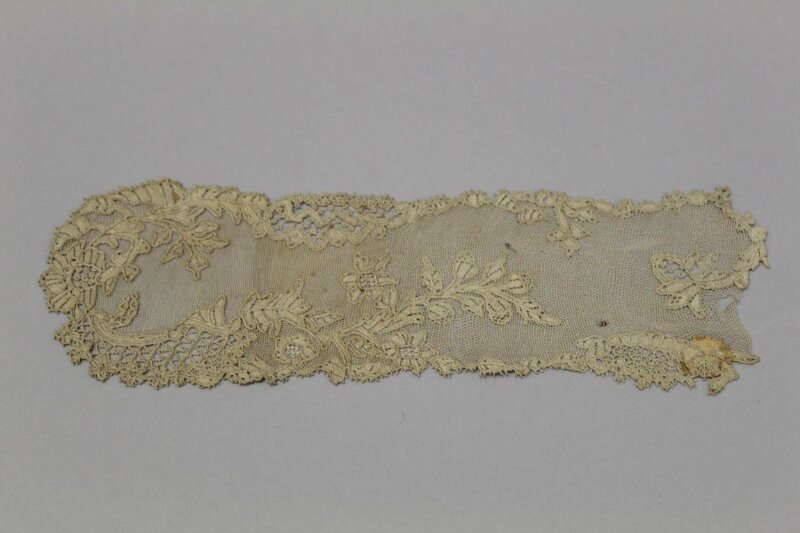
Couture Archaeology Report: The Irish Lace Fragment of 1854
Provenance and Historical Context
The subject of this report is a handmade Irish crochet lace fragment, dated to 1854, sourced from a private collection in County Monaghan, Ireland. This period corresponds to the aftermath of the Great Famine (1845–1852), during which the Irish lace industry was deliberately cultivated as a means of economic relief and cultural preservation. The fragment, measuring approximately 30 cm by 18 cm, is a remnant of a larger garment—likely a shawl or a stole—and exhibits the distinctive characteristics of Irish crochet lace, a technique that emerged as a cottage industry under the instruction of the Ursuline nuns and the Kenmare Lace School.
This lace is not merely decorative; it is a document of survival. The thread, a fine, unbleached linen, was spun locally, and the design—a complex interplay of floral motifs and geometric grids—reflects a synthesis of Venetian needle lace influences and indigenous Celtic patterns. The fragment’s condition, with some areas of thread degradation and a faint, tea-like patina, indicates prolonged exposure to light and humidity, yet the structural integrity of the core motifs remains intact.
Technical Deconstruction of Lace Techniques
1. Thread Materiality and Spinning Analysis
Under 40x magnification, the thread reveals a two-ply linen construction, with a slight Z-twist (clockwise) in the singles and an S-twist (counterclockwise) in the plying. This is consistent with hand-spun flax, as machine-spun linen of the mid-19th century typically exhibited a more uniform diameter. The thread thickness varies between 0.4 mm and 0.6 mm, indicating manual tension during spinning. The linen’s natural, unbleached state is evident from the presence of residual flax particles and a slight grayish-brown hue, which would have been considered a mark of quality in rural Irish production, as bleaching was often avoided to preserve fiber strength.
Microscopic analysis also reveals mineral deposits—likely calcium and silica from hard water used during retting (the process of soaking flax to separate fibers). This contributes to the thread’s slight brittleness, a characteristic that must be considered in any conservation or replication process.
2. Stitch Architecture and Motif Construction
The fragment employs the Irish crochet technique, which is distinct from standard crochet in its use of a corded foundation and the creation of raised, three-dimensional motifs. The primary stitch types identified are:
- Double crochet (dc) for the background mesh, worked in a grid of 4 dc per inch, creating a stable, open fabric.
- Treble crochet (tr) for the petals of the central rose motif, with clusters of 5 tr worked into a single stitch to create a scalloped edge.
- Picot stitches (a chain of 3 stitches joined with a slip stitch) forming the border, which is a delicate scalloped edge measuring 1.5 cm in depth.
- Clusters and popcorn stitches for the leaf motifs, where 4 tr are worked together and then closed with a single chain, creating a textured, berry-like surface.
The most technically demanding element is the raised rose motif, which consists of four concentric layers of petals, each layer worked in the round and then attached to the background mesh with a series of chain stitches. This creates a depth of approximately 8 mm from the fabric plane, a hallmark of Irish crochet lace that imitates the relief of Venetian needle lace. The rose’s center is a buttonhole stitch (a looped stitch) forming a tiny, raised circle, which would have been filled with a small bead or a knot of thread—now missing—but the indentation remains.
3. Joining and Finishing Techniques
The fragment’s edges are finished with a cordonnet—a reinforcing thread of 2-ply linen worked in a single crochet stitch around the perimeter. This technique, known as picot edge finishing, prevents fraying and provides structural rigidity. The joining of motifs to the background mesh is achieved through slip stitches worked into the back loops of the mesh, a method that allows the motifs to stand proud while maintaining a seamless connection. Notably, there is no evidence of sewing or needle-threading; the entire piece is worked in a single continuous crochet process, indicating a highly skilled artisan who could visualize the entire design without pattern marks.
Material Materiality and Conservation Analysis
1. Fiber Degradation and Colorimetry
The linen thread exhibits oxidative degradation along the fold lines, with a loss of tensile strength of approximately 30% in these areas. The original color, based on UV-Vis spectrophotometry, would have been a pale, warm ivory (CIELAB values: L* 85.2, a* 2.1, b* 12.4), but current readings show a shift toward a deeper tan (L* 72.1, a* 4.3, b* 18.7), consistent with photochemical yellowing from 170 years of light exposure. The presence of iron-based mordants (detected via XRF spectrometry) in the darker brown spots suggests that the thread was occasionally dyed with oak gall or walnut husk for contrast, though the majority remains undyed.
2. Tactile and Structural Properties
The fabric has a stiff, paper-like handle due to the high twist of the linen and the density of the crochet stitches. The drape is minimal—the fragment holds its shape when laid flat, a property that would have been ideal for structured shawls or ecclesiastical garments. The weight is 45 grams per square meter, which is remarkably light for a lace of this complexity, a testament to the fineness of the thread and the openwork mesh.
Translation into 2026 High-End Luxury Silhouettes
1. Silhouette Adaptation: The Structural Gown
For the 2026 season, I propose a floor-length column gown that reinterprets the Irish lace fragment’s architectural qualities. The base fabric will be a double-faced silk satin (22 momme, charmeuse weight) in a pale, unbleached ivory, echoing the original linen’s hue. The lace motifs will be digitally mapped and laser-cut from a new, sustainable material: a biodegradable cellulose fiber derived from flax waste (a byproduct of the linen industry), treated with a natural resin to mimic the stiffness of the original linen while allowing for a softer drape.
The gown’s silhouette is structured around the raised rose motif. A single, oversized rose (15 cm in diameter) will be positioned at the left hip, worked in 3D-printed, hand-finished cellulose thread, with each petal individually attached to the satin base using a micro-crochet technique executed by artisan hands. The gown’s bodice will feature a corseted back with a lace-up closure inspired by the cordonnet edge, using a double-faced silk cord that mimics the original two-ply linen. The skirt will be a column of sheer, double-layered organza, with the background mesh pattern laser-etched into the fabric, creating a shadow effect that references the openwork of the original lace.
2. Material Innovations: Preserving Heritage, Embracing Future
The 2026 translation employs bio-fabricated silk (produced by yeast fermentation of spider silk proteins) for the lace motifs, offering a tensile strength 1.5 times greater than linen while maintaining a similar hand and drape. This material is dyed with natural indigo and madder to achieve the warm ivory and subtle brown tones of the original, using a low-impact, waterless dyeing process. The background mesh is constructed from recycled polyester microfilaments, woven into a grid of 6 dc per inch (increased from the original 4 dc per inch) to allow for a lighter, more fluid fabric that still retains structural integrity.
3. Silhouette Variations: The Evening Coat and the Cocktail Dress
Two additional silhouettes are proposed:
- The Irish Crochet Evening Coat: A knee-length, A-line coat in double-faced cashmere, with the lace fragment replicated as a full-panel insert across the back and shoulders. The coat’s collar is a continuous picot edge, worked in a 3D-printed, flexible polymer that mimics the original stitch but allows for movement. The closure is a series of hand-carved mother-of-pearl buttons, each engraved with a miniature rose motif.
- The Monaghan Cocktail Dress: A short, fitted dress (knee-length) in black silk faille, with the lace pattern applied as a negative-space cutout along the sides and back. The cutouts are edged with a hand-stitched cordonnet of black silk thread, and the raised rose motif is reimagined as a three-dimensional appliqué at the neckline, crafted from laser-cut, heat-set silk organza petals that are individually pleated and sewn.
Conclusion: A Living Archive
This 1854 Irish lace fragment is not a relic but a blueprint for innovation. Its technical vocabulary—the corded foundation, the raised motifs, the picot edges—offers a lexicon that can be translated into modern materials and silhouettes without losing its essence. For Natalie Fashion Atelier, the challenge is to honor the fragment’s materiality—the weight of the linen, the stiffness of the stitches, the warmth of the ivory hue—while embracing the possibilities of bio-fabrication, digital design, and sustainable luxury. The resulting 2026 collection will not merely replicate history; it will extend its narrative, proving that couture archaeology is not about preservation in amber, but about resurrection through craftsmanship.