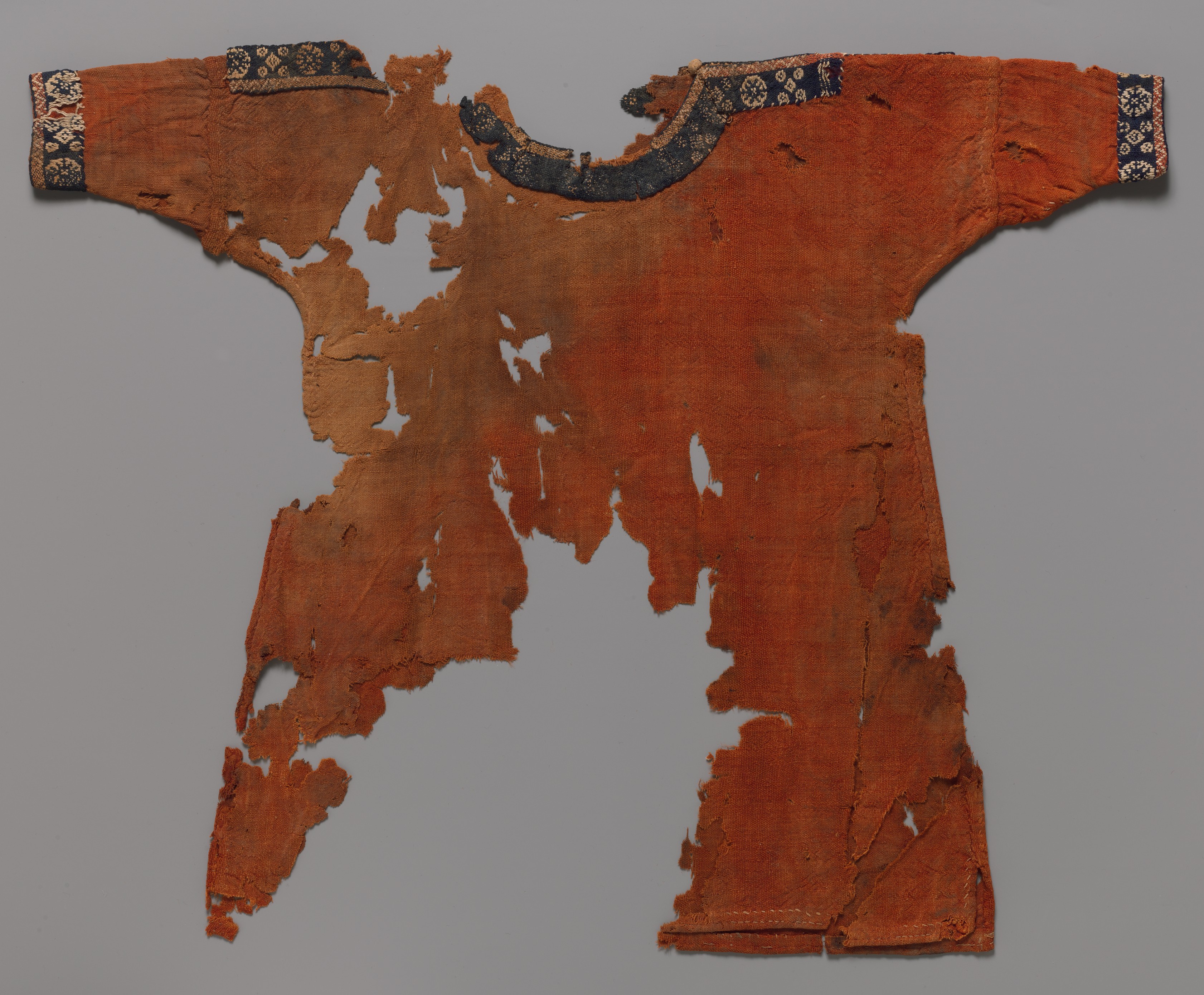
Archaeology of the Silhouette: The Plain Weave Child’s Dress as a Blueprint for 2026 Haute Couture
The artifact under examination—a child’s dress executed in a plain weave of red wool, dyed with madder, and adorned with applied borders featuring pattern wefts in blue and red wool alongside undyed linen—presents a paradox of restraint and opulence. At first glance, its materiality suggests a utilitarian origin, yet the chromatic discipline and structural logic reveal a sophisticated aesthetic archaeology. For the 2026 luxury silhouette, this isolated fragment becomes a masterclass in how archaic simplicity can be re-engineered into contemporary architectural elegance. The dress does not merely survive; it instructs.
Materiality as a Structural Lexicon
The plain weave of the red wool ground is the foundational grammar. In textile engineering, a plain weave (1/1 interlacing) offers maximum stability with minimal flexibility—a fabric that holds its shape without yielding to drape. This is critical for the 2026 silhouette, where rigid geometry and sculptural volume dominate. The madder-dyed red, a deep, organic crimson, provides a chromatic anchor that is both visceral and refined. Unlike synthetic reds, madder possesses a tonal complexity that shifts under natural light, from rust to carmine. For the atelier, this informs a palette of earth-born hues—terracotta, dried blood, ochre—that ground the collection in historical gravity.
The applied borders, however, are where the artifact’s true innovation lies. These are not mere embellishments; they are structural interventions. The pattern weft in blue and red wool and undyed linen creates a differential density along the garment’s edges. In 2026 couture, this translates to weighted hemlines and reinforced seams that control how a garment falls and moves. The undyed linen, with its natural beige tone, introduces a textural counterpoint to the saturated wool. This interplay of matte and sheen, of color and raw fiber, is the essence of luxury through contrast.
Silhouette Deconstruction: From Child’s Scale to Woman’s Frame
The child’s dress, by its nature, is a study in proportional compression. The bodice is short, the waist high, the skirt full but not excessive. This cropped, elevated waistline—a precursor to the Empire line—is the primary silhouette extraction for 2026. The modern interpretation elongates the torso while compressing the bust, creating a columnar verticality that is both severe and graceful. The applied borders, originally placed at the hem and neckline, are reimagined as architectural bands that cinch the waist or define the shoulder line. These bands function like exoskeletal stays, providing structure without the need for boning or corsetry.
The skirt volume, derived from the original’s A-line, is updated through asymmetric pleating and gored panels. The pattern weft technique—where supplementary wefts are inserted only in specific areas—informs a gradient of opacity. In 2026, this manifests as translucent overlays over opaque bases, or dense embroidery that mimics the applied border’s weight. The blue and red wool threads, originally used in geometric patterns, become chromatic markers that guide the eye along the garment’s architecture. The undyed linen serves as a negative space, allowing the red ground to breathe.
Chromatic Discipline: The Madder Red as a Signature
Madder red is not a color; it is a chemical memory. Its extraction from the Rubia tinctorum root requires precise mordanting with alum, yielding a hue that is simultaneously warm and austere. For the 2026 palette, this red becomes the foundational tone for a monochromatic collection. The applied borders introduce a secondary triad: the blue (likely woad or indigo) provides a cool counterbalance, while the undyed linen offers a neutral ground. This is a lesson in restrained chromatic architecture—no more than three tones, each with a distinct material presence. The atelier’s 2026 silhouettes will employ this triad in layered gradients: a red wool coat over a blue linen dress, with undyed silk as an interior lining.
Construction Techniques for the Modern Atelier
The applied borders of the original dress were likely sewn using a couching technique, where the pattern weft is laid over the ground fabric and secured with a fine thread. For 2026, this is upgraded to laser-cut appliqué and 3D-printed weft structures that replicate the density and texture of the original. The plain weave itself is reinterpreted through double-faced weaving, where the red wool is paired with a contrasting backing—perhaps a charcoal cashmere or a raw silk—to create a reversible garment. This aligns with the contemporary demand for transformative luxury: a coat that can be worn inside out, revealing a different material narrative.
The hem of the child’s dress, weighted by the applied border, is a critical detail. In 2026, this becomes a weighted chain hem—a thin metal chain encased in a wool binding—that ensures the garment falls with a deliberate, sculptural gravity. The neckline, originally a simple drawstring or button closure, is reimagined as a structural collar that stands away from the body, supported by the same differential weft technique. This collar, in blue wool and undyed linen, frames the face like a modern gorget, blending historical armor with soft tailoring.
Conclusion: The Artifact as a Living Codex
This child’s dress, though isolated in its archaeological context, is not a relic. It is a codex of material intelligence. The plain weave teaches us that luxury need not be complex in construction; it can be profound in its simplicity. The applied borders demonstrate that decoration is structure, and that the most enduring silhouettes arise from the logic of the weave. For Natalie Fashion Atelier, the 2026 collection will not imitate this dress but will extract its principles: the discipline of a three-tone palette, the weight of a reinforced hem, the geometry of a compressed bodice. The red wool, dyed with madder, will be our chromatic signature—a thread connecting the child of centuries past to the woman of tomorrow. In this artifact, we find not nostalgia, but a blueprint for architectural elegance.