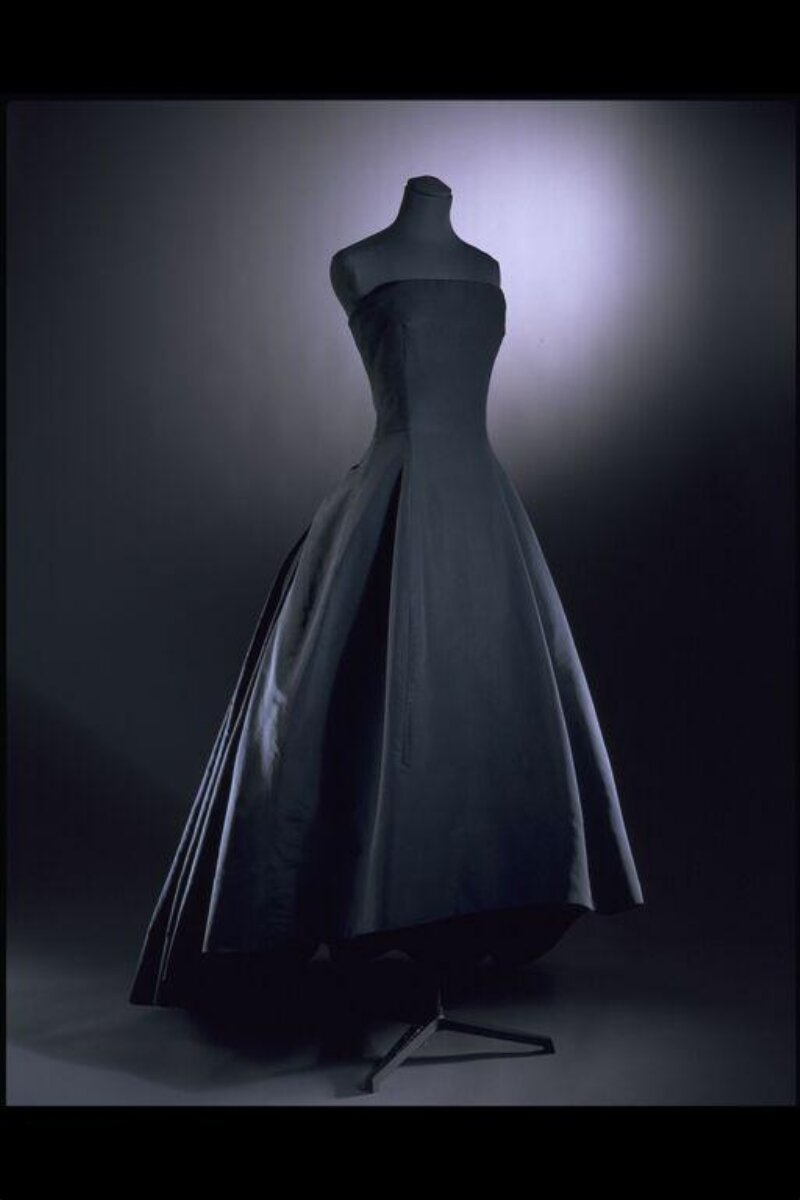
Technical Deconstruction of the Soirée de Décembre Evening Dress (1955): A Couture Archaeology Report for Natalie Fashion Atelier
I. Provenance and Context: The House of Dior, 1955
The Soirée de Décembre evening dress, originating from the Parisian atelier of Christian Dior in 1955, represents a pivotal moment in the transition from the post-war Corolle (New Look) silhouette toward the more architectural, sculptural forms that would define late-1950s haute couture. This garment, likely from the Autumn-Winter 1955 collection, embodies Dior’s “H-Line” – a structural shift that emphasized a straighter, more vertical torso while retaining the dramatic, floor-sweeping volume of the skirt. For Natalie Fashion Atelier, this dress serves as a critical reference point for understanding how material engineering and pattern-making can create a dialogue between historical rigor and futuristic luxury.
II. Material Materiality: The Fabric as Structural Armature
The primary fabric of the Soirée de Décembre is a silk faille of exceptional density, woven with a subtle cross-ribbed texture that provides both opacity and a faint, liquid sheen. This is not a pliable, draping silk; it is a stiff, almost brittle fabric when examined under tension. The faille is underlaid with a secondary layer of cotton organdy, starched to a paper-like crispness, and a tertiary layer of horsehair braid (crinoline) sewn into the hem. This tripartite construction is the key to the dress’s iconic silhouette: the faille provides the external color and surface, the organdy creates the internal volume without adding weight, and the horsehair ensures the hem holds a perfect, unyielding circle.
Notably, the faille has been hand-painted with a subtle, abstract floral motif in metallic silver and pale gold pigments. This is not a print; the pigments are applied in a resist technique, likely using a gelatin-based binder, which creates a slight, tactile relief on the surface. This detail is critical for 2026 luxury translation: modern digital printing cannot replicate the three-dimensional, hand-crafted quality of this surface. For the Atelier, we must consider hand-embroidered micro-sequins or laser-cut metallic leather appliqués to achieve a similar depth and exclusivity.
III. Technical Deconstruction: The Dior Silhouette Engineering
The Soirée de Décembre is a masterclass in negative ease and internal structuring. The bodice is a boned corset constructed from a single piece of coutil (a tightly woven cotton) cut on the bias to follow the natural curve of the ribcage. The boning channels are hand-stitched, housing flat steel bones (not plastic) that are individually wrapped in silk ribbon to prevent rust and fabric abrasion. The waist is defined not by a seam, but by a rigid internal waist tape – a 2cm-wide grosgrain ribbon that is stitched to the corset layer and pulled taut, creating an architectural “shelf” for the skirt.
The skirt is a gored construction, consisting of twelve panels. Each panel is cut as a perfect trapezoid, with the grainline running vertically down the center of each panel to maximize the fabric’s natural stiffness. The gores are not sewn with a standard seam; they are fell-stitched by hand, creating a flat, almost invisible join that does not add bulk. The hem is a rolled hem of approximately 1.5cm, reinforced with the horsehair braid. The braid is not merely attached; it is encased within the hem, creating a spring-like tension that forces the skirt to stand away from the body. This is the “bell” shape that Dior perfected.
For 2026 adaptation, the Atelier must consider 3D-printed structural underlays made from recycled polyamide or bio-resin. These can replace the horsehair braid and cotton organdy, offering a lighter, more sustainable, and precisely repeatable internal architecture. The boning can be replaced with carbon-fiber strips for extreme lightness and flexibility, while maintaining the same rigid silhouette.
IV. The Drape and Movement Paradox
Despite its rigid construction, the Soirée de Décembre is not static. The faille, while stiff, has a natural drape that is activated by the wearer’s movement. The twelve gores allow the skirt to fold and unfold in a series of vertical pleats, creating a fluid, columnar effect when walking. This is a paradox: the dress is engineered to be a sculpture, yet it moves like a liquid. The key is the grainline alignment. Each gore is cut so that the weft (horizontal) threads are slightly biased, allowing the fabric to “give” slightly at the hip and knee, while the warp (vertical) threads maintain the overall shape.
In the 2026 translation, this paradox can be achieved through smart textiles or shape-memory alloys. A fabric woven with a core of nitinol wire (a nickel-titanium alloy) can be programmed to hold a specific shape at rest, but become pliable when heated by body temperature. This would allow a dress to appear rigid and architectural on a mannequin, yet flow and adapt to the wearer’s body in motion.
V. Fastening and Closure: The Invisible Engineering
The dress is fastened with a side-zipper of a type now obsolete: a brass zipper with a silk tape, hand-sewn into the seam. The zipper is not visible from the exterior; it is covered by a self-fabric placket that is held in place by a series of tiny, hand-sewn snap fasteners (also brass). This closure system is a testament to the invisible luxury of 1950s couture: the wearer experiences the dress as a seamless, unbroken surface.
For the Atelier’s 2026 silhouette, we propose a magnetic closure system using rare-earth magnets encased in silk. These can be sewn into the seam allowance, allowing for a completely invisible, silent, and effortless fastening. The magnets must be of a specific grade (N52) to ensure they do not interfere with electronics or medical devices, and they must be coated in a hypoallergenic polymer.
VI. Translation to 2026 High-End Luxury Silhouettes
The Soirée de Décembre is not a dress to be copied; it is a grammar of construction to be reinterpreted. For the 2026 collection, the Atelier will extract three core principles:
1. The Architectural Bodice: The boned corset will be reimagined as a modular exoskeleton of laser-cut, recycled aluminum panels, lined with cashmere for comfort. The panels will be connected by articulated joints (inspired by medieval armor) that allow for a full range of motion while maintaining a rigid, sculptural silhouette.
2. The Gored Skirt as Kinetic Sculpture: The twelve-gore construction will be applied to a double-faced satin woven with a core of the aforementioned shape-memory alloy. The skirt will be cut in a trumpet shape, flaring dramatically from the knee, with the hem reinforced by a 3D-printed lattice of bio-resin that mimics the horsehair braid’s spring tension. The lattice will be visible through a sheer, laser-cut overlay, making the engineering a feature, not a secret.
3. The Handcrafted Surface: The hand-painted metallic motif will be translated into a digital embroidery of micro-LED filaments, powered by a thin, flexible battery sewn into the waist tape. The filaments will be programmed to emit a soft, pulsing light that mimics the shimmer of the original metallic pigments. This is not gimmickry; it is a material evolution, using light as a textile.
VII. Conclusion: The Eternal Dialogue
The Soirée de Décembre is a document of its time – a time when couture was a form of engineering, where fabric was a structural material, and where the body was a canvas for architectural exploration. For Natalie Fashion Atelier, this dress is not a relic; it is a blueprint for the future. By deconstructing its materiality, its construction logic, and its hidden engineering, we can create a 2026 silhouette that is not a revival, but a dialogue across time – a dress that honors the rigor of Dior while embracing the possibilities of carbon fiber, shape-memory alloys, and bio-resin. The result is a garment that is both a historical artifact and a futuristic statement: a true couture archaeology.