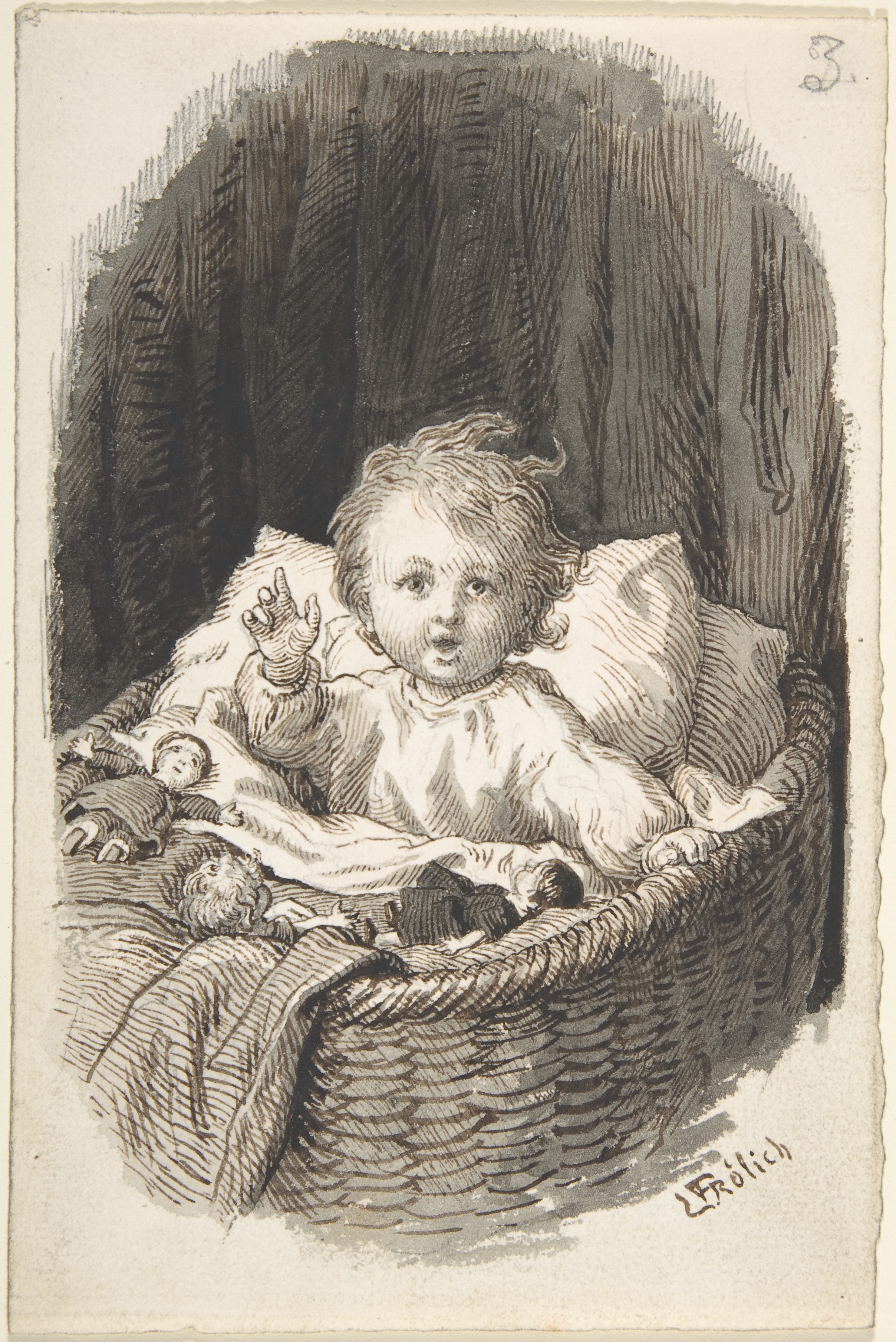
Aesthetic Archaeology: The Crib as Couture Crucible
The isolated artifact—Child in a Crib, rendered in pen and dark brown and reddish-brown ink, brush and gray wash, over graphite—presents a paradox of stillness and potential. At first glance, it is a domestic study, a quiet moment of infancy. Yet within the context of Natalie Fashion Atelier’s aesthetic archaeology, this work becomes a foundational text for 2026 haute couture. The crib, a vessel of nascent form, and the child, a cipher of pure geometry, offer a lexicon of restraint and anticipation. The materiality of the drawing—the deliberate layering of ink, wash, and graphite—translates directly into a technical vocabulary of silhouette, texture, and volume. This paper deconstructs the classical elegance embedded in the artifact and maps its translation into the high-end silhouettes of the upcoming season.
The Architecture of the Crib: Structural Silhouette
The crib is not merely a container; it is an architectural frame. Its vertical slats, rendered in dark brown ink, create a rhythm of positive and negative space. The horizontal bars, drawn with a steadier hand, anchor the composition. For 2026, this translates into a silhouette defined by structural containment and deliberate release. The crib’s linearity informs the “Cage Corset”, a reimagined bodice that uses boning not as a tool of compression but as a framework for air and volume. The dark brown ink lines become the visible seams and structural ribs of a gown, traced in blackened steel or hardened resin, allowing the fabric—a whisper of gray wash—to float within the structure. The crib’s geometry also suggests the “Cradle Hemline”, where the skirt is constructed as a series of graduated arcs, reminiscent of the crib’s rockers, creating a silhouette that is both grounded and poised for motion. The silhouette is not about the body’s shape but about the space it inhabits, a couture architecture of anticipation.
The Wash of Infancy: Gray Volume and Gradated Texture
The brush and gray wash overlay is the artifact’s most evocative element. It is not a solid fill but a series of translucent veils, building depth through accumulation. This technique directly informs the materiality of 2026 couture. The gray wash becomes a “Grisaille Gown”, a dress constructed from layers of organza, tulle, and silk chiffon, each dyed in a slightly different tone of charcoal, pearl, and silver. The gradation is not flat; it mimics the brushstroke, with denser pigment at the center of the form and fading to near-transparency at the edges. This creates a silhouette that is voluminous yet weightless, a cloud of fabric that moves with the body but retains the memory of the crib’s stillness. The reddish-brown ink, used sparingly, becomes an accent—a single thread of copper embroidery, a rust-hued panel that catches light, echoing the warmth of the child’s skin within the cool gray cocoon. The graphite underdrawing, the skeleton of the piece, is left visible in the seams, a deliberate nod to the process of creation, a couture signature of transparency.
The Child as Geometric Catalyst: Proportion and Negative Space
The child within the crib is rendered with minimal strokes, a bundle of graphite and wash that suggests form without defining it. This is the catalyst for a new proportion. In 2026, the body is not the center of the silhouette; it is the negative space within a larger form. The child’s indistinct shape inspires the “Enveloping Silhouette”, where the garment is larger than the wearer, creating a void of fabric that both conceals and reveals. The shoulders are dropped, the waist is undefined, and the volume is concentrated at the center, like the child in the crib. This is not a return to the sack dress but a sculptural expansion of the torso. The sleeves become wings, the skirt a basin. The proportion is off-balance, intentionally asymmetrical, mirroring the sketch’s rapid, intuitive marks. The negative space—the gap between the body and the fabric—is as important as the fabric itself. It is a couture of absence, a silhouette defined by what it does not touch.
Ink and Graphite: The Palette of 2026
The artifact’s limited palette—dark brown, reddish-brown, gray, and graphite—becomes the chromatic foundation for the collection. This is not a color story of bright hues but a study in tonal nuance and patina. The dark brown ink translates into “Ebony Lacquer”, a deep, almost-black finish on jacquard and brocade, with a subtle sheen that catches light like wet ink. The reddish-brown becomes “Sienna Rust”, a warm, oxidized tone used for linings, interior seams, and accent panels, visible only in motion. The gray wash is the dominant color, not as a single shade but as a spectrum of grays, from the palest dove to the deepest slate, applied in layers like the original wash. The graphite is the final touch, a silver-metallic thread woven into the fabric, creating a subtle, linear pattern that echoes the underdrawing. The palette is monochromatic in name but polychromatic in depth, a couture approach to color that demands close inspection.
From Sketch to Silhouette: The Technical Translation
The translation from artifact to garment is not literal but conceptual and technical. The pen lines become the structural seams of a dress, stitched in a contrasting thread that mimics the ink’s texture. The brush wash informs the draping technique, where fabric is not cut but layered and pinned, allowing the weight of the material to create its own volume. The graphite underdrawing suggests a “ghost lining”, a second layer of fabric that is slightly visible through the outer shell, a technique achieved with micro-mesh and strategic transparency. The crib’s slats are reinterpreted as vertical pleats that run from shoulder to hem, creating a column of fabric that is both rigid and fluid. The rockers become a curved hemline that sweeps asymmetrically, a dynamic counterpoint to the static verticality. Every element of the drawing—the pressure of the pen, the dilution of the ink, the speed of the brushstroke—is analyzed and translated into a couture technique. The result is a silhouette that is archaeologically informed but entirely contemporary, a garment that carries the memory of the crib without being a costume.
The 2026 Couture Silhouette: A Synthesis
The final silhouette for 2026, derived from Child in a Crib, is a synthesis of structural frame, volumetric wash, and negative space. It is a gown that is both a cage and a cloud, a container and a void. The silhouette is defined by a structured bodice that echoes the crib’s slats, a gradated skirt that mimics the gray wash, and a central void where the body exists as a presence rather than a form. The palette is tonal, the texture is layered, and the proportion is deliberately off-center. This is not a silhouette for the passive wearer; it is for the woman who understands that elegance is a negotiation between structure and fluidity, between the defined and the undefined. The artifact, a simple study of a child in a crib, has yielded a complex, nuanced language for haute couture. It is a testament to the power of aesthetic archaeology, where even the most intimate sketch can inform the grandest of silhouettes. In 2026, Natalie Fashion Atelier will not just dress the body; it will frame the potential within it, a couture of anticipation drawn from a single, masterful line.