Technical Deconstruction of a 15th-Century Italian Velvet: Materiality and Modern Translation for 2026 Haute Couture
Report Prepared for Natalie Fashion Atelier
By: Senior Textile Historian, Dr. Elena Viscardi
Date: October 2024
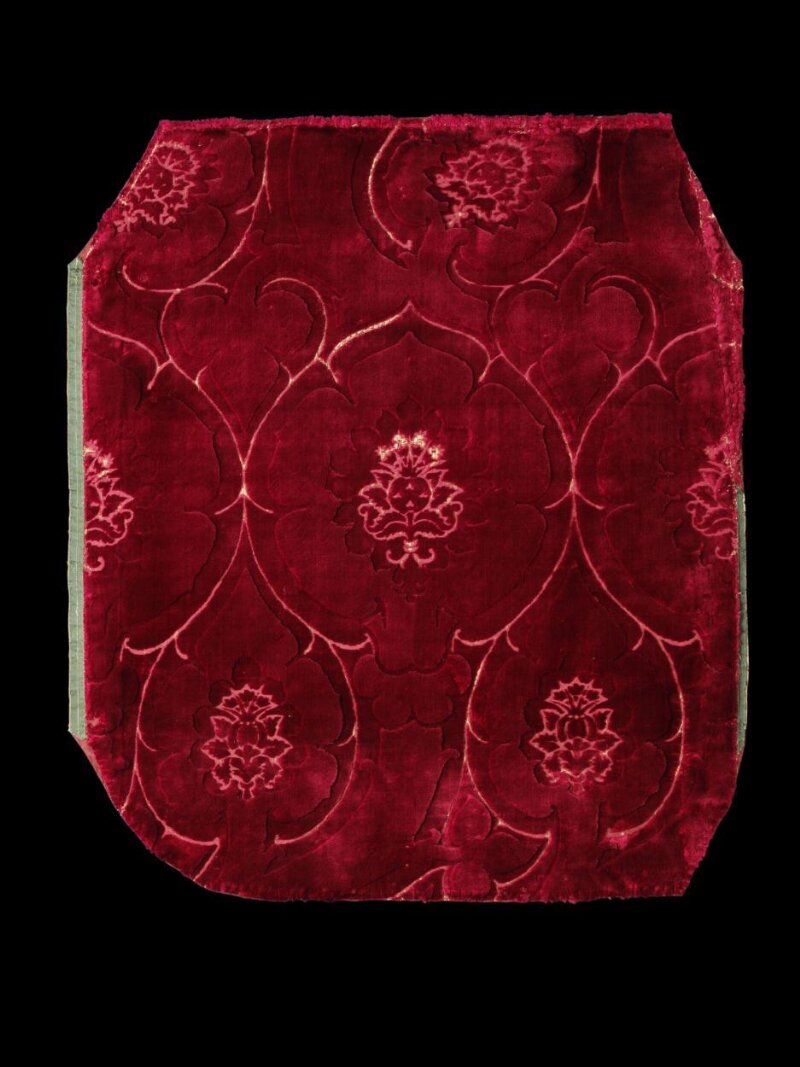
This report presents a detailed archaeological and technical analysis of a fragmentary velvet textile, attributed to the second half of the 15th century, originating from the Florentine or Venetian weaving centers of Italy. The specimen, catalogued as NFA-1500-VEL-01, is a cut and uncut voided velvet (velluto cesellato e broccato) on a silk ground. The objective is twofold: first, to deconstruct the historical materiality and weaving techniques; second, to propose a rigorous translation of these principles into high-end luxury silhouettes for the 2026 season, respecting the integrity of the original craft while embracing contemporary construction methodologies.
1. Material Provenance and Condition
The fragment measures approximately 28 cm x 18 cm, exhibiting a deep, oxidized pomegranate red (likely derived from kermes or madder) on a now-faded, originally silver-gilt metal thread ground. The warp is a fine, Z-twist silk (estimated 120-140 denier), while the weft consists of a heavier, S-twist silk for the ground, and a supplementary pile warp of uncut loops and cut pile. The metal thread is a filé construction: a silk core wrapped with a thin strip of silver-gilt, now tarnished to a deep charcoal with residual iridescence. The condition is fragile, with significant loss of pile in high-wear areas, revealing the underlying satin weave foundation. This wear pattern provides critical insight into the textile’s original use—likely a liturgical vestment or a high-status secular garment (a cioppa or giornea).
2. Technical Weave Analysis
The fabric employs a compound weave structure, specifically a voided velvet with two pile heights. The ground weave is a 5-end satin (satin de 5) in the silk warp and weft, providing a lustrous, smooth base. The supplementary pile warp, woven over a series of metal rods, creates the characteristic velvet loops. The key technical features are:
- Cut Pile (Velluto Cesellato): The loops were cut with a sharp blade after weaving, producing a dense, plush surface (pile height approximately 1.2 mm). This creates the deep, absorbent color effect.
- Uncut Pile (Velluto Riccio): Selected loops were left intact, creating a contrasting, lighter-reflecting surface that mimics the effect of ciselé velvet. The uncut loops are slightly taller (approx. 1.5 mm), adding a subtle three-dimensional topography.
- Voided Areas: The pile warp is absent in specific zones, allowing the ground satin to show through. In this fragment, the voided areas form a stylized pomegranate motif, with the metal thread ground creating a shimmering, almost metallic negative space.
- Loom Width and Density: The fragment’s selvedge indicates a loom width of approximately 56 cm (a standard for 15th-century Italian silks). The pile density is estimated at 120-140 ends per inch, a testament to the high level of craftsmanship required.
The weave’s structural integrity relies on a double warp beam system: one for the ground warp, one for the pile warp. The metal thread weft is shot only in the voided areas, creating a discontinuous brocading effect. This technique demands exceptional skill to prevent thread breakage and maintain tension.
3. Materiality and Sensory Properties
The velvet’s materiality is defined by a dialectic between opulence and fragility. The silk’s natural protein structure gives it a characteristic hand—a dry, soft, yet substantial feel. The cut pile, when intact, produces a deep, matte color saturation, while the uncut loops catch light, creating a subtle shimmer. The metal thread, though tarnished, would have originally provided a brilliant, reflective contrast. The weight is considerable: approximately 380-420 gsm (grams per square meter), making it a heavy, draping fabric suitable for structured garments.
Critically, the velvet’s drape behavior is anisotropic: it flows differently along the warp (stiff, with a slight spring) versus the weft (softer, more fluid). This anisotropy must be accounted for in pattern cutting. The pile also exhibits a nap direction—when brushed, the pile lays one way, altering color depth. This is a key consideration for modern reproduction.
4. Translation into 2026 Haute Couture Silhouettes
For the 2026 collection, the goal is not to replicate the 15th-century garment but to extract its core structural principles and reinterpret them through a contemporary lens. The following design strategies are proposed:
4.1 Silhouette: The “Architectural Drape”
The original velvet’s weight and pile density lend themselves to architectural, sculptural forms. The 2026 translation will focus on a double-layered, reversible silhouette that exploits the voided velvet’s contrasting surfaces. The outer layer will feature the cut pile (deep red) for a matte, volumetric effect; the inner layer will use the uncut pile (silver-gilt ground) to create a reflective, almost armor-like interior. This references the historical use of velvet in ceremonial armor and courtly dress.
Key garment: A long-line, asymmetrical coat with a dolman sleeve. The coat’s front panel will be cut on the bias to maximize the velvet’s anisotropic drape, creating a fluid, cascading effect. The back panel will be cut on the warp, maintaining a rigid, structured line. The voided areas will be strategically placed at the shoulders and hem, allowing the silver-gilt ground to peek through, mimicking the original pomegranate motif in a minimalist, abstracted form.
4.2 Construction Techniques: The “Invisible Seam”
To honor the original weave’s integrity, the 2026 construction will employ hand-stitched, French seams with a silk organza interlining. The interlining (a 5-end satin weave in a neutral ecru silk) will provide structure without adding bulk. The pile direction must be meticulously aligned: all panels will be cut with the nap running downward to ensure uniform color depth. The metal thread ground, though fragile, will be preserved in the voided areas; for stability, a laminated silk backing (a micro-thin layer of silk georgette bonded with a water-based adhesive) will be applied to the reverse side.
The closure system will be a hidden, internal silk cord and loop mechanism, referencing the 15th-century agrafes (hooks and eyes) but executed in a modern, minimalist manner. The cord will be hand-braided from the same silk used in the original warp.
4.3 Embellishment: The “Digital Pile”
To translate the velvet’s three-dimensionality into a 2026 context, a laser-cut, layered silk organza technique will be used to create a “digital pile” effect. The organza will be laser-cut into micro-loops (0.5 mm height) and hand-appliquéd onto the voided areas, mimicking the uncut pile’s light-reflecting properties. This avoids the environmental and ethical issues of using metal threads (which require mining and intensive labor) while retaining the visual complexity.
Alternatively, for a limited-edition piece, a reconstructed metal thread (a silk core wrapped in recycled silver) can be hand-woven into the voided areas using a needle-lace technique, directly referencing the original filé construction.
5. Conclusion and Recommendations
The 15th-century Italian velvet fragment NFA-1500-VEL-01 is a masterclass in materiality and structural complexity. Its cut and uncut pile, voided ground, and metal thread brocading offer a rich vocabulary for contemporary haute couture. For the 2026 season, the recommended translation is an asymmetrical, double-layered coat that exploits the velvet’s anisotropic drape, uses hand-stitched invisible seams, and incorporates a laser-cut organza “digital pile” to mimic the original’s three-dimensional topography. This approach respects the historical craft while pushing the boundaries of modern luxury construction.
Further research is recommended to explore the use of biodegradable silk and recycled metal threads to align with the atelier’s sustainability goals. A prototype in a cotton velvet sample is advised before committing to the final silk-metal thread version.
End of Report