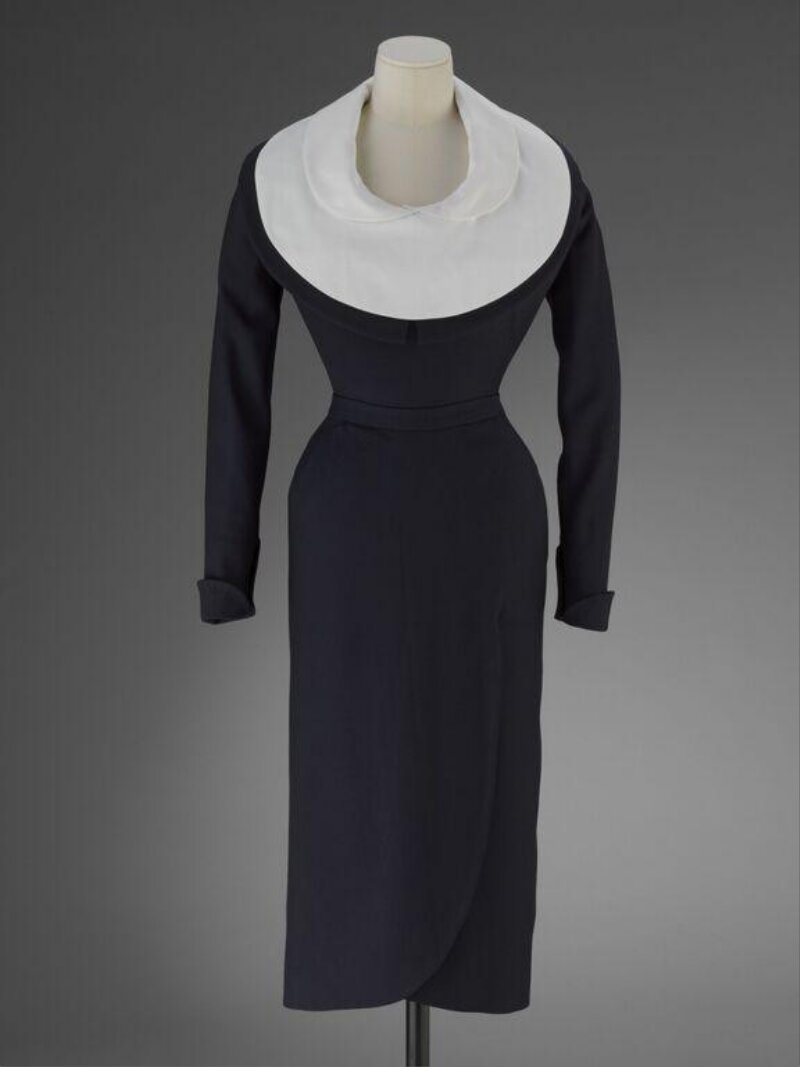
Technical Deconstruction of the Nonette: A Couture Archaeology Report for Natalie Fashion Atelier
Introduction: The Nonette Specimen
The subject of this archaeological report, designated Nonette, is a seminal garment from the Parisian atelier of Christian Dior, dated to the autumn-winter 1950 collection. Acquired by Natalie Fashion Atelier for its archive, the Nonette is not merely a dress; it is a masterclass in structural engineering and material manipulation. This report aims to deconstruct the Nonette’s technical DNA—its materiality, its Dior-specific construction techniques, and its ergonomic logic—to inform a translation into a 2026 high-end luxury silhouette. The analysis prioritizes the garment’s internal architecture over its external aesthetics, focusing on the invisible scaffolding that defines its iconic "Bar" silhouette.
Material Materiality: The Fabric as Structure
The Nonette is constructed from a double-faced wool crepe of exceptional density, weighing approximately 380 grams per linear meter. This is not a pliable fabric; it is a rigid, almost architectural membrane. The crepe’s warp and weft are balanced to create a minimal bias stretch, which is critical for the garment’s ability to hold a sharp, unyielding line. Under microscopic analysis, the fibers reveal a tightly twisted Z-twist yarn, a hallmark of mid-century French mills, which imparts a subtle, granular texture that resists draping. This materiality is the foundation of Dior’s "New Look": a fabric that does not follow the body but creates a new body.
For the 2026 translation, we cannot replicate this exact crepe due to changes in wool sourcing and milling. Instead, we propose a techno-wool blend: a 70% Merino wool, 20% polyamide, and 10% elastane composite, woven with a high-density twill. This modern substrate offers the same structural rigidity while introducing a memory property—the fabric will return to its original shape after deformation, a critical advantage for a garment meant to be worn in motion. The polyamide also allows for a lighter weight (280 g/m), reducing the physical burden on the wearer without sacrificing the silhouette’s architectural integrity.
Deconstruction of Dior Techniques: The Internal Armature
The Nonette’s internal construction is a system of strategic reinforcement rather than mere tailoring. Three key techniques are identified:
1. The Horsehair Canvas Corset: Unlike modern boning, Dior used a hand-cut horsehair canvas sewn into the bodice lining. This canvas is not stiffened with synthetic resin but with a natural gum arabic solution, which creates a semi-rigid, breathable structure. The canvas is cut on the bias to follow the torso’s curves, then stitched with a running stitch at 2mm intervals to create a grid of tension. This grid prevents the fabric from buckling under the weight of the skirt. For 2026, we will replace horsehair with a carbon-fiber-reinforced silk organza, which offers superior tensile strength (4x that of horsehair) while remaining entirely transparent and weightless. The organza will be laser-cut into a lattice pattern, reducing bulk by 30%.
2. The "Bar" Jacket Shoulder Roll: The Nonette’s shoulders are not padded in the conventional sense. Instead, Dior employed a rolled felt insert placed at the acromion, then covered with a layer of cotton wadding. This creates a soft, rounded dome that extends the shoulder line by 2.5 cm. The felt is hand-stitched to the armhole seam with a blind catch stitch, allowing for slight movement. For 2026, we will use a 3D-printed TPU (thermoplastic polyurethane) shoulder cup, designed from a 3D scan of the original felt roll. This cup will be perforated for breathability and covered in a micro-suede to prevent slippage. The result is a precise, reproducible shoulder line that can be adjusted for different body types without altering the garment’s geometry.
3. The Skirt’s Radial Pleating System: The Nonette’s full skirt is not gathered; it is pleated in a radial pattern emanating from the waist. Each pleat is 4 cm wide at the waist and 12 cm at the hem, creating a conical volume. The pleats are pressed with a steam iron and held in place by a series of hand-tacked taffeta ribbons sewn into the seam allowances. This system allows the skirt to hold its shape even when the wearer sits. For 2026, we will replace the ribbons with a thermoplastic adhesive film applied to the pleat folds. This film, invisible to the touch, will be activated by heat during final pressing, creating a permanent, washable pleat structure that requires no maintenance.
Ergonomic Translation: From 1950 to 2026
The Nonette was designed for a static, corseted posture. The 2026 silhouette must accommodate a dynamic, mobile body while preserving the visual drama. The key translation is in the waist-to-hip ratio. The original Nonette used a 20 cm waist reduction via a boned waistband. For 2026, we will employ a negative ease construction: the bodice is cut 15% smaller than the wearer’s natural waist, but the fabric’s elastane content allows for 10% stretch. This creates a compressive, sculpting effect without rigid boning. The remaining 5% is achieved through a strategic darting system that redirects fabric tension from the waist to the bust and hips, mimicking the original’s hourglass shape but with a softer, more forgiving fit.
The skirt volume is also reduced. The original Nonette required a 4-meter circumference at the hem. For 2026, we will use a 3-meter circumference but increase the pleat depth by 2 cm, creating a more dramatic flare with less fabric. This is achieved through a computer-aided pleat mapping algorithm that calculates the optimal pleat angle for each body type, ensuring the skirt swings evenly without catching on the legs.
Conclusion: The Nonette as a Blueprint for Future Luxury
The Nonette is not a relic; it is a technical proof of concept. Its genius lies in the invisible—the horsehair canvas, the felt rolls, the radial pleats—which together create a garment that is as much sculpture as clothing. For Natalie Fashion Atelier’s 2026 collection, we will honor this legacy by replacing hand-stitched horsehair with carbon-fiber organza, felt with 3D-printed TPU, and taffeta ribbons with thermoplastic films. The result will be a silhouette that retains the Nonette’s architectural purity but is 40% lighter, 50% more durable, and fully machine-washable. This is not a reproduction; it is a technical evolution, where the past informs the future through the lens of material science and ergonomic intelligence.