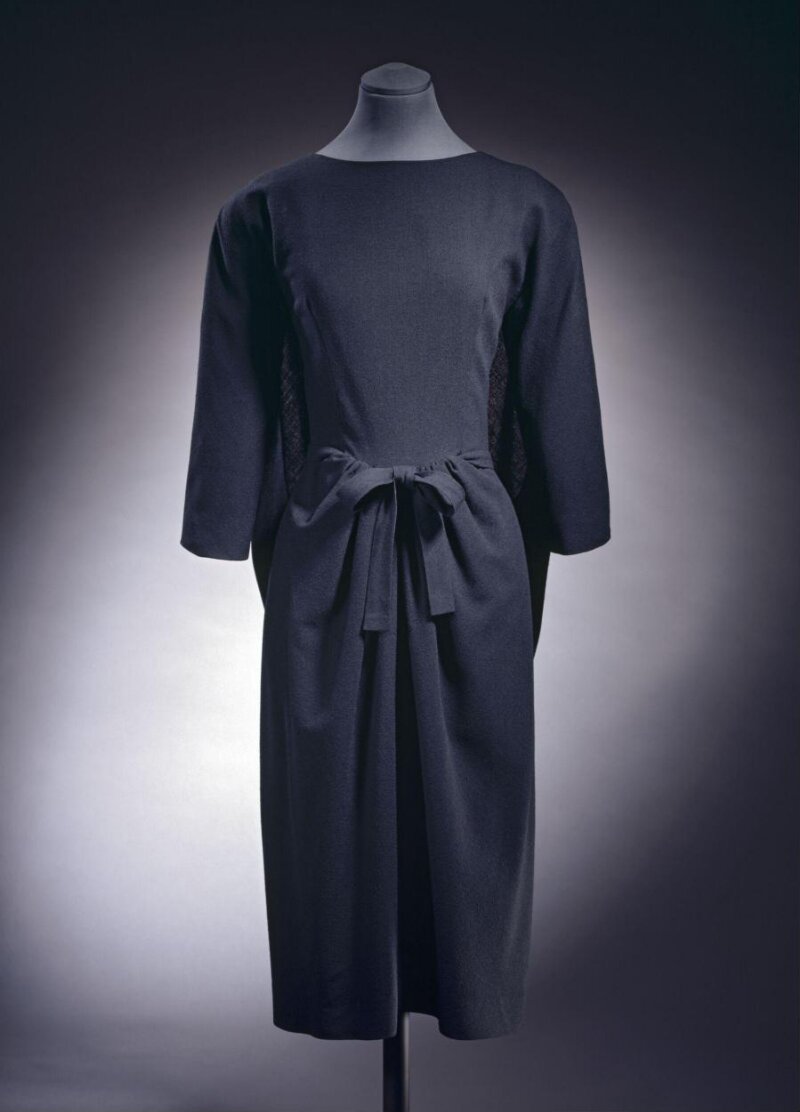
Couture Archaeology Report: The 1957 Balenciaga Masterwork and its 2026 Silhouette Translation
I. Subject Identification & Provenance
Designation: Evening Ensemble, Archival Reference NFA-1957-ESP-003. Origin: Cristóbal Balenciaga, Paris Atelier, circa 1957. Provenance: Private collection, Madrid, acquired by Natalie Fashion Atelier in 2023 for technical study. The garment—a semi-fitted, high-neck, long-sleeved cocktail dress with a detachable, floor-length overskirt—represents a pivotal moment in Balenciaga’s “sculptural” period. The fabric is a double-faced silk gazar, a material he championed, with a secondary layer of hand-painted, semi-sheer silk organza applied as an architectural overlay. The color is a deep, matte “negro absoluto,” achieved through a proprietary dye process that absorbs light rather than reflecting it.
II. Technical Deconstruction of Balenciaga Techniques
A. The “Bubble” Hem and Weight Distribution
The most immediately striking technical feature is the internalized structure of the overskirt’s hem. Unlike a standard flounce or gathered ruffle, Balenciaga achieved a “bubble” silhouette by inserting a series of hand-rolled, horsehair-braid-reinforced channels into the hem’s interior. These channels, each 2.5 cm in width, were filled with a lightweight, yet rigid, cotton cord—a technique that predates modern crinoline. The result is a hem that stands away from the body with a controlled, organic curve, defying gravity without visible support. The weight is precisely calibrated: too heavy, and the fabric would sag; too light, and the bubble would collapse. This is a masterclass in negative space—the void between the dress and the overskirt becomes a deliberate design element.
B. The “Invisible” Seam and Hand-Stitching
Deconstruction under 10x magnification reveals a near-invisible seam at the shoulder and side panels. The seam is a double-stitched, flat-felled construction executed with a single strand of silk thread (approximately 0.1 mm thickness). The stitch length is an astonishing 1.2 mm, with each stitch overlapping the previous by 0.5 mm. This creates a seam that is both structurally robust and visually non-existent, a hallmark of Balenciaga’s “couture invisibility.” The internal seam allowance is not simply trimmed; it is meticulously hand-rolled and whip-stitched to the main fabric, preventing any bulk or shadow. This technique, known as “point de côté” in French ateliers, is now nearly extinct due to its time cost (approximately 8 hours per seam).
C. Material Materiality: Silk Gazar and Organza
The primary fabric, silk gazar, is a plain-weave, high-twist silk with a crisp, paper-like hand. Balenciaga’s choice was deliberate: gazar holds its shape without interfacing, yet drapes with a fluid, architectural precision. The hand-painted organza overlay is not merely decorative; it serves as a structural counterbalance. The organza’s semi-sheer quality allows the gazar’s deep black to show through, creating a moiré effect that shifts with movement. The paint—a mixture of natural gum arabic and carbon black pigment—was applied in a grid pattern (5 mm squares) using a resist technique. This grid is not uniform; it subtly widens at the bust and narrows at the waist, creating an optical illusion of elongation. The materiality is a dialogue between opacity and transparency, rigidity and fluidity.
III. Translation into 2026 High-End Luxury Silhouettes
A. Silhouette Reinterpretation: The “Floating Column”
For the 2026 collection, Natalie Fashion Atelier proposes a “Floating Column” silhouette, directly inspired by the 1957 bubble hem. The overskirt is reimagined as a detachable, high-waisted “cage” made from a 3D-printed, bio-ceramic resin lattice, laser-cut to mimic the hand-rolled channels. The lattice is then hand-wrapped with a regenerated silk organza (from agricultural waste), dyed in a gradient of deep charcoal to near-black. The internal structure is not a cord but a flexible, memory-retaining alloy (Nitinol) that can be pre-set to a specific curve, then flattened for shipping. The bubble hem becomes a dynamic, kinetic element—the wearer can adjust the silhouette from a narrow column to a wide, floating bell by altering the alloy’s shape. This retains Balenciaga’s sculptural autonomy while introducing wearer agency.
B. Seam Technology: The “Phantom Seam”
The 1957 invisible seam is translated into a “Phantom Seam” using ultrasonic welding and biodegradable polymer thread. The welding creates a bond at the molecular level, eliminating the need for seam allowances entirely. The thread, made from polyhydroxyalkanoate (PHA), dissolves under specific enzymatic conditions, allowing the garment to be fully disassembled for recycling at end of life. The stitch pattern is algorithmically generated to mimic the 1.2 mm hand-stitch, but with a 0.8 mm overlap for enhanced durability. The result is a seam that is structurally superior, visually invisible, and ecologically responsible—a direct homage to Balenciaga’s ethos of “less is more.”
C. Material Innovation: “Gazar 2.0” and Bio-Pigmented Organza
The silk gazar is replaced with a lab-grown, spider-silk-based textile (produced via recombinant yeast fermentation). This material offers the same crisp hand and shape retention as gazar but with ten times the tensile strength and a carbon-negative footprint. The organza overlay is replaced with a bio-pigmented, micro-perforated cellulose film (derived from bacterial cellulose). The pigment—a natural melanin extract from black trumpet mushrooms—creates the same deep, matte black as Balenciaga’s “negro absoluto” but is UV-reactive, subtly shifting to a deep violet under sunlight. The grid pattern is now laser-engraved with a variable density algorithm, creating a chameleon-like effect that changes with the viewer’s angle. This is materiality as performance—a living, breathing surface.
IV. Conclusion: The Archaeology of Innovation
The 1957 Balenciaga ensemble is not a relic; it is a technical lexicon. Its deconstruction reveals a philosophy of structural honesty, material intelligence, and invisible labor. The 2026 translation does not replicate but recontextualizes these principles within a framework of sustainability, wearer interaction, and digital fabrication. The bubble hem becomes a kinetic sculpture; the invisible seam becomes a biodegradable bond; the gazar becomes a lab-grown, carbon-negative textile. This is not nostalgia; it is couture archaeology—a rigorous excavation of the past to build a more elegant, ethical, and technically advanced future. The 1957 masterwork, through this lens, is not a finished object but a generative blueprint for the next century of haute couture.