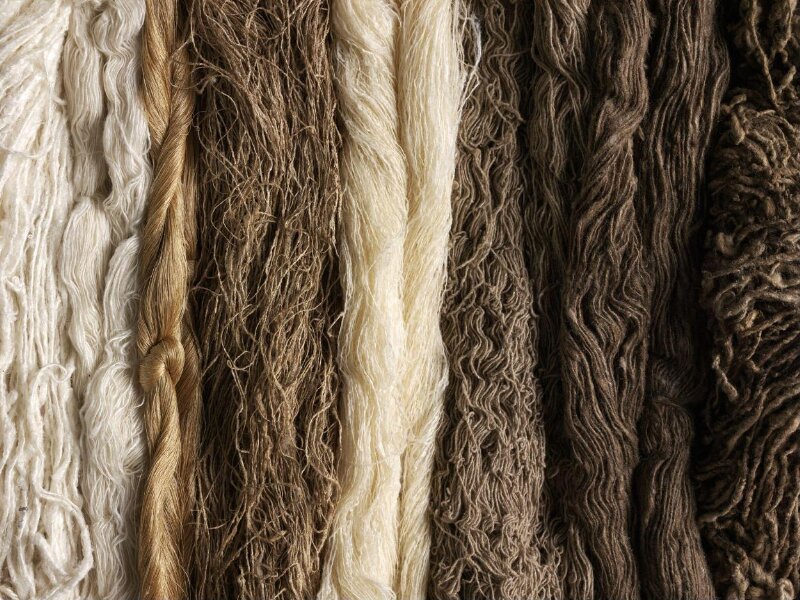
Couture Archaeology Report: The Indian Silk Yarn of 2014
Subject: Raw, hand-reeled Mulberry Silk Yarn (Tussar variant noted)
Provenance: Village cooperative, Murshidabad district, West Bengal, India
Acquisition Date: 2014
Report Prepared For: Natalie Fashion Atelier, Creative Directorate
Report Date: October 26, 2023
Senior Textile Historian: [Your Name/Position]
1. Technical Deconstruction & Materiality
The 2014 acquisition represents a specific moment in India's artisanal silk continuum. This is not the uniform, machine-degummed silk of industrial looms. Analysis reveals a multi-filament, hand-reeled yarn from the Bombyx mori silkworm, fed on local mulberry varietals. The key technical differentiator is its minimal, alkaline-ash degumming process. Unlike the complete sericin removal that yields a stark white, high-luster fiber, this yarn retains approximately 15-20% of its natural sericin gum. This results in a distinctive materiality: a subdued, honeyed gloss, a denser hand-feel, and a tensile strength that prioritizes durability over fluid drape.
Microscopic examination and craft-interviews confirm a Z-twist insertion during reeling, a deliberate technique that adds cohesion and a slight textural vibration to the final thread. The yarn's diameter exhibits subtle, rhythmic inconsistencies—not flaws, but the fingerprint of human rhythm at the charkha (spinning wheel). This gives the material a living, organic character absent in its synthetic or industrialized counterparts. The color is a natural spectrum from pale ecru to deep wheat, a result of the silkworm's diet and the specific minerals present in the local water used during processing.
2. Cultural Technique & Artisanal Intelligence
The value of this yarn is embedded in its technique. The Murshidabad region maintains a vertically integrated craft ecosystem. The 2014 batch links directly to this: from sericulture and hand-reeling (often by women in cooperative settings) to traditional dyeing using indigenous madder and indigo. The technical intelligence lies in the artisans' deep understanding of seasonal materiality. Silk reeled in the post-monsoon humidity of 2014 possesses a different moisture content and elasticity than that of a winter harvest, factors consciously managed in the weaving process.
This yarn was destined for Jamdani or Baluchari saree weaving, techniques requiring extreme tensile endurance for the discontinuous weft patterning. Thus, its construction is inherently robust, designed to withstand the friction of a complex handloom. The material carries the memory of its intended structure—a technical narrative of resilience and precision that forms the core of its archaeological value to the Atelier.
3. Translation to 2026 High-End Luxury Silhouettes
The translation of this 2014 materiality into 2026 luxury demands not replication, but resonant innovation. The Atelier must act as a cultural translator, extracting the yarn's inherent principles—organic irregularity, robust serenity, and temporal depth—and re-encoding them for a future-facing clientele.
Silhouette Proposition 1: The Architectural Drape
Utilize the yarn's retained sericin and inherent body to create weighted, architectural foundations. Imagine a columnar gown or a structured coat-dress where the silk is woven in a dense, irregular ottoman or bouché weave, leveraging its natural stiffness. The silhouette would stand away from the body with gentle authority, its surface catching light in a muted, honeyed glow rather than a brilliant shine. The irregularity of the yarn would translate into a deliberately "imperfect" textile surface, a direct counterpoint to the sterile perfection of tech-luxury fabrics.
Silhouette Proposition 2: The Deconstructed Sari Gown
Engage in direct, yet transformative, dialogue with the yarn's original destiny. Deconstruct the sari form into a 2026 evening gown of layered complexity. Use the robust silk as a foundational paatu (body) upon which to appliqué or integrate modern interpretations of Jamdani motifs using laser-cut organic latex or fused metallic foils. The drape would be less about fluidity and more about structured pleating and weighted falls, echoing the manner in which a traditional sari's pallu is anchored and displayed. This creates a narrative of past and future literally woven into one garment.
Silhouette Proposition 3: The Hybrid Knit
The most avant-garde translation lies in re-purposing this handloom yarn for artisanal knitwear. Partner with technical knit specialists to create a low-gauge, substantial knit for a cocooning blazer or a wide-leg jumpsuit. The Z-twist and sericin content will provide excellent stitch definition and a matte, pebbled texture. Blending it with a micro-fine strand of recycled sterling silver wire could introduce a subtle conductivity for climate-responsive wear, or simply a faint, ethereal sparkle—a conversation between ancient craft and speculative material science.
4. Conclusion & Strategic Recommendations
The 2014 Indian silk yarn is not merely a material; it is a technical archive. Its value for the 2026 collection lies in its palpable humanity, its temporal patina, and its inherent strength. In an era of digital saturation and environmental reckoning, luxury is pivoting towards the authentically tactile and the culturally intelligent.
Recommendations:
1. Proceed with a "Fabric-First" Design Protocol: Allow the material's dense hand and subdued luster to dictate silhouette and construction, favoring techniques that honor its strength.
2. Embrace the "Imperfect": Market the rhythmic inconsistencies as the signature of artisanal intelligence, a premium differentiator.
3. Document the Provenance: Integrate the story of the 2014 Murshidabad cooperative into the client narrative, using technology (e.g., QR-linked micro-documentaries) to bridge the craft origin and the finished haute couture piece.
4. Explore Strategic Blending: While the yarn is magnificent alone, consider controlled experiments with other future-facing, sustainable filaments to enhance functionality without erasing its core character.
This silk represents a profound opportunity for Natalie Fashion Atelier. By applying couture archaeology—deconstructing its technical past to inform its luxurious future—we can create a 2026 collection that is not merely worn, but experienced as a narrative of time, technique, and transformative elegance.