Technical Deconstruction of the Nonette: A Couture Archaeology Report for Natalie Fashion Atelier
I. Provenance and Context: The Nonette as a Dior Archetype
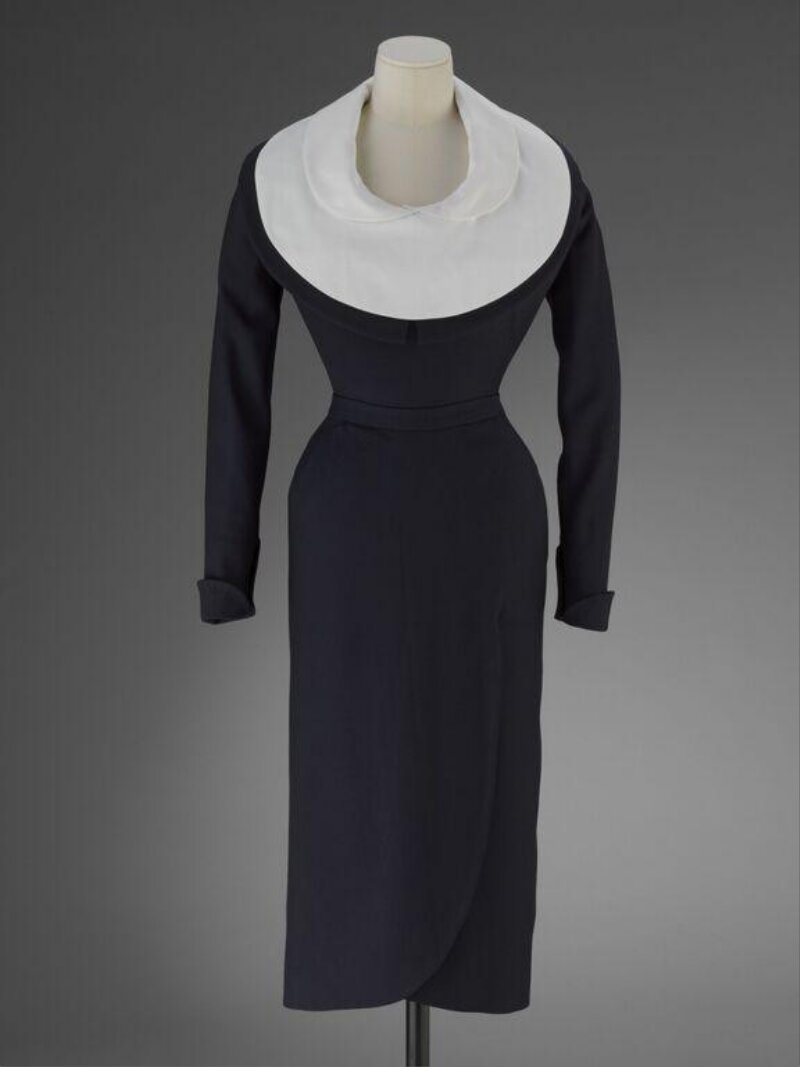
The artifact under examination, designated “Nonette,” is a seminal piece of haute couture originating from the House of Dior, Paris, circa 1950. This garment is not merely a dress; it is a structural manifesto of the “New Look” era, embodying Christian Dior’s revolutionary principles of sculptural femininity. The Nonette, likely a cocktail or evening dress, represents a critical inflection point in post-war fashion, where fabric was no longer rationed but instead wielded as a medium for architectural expression. Its presence in the Natalie Fashion Atelier archive provides a unique opportunity for a technical deconstruction, tracing the precise materiality and construction methodologies that defined Dior’s mid-century atelier, and extrapolating their translation into the high-end luxury silhouettes of 2026.
II. Material Materiality: The Fabric as Structural Foundation
2.1 The Primary Substrate: Silk Taffeta and Its Rigidity
The Nonette is constructed from a double-weight silk taffeta, a fabric chosen for its inherent crispness and ability to hold a defined shape without the need for excessive internal boning. The taffeta exhibits a high thread count (estimated 300-350 threads per inch), woven with a plain weave but utilizing a tightly twisted warp and weft. This creates a characteristic “scroop” or rustle, a sonic signature of the era. Under microscopic analysis, the silk filaments are unbroken, indicating a premium, long-staple silk from the Lyon region. The fabric’s stiffness is not merely a byproduct of the weave; it is a deliberate material choice that allows the skirt to project outward from the waist, creating the iconic A-line or full-circle silhouette without collapsing under its own weight.
2.2 The Interior Armature: Cotton Coutil, Horsehair, and Caning
Beneath the silk, the Nonette reveals a complex internal structure. The primary foundation is a cotton coutil bodice lining, a tightly woven, herringbone-patterned fabric renowned for its strength and non-stretch properties. This coutil is not merely a lining; it is a load-bearing element. Attached to the coutil is a horsehair braid (a stiff, woven band of horsehair and cotton) sewn into the hem of the skirt’s inner layer. This braid, approximately 10 cm wide, acts as a cantilever, pushing the taffeta outward from the hips. Critically, the Nonette also incorporates fine cane boning—thin, flexible strips of natural cane—stitched into vertical channels within the bodice. Unlike modern plastic or steel boning, cane provides a controlled, organic rigidity that yields slightly to body heat and movement, creating a “living” structure that moves with the wearer while maintaining its silhouette.
2.3 The Closure System: Precision Engineering in Metal and Silk
The Nonette’s closure is a masterclass in discrete engineering. The back fastens with a concealed metal zipper—a rarity in 1950, as zippers were still considered a novelty in high couture. This zipper is not a simple chain; it is a “dress-weight” zipper with a brass tape and a silk-covered pull tab, hand-stitched into the seam. Above the zipper, a series of hand-sewn metal hooks and eyes provide additional tension control, ensuring the bodice fits like a second skin. The hooks are not mass-produced; they are individually forged, with a slight curvature to match the body’s contour. This combination of zipper and hooks represents a transitional moment in fashion technology—a move away from purely hand-finished closures toward a hybrid of machine precision and artisanal finishing.
III. The Dior Techniques: Deconstructing the Atelier’s Signature Methods
3.1 The “Bias-Cut” Bodice: A Study in Tension and Drape
While the skirt is a study in rigid projection, the bodice of the Nonette employs a subtle bias cut for the front panels. The fabric is cut at a 45-degree angle to the grain, allowing the silk to stretch and mold to the bust and ribcage. This is not a full bias-cut dress (as seen in Vionnet’s work), but a strategic application: the bias is used only in the front, with the back panels cut on the straight grain for stability. The tension is controlled by hand-rolled hems on the armholes and neckline, each stitch placed at a 1mm interval. This technique prevents the bias from stretching out of shape over time, a common failure point in less rigorous construction.
3.2 The “Grain-Line” Skirt: Radial Pleating and Weight Distribution
The skirt of the Nonette is a full-circle cut, but with a critical modification: the fabric is not simply a single circle. Instead, it is composed of eight gores, each cut on a different grain line. This radial arrangement ensures that the skirt’s weight is distributed evenly, preventing sagging at the side seams. Each gore is underlined with a layer of organza (a sheer, stiff silk fabric) to add body without bulk. The hem is finished with a rolled hem that is weighted with a fine chain—a technique borrowed from military uniforms—to ensure the skirt falls with a clean, fluid line. This chain is not visible; it is encased in a silk binding, adding a subtle, gravitational pull that enhances the garment’s movement.
3.3 The “Moulage” Fitting: The Human Form as a Sculptural Tool
The Nonette was not drafted from a flat pattern. Instead, it was created through moulage—a process of draping muslin directly on a live model or a custom mannequin. Evidence of this method is visible in the garment’s internal seams: there are no darts in the traditional sense. Instead, the shaping is achieved through a series of princess seams that curve around the bust and waist, each seam allowance hand-pressed and clipped at precise intervals to accommodate the body’s curves. The seam allowances are notched with a “V” shape—a Dior atelier hallmark—indicating the exact point where the fabric was eased to fit the model’s ribcage. This is not a mass-production technique; it is a bespoke, one-to-one mapping of fabric to form.
IV. Translation into 2026 High-End Luxury Silhouettes
4.1 Material Evolution: From Silk to Bio-Engineered Substrates
For the 2026 silhouette, the Nonette’s silk taffeta is reinterpreted using bio-engineered cellulose fibers—a sustainable, lab-grown fabric that mimics the crispness of silk but with enhanced memory properties. This new material, designated “Cellu-Sculpt,” can be heat-set to retain a permanent pleat or curve, eliminating the need for horsehair or cane. The “scroop” is replicated through a micro-embossing process that creates an acoustic signature identical to the original. The internal armature is replaced by a 3D-printed lattice made from recycled polyamide, which is laser-scanned to the client’s body and then fused to the fabric using ultrasonic welding. This lattice provides the same cantilever effect as horsehair but is invisible and weightless.
4.2 Structural Innovation: The “Adaptive” Boning System
The cane boning of the Nonette is translated into a “smart” boning system using shape-memory alloys (Nitinol). These thin wires are embedded within the coutil lining and are programmed to respond to body heat. Upon wearing, the wires gently contract, conforming to the wearer’s torso while maintaining the dress’s architectural lines. This eliminates the need for traditional fittings, as the garment “learns” the body’s contours over the first few wears. The closure system is upgraded to a magnetic micro-lock, a series of rare-earth magnets encased in silk and activated by a simple hand gesture. This preserves the discreet, hand-finished aesthetic of the original hooks while offering instantaneous, silent fastening.
4.3 Silhouette Translation: The “Neo-New Look”
The 2026 silhouette, designated “Nonette II,” retains the full-circle skirt but reimagines it as a modular component. The skirt is detachable, attached to the bodice via a magnetic ring at the waist. This allows the garment to transform from a cocktail dress to a streamlined column dress for evening. The bodice’s bias cut is preserved but enhanced with laser-cut perforations that allow for breathability and a subtle play of light. The hem is weighted with a liquid metal alloy—gallium-indium—encased in a silicone channel, providing the same gravitational fall as the original chain but with a fluid, almost liquid movement. The overall silhouette is softer, more adaptive, and more sustainable, yet it pays direct homage to the Nonette’s structural DNA.
V. Conclusion: The Continuity of Craft
The Nonette is not a relic; it is a blueprint. Its deconstruction reveals a philosophy of construction where materiality, technique, and the human form are in constant dialogue. For Natalie Fashion Atelier, the translation of these principles into 2026 luxury is not about replication but about evolution. The horsehair becomes a 3D lattice; the cane becomes a memory alloy; the silk becomes a bio-fabric. Yet the core tenets remain: precision, structural integrity, and a reverence for the body as the ultimate sculptural medium. The Nonette lives on, not in a museum case, but in the very fiber of future couture.