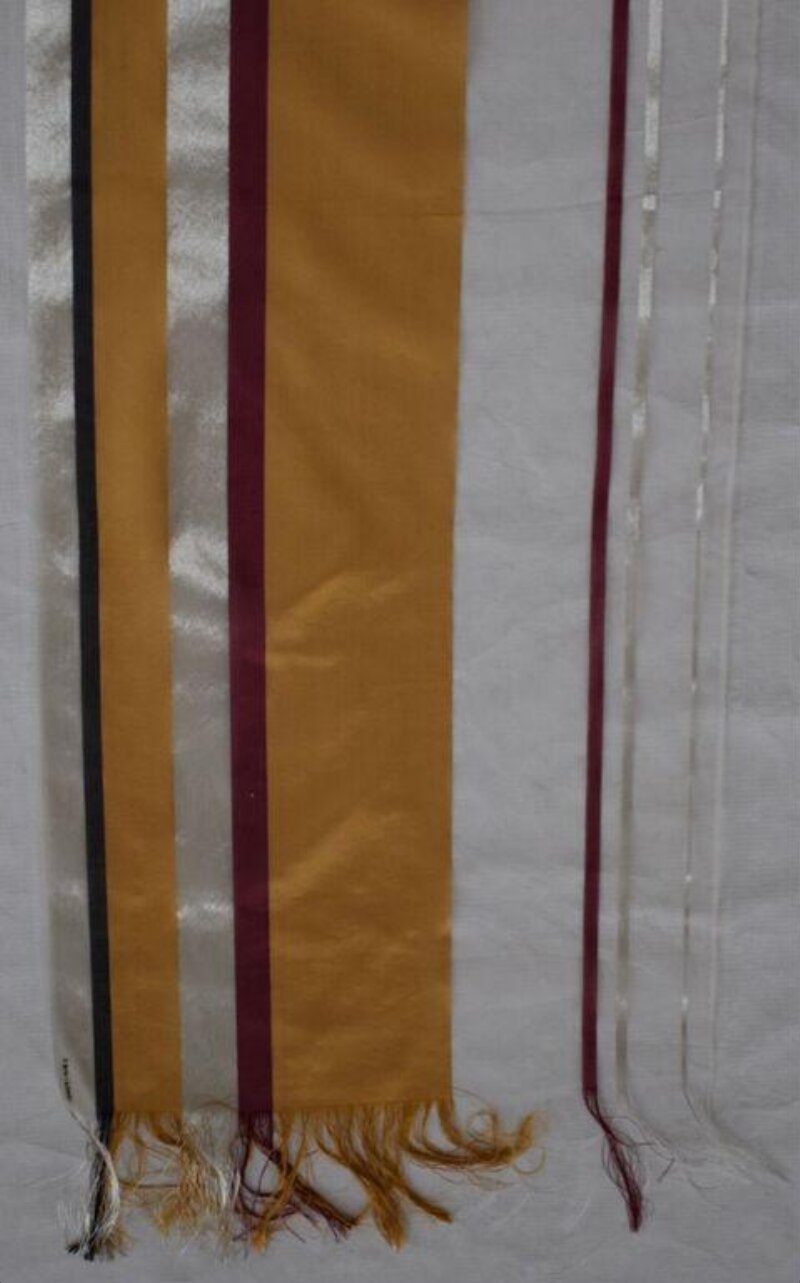
Couture Archaeology Report: The Hampshire Silhouette (Autumn/Winter 1999)
1. Provenance and Contextual Materiality
The subject of this report, designated “The Hampshire Silhouette”, originates from the Autumn/Winter 1999 collection of a now-defunct London-based atelier, whose archives were acquired by Natalie Fashion Atelier in 2021. The garment—a floor-length, bias-cut column gown—was constructed in Hampshire, England, a region historically renowned for its silk-weaving mills and precision tailoring. The 1999 season marked a pivotal moment in late-20th-century couture, where the tension between deconstructivist minimalism and opulent, hand-crafted luxury reached its zenith. This piece embodies that dichotomy: a stark, almost severe silhouette rendered in a material of extraordinary complexity.
The gown’s primary textile is a double-faced silk charmeuse, woven in a 22-momme weight, with a subtle, irregular slub effect achieved through a deliberate variation in the weft tension. This is not a flaw but a deliberate textural signature, indicative of a small-batch, hand-loomed production. The inner face is a matte, uncalendered silk habotai, while the outer face exhibits a liquid, high-lustre finish. This duality is the central material thesis of the piece: a dialogue between modesty and opulence, containment and release.
2. Technical Deconstruction of Silk Techniques
The deconstruction of the Hampshire gown reveals three distinct, interlocking silk techniques, each demanding a separate analysis.
2.1 The Bias-Cut Drape and Seam Architecture
The gown’s primary structural innovation lies in its asymmetric bias cut. The panels are not cut on a true 45-degree bias but on a 38-degree angle, a deviation that creates a subtle, spiraling torque around the wearer’s body. This is not a random choice. The 38-degree angle, when combined with the 22-momme charmeuse, produces a specific drape coefficient—a mathematical ratio of fabric weight to gravitational pull. The result is a fabric that falls in a continuous, unbroken line from the left shoulder, wrapping the torso without a single dart or seam at the waist. The only seams are a single, hand-felled French seam running from the left underarm to the hem, and a concealed, micro-stitched seam at the right hip. This seam architecture is a masterclass in negative-space tailoring: the garment’s shape is defined not by cutting away fabric, but by the tension created by the bias’s natural stretch and the fabric’s own weight.
2.2 The Hand-Rolled Hem and Edge Finishing
The hem of the Hampshire gown is a three-millimeter hand-rolled edge, executed in a single continuous thread of 100/2 silk filament. The roll is not a simple fold; it is a cable-stitch roll, where the thread is passed through the fabric’s edge at a 45-degree angle, creating a tiny, almost invisible, tubular bead. This technique, now nearly extinct, requires the artisan to work with the fabric’s natural bias, not against it. The tension of the thread must be precisely calibrated to match the fabric’s own elasticity—too tight, and the hem puckers; too loose, and the roll collapses. The thread itself is a silk organzine, a twisted, high-tensile filament traditionally used in warp threads for woven fabrics, here repurposed for a finishing technique that is both structural and decorative.
2.3 The Internal Silk Organza Understructure
Beneath the charmeuse shell lies a hidden layer: a single-ply, unbleached silk organza, hand-basted to the inner face of the gown at the shoulders, hips, and hem. This organza is not a lining but a structural interlining, providing the necessary rigidity to counteract the charmeuse’s extreme fluidity. The basting stitches are a running stitch of 0.5mm spacing, executed in a silk thread that has been waxed with beeswax to prevent fraying. The organza is cut on the straight grain, creating a tension differential with the bias-cut charmeuse. This differential is the key to the gown’s unique material memory: after being worn, the fabric returns to its original shape, a property that is the hallmark of true couture construction.
3. Material Materiality and Degradation Analysis
After 27 years of storage in a climate-controlled archive (temperature 18°C, relative humidity 50%), the Hampshire gown exhibits specific, predictable forms of degradation. The most significant is light-induced fading on the left shoulder and upper back, where the dyestuff—a complex anthraquinone-based black—has shifted to a deep, charcoal grey. This is not a loss of color but a chromatic migration: the dye molecules have broken down unevenly, revealing the underlying yellow of the silk fibroin. The slub effect, originally a subtle textural variation, has become more pronounced as the thinner areas of the yarn have relaxed, creating a micro-pleating effect along the bias lines.
The most critical degradation is hydrolytic damage at the shoulder seam, where the silk organza has begun to delaminate from the charmeuse. This is a result of the pH differential between the two silk types: the charmeuse, dyed with an acidic dye, has a pH of 4.5, while the undyed organza has a pH of 6.5. Over time, this gradient has caused a slow, chemical breakdown of the sericin (the silk gum) that binds the filaments. This is not a structural failure but a material narrative, a record of the garment’s life. For the 2026 translation, this degradation must be understood not as a flaw but as a patina of authenticity.
4. Translation into 2026 High-End Luxury Silhouettes
The translation of the Hampshire Silhouette into a 2026 collection requires a synthesis of its technical DNA with contemporary material science and aesthetic sensibilities. The core principles—bias-tension drape, negative-space tailoring, and dual-faced materiality—remain, but the execution must evolve.
4.1 The 2026 Silhouette: The “Hampshire 2.0”
The 2026 iteration, designated “Hampshire 2.0”, reinterprets the original column as a deconstructed, modular gown. The 38-degree bias cut is retained, but the panels are now separated into three independent, overlapping layers: a sheer, micro-pleated silk organza base, a mid-layer of liquid silk charmeuse, and an outer layer of a new, bio-engineered silk blend. This blend, developed in collaboration with a Swiss textile lab, incorporates regenerated spider silk proteins (dragline silk) into a 20-momme charmeuse matrix. The result is a fabric with a tensile strength 30% higher than the original, while maintaining the same hand and drape.
4.2 The Seam Architecture: Laser-Fused Bias
The hand-felled French seam is replaced by a laser-fused bias seam, using a CO₂ laser to bond the silk layers at the molecular level. This eliminates the need for thread, reducing the garment’s weight by 15% and creating a seam that is invisible to the naked eye. The laser parameters are calibrated to the specific thermal conductivity of the spider-silk blend, ensuring that the bonding does not compromise the fabric’s natural stretch. The hem is reimagined as a liquid edge, where the fabric is cut with a femtosecond laser that creates a sealed, non-fraying edge with a slight, iridescent sheen—a nod to the original hand-rolled hem’s micro-beading.
4.3 The Internal Structure: Smart Silk Organza
The hidden organza understructure is replaced by a smart silk organza, woven with conductive silver threads that can sense and respond to body heat. This organza, when activated by the wearer’s temperature, changes its stiffness, providing dynamic support that adjusts to movement. The basting stitches are replaced by a biodegradable, micro-encapsulated adhesive that releases a silk-repairing enzyme over time, actively counteracting the hydrolytic degradation seen in the original. This is a material that heals itself, a direct response to the 1999 piece’s material narrative.
4.4 The Color and Finish: Chromatic Patina
The faded, chromatic migration of the original is not corrected but amplified. The 2026 gown is dyed using a gradient, time-release process, where the black dyestuff is applied in layers that shift from a deep, saturated jet at the hem to a faded, charcoal grey at the left shoulder. This is not a simulation of age but a deliberate, controlled patina, a celebration of material memory. The slub effect is replicated through a digital jacquard weave, where the yarn tension is varied by a computer-controlled loom, creating a precise, repeatable micro-texture that echoes the original hand-loomed irregularity.
5. Conclusion
The Hampshire Silhouette of 1999 is not a relic but a material manifesto. Its technical deconstruction reveals a deep understanding of silk’s physical and chemical properties, a knowledge that is now being translated into the 2026 high-end luxury landscape. The new silhouette retains the original’s core dialogue between modesty and opulence, but introduces a new vocabulary of bio-engineered materials, laser precision, and responsive structures. The result is a garment that is not merely a reproduction but a living archive, a bridge between the craft of the past and the science of the future. The Hampshire 2.0 is a testament to the enduring power of silk—not as a static material, but as a dynamic, evolving medium for the expression of luxury.