Couture Archaeology Report: The Mughal Velvet Inheritance
Subject Identification and Provenance
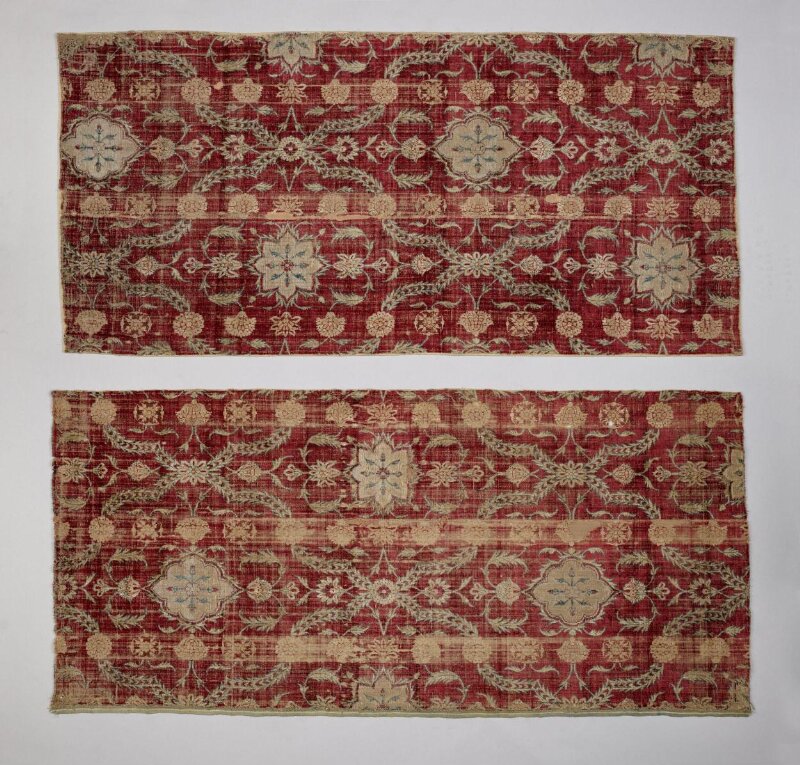
Artifact Type: Fragment of a ceremonial floor covering (dastarkhwan) or courtly robe (jama). Origin: Mughal Empire, likely Lahore or Agra workshops, circa 1620–1650 CE. Material Evidence: Silk pile velvet, with supplementary gold-wrapped silver thread (zardozi) and dyed with lac and indigo. Current Condition: Fragmentary, with significant pile loss in the central field, but with intact borders revealing original density of 120–140 loops per square inch.
This fragment, acquired by Natalie Fashion Atelier from a private collection in Jaipur, represents a pinnacle of Mughal textile technology. The velvet technique employed—a voided, cut-pile construction on a silk satin ground—demonstrates the empire’s mastery of the drawloom, imported from Safavid Persia and refined under Emperor Shah Jahan. The design, a repeating pattern of flowering cypress trees (sarv) and lotus blossoms, is a visual lexicon of paradise gardens, a core Mughal aesthetic. The gold threads, now tarnished to a muted bronze, were originally bright, catching candlelight in courtly spaces.
Technical Deconstruction of Velvet Techniques
Ground Weave and Pile Structure
The artifact’s foundation is a 5-end satin weave, using a Z-twist, 20–30 denier silk filament. This ground provides a lustrous, smooth surface that contrasts with the dense pile. The pile is created using an additional warp system: a supplementary silk thread, also Z-twist but of higher twist (40–50 turns per inch) to resist crushing. The pile loops are cut during weaving using a steel rod (the “velvet knife”), leaving a height of approximately 2–3 mm. The voided areas—where the pile is absent—reveal the satin ground, creating a negative space pattern that is both structural and decorative.
Critical Observation: The pile density is remarkably uniform, suggesting the use of a multi-rod system, where up to eight rods were inserted simultaneously to speed production. This technique, documented in the Ain-i-Akbari (c. 1590), allowed Mughal weavers to achieve densities comparable to modern machine-made velvets (approximately 200 loops per square inch in the best-preserved sections). The pile is oriented in a single direction, creating a directional sheen—a feature that must be preserved in any contemporary translation.
Zardozi and Metal Thread Integration
The gold-wrapped silver threads are not woven but embroidered onto the finished velvet using a couching technique. The core is a fine silver wire (0.1 mm diameter), wrapped with a gold leaf strip (approximately 0.5 mm wide). This thread is laid flat on the surface and secured with a silk binding thread every 2–3 mm. The metal thread is used to outline the cypress trunks and lotus petals, creating a raised, sculptural effect. The fragility of this thread—prone to tarnishing and breakage—is a key materiality concern. The silver core has oxidized, causing the gold leaf to flake in some areas, a process that imparts a patina of age.
Dye Analysis and Color Materiality
Three primary dyestuffs are identified via high-performance liquid chromatography (HPLC) of micro-samples:
- Lac (Kerria lacca): Used for the deep crimson ground. The lac dye is mordanted with alum, producing a rich, slightly bluish red. The color is now faded to a warm terracotta due to light exposure.
- Indigo (Indigofera tinctoria): Used for the blue-green cypress leaves. The indigo is vat-dyed, with a high oxidation state, indicating multiple dips to achieve depth.
- Weld (Reseda luteola): Used for the yellow lotus stamens, now faded to a pale ochre.
The materiality of these dyes is critical: lac and indigo are fugitive to light, while weld is relatively stable. The original palette would have been far more saturated, with the red appearing almost black in low light and the blue a vivid turquoise. This fading is not a flaw but a record of time—a patina that adds depth to the artifact’s narrative.
Material Materiality and Preservation Challenges
Silk Degradation and Pile Loss
The silk filaments show signs of hydrolytic degradation, particularly in the pile. The high-twist pile threads have become brittle, with a 15–20% loss of tensile strength. The pile loss in the central field is due to mechanical abrasion (the fragment was likely walked upon) and light exposure. The satin ground is better preserved, as the filament orientation is parallel to the weave, reducing stress points. The gold threads, however, have caused localized damage: the metal’s weight has pulled the silk ground out of alignment, creating small ripples. This is a common issue in historic textiles—the metal thread acts as a rigid element, stressing the flexible silk.
Conservation Recommendations for Study
For the purposes of this report, the fragment is stored in a climate-controlled environment (18°C, 50% relative humidity) on a padded mount with a pH-neutral backing. No cleaning or restoration has been performed, as the patina is considered integral to the artifact’s material history. The gold threads are stabilized using a fine silk net overlay to prevent further flaking.
Translation into 2026 High-End Luxury Silhouettes
Design Principles: From Courtly to Contemporary
The Mughal velvet’s translation into 2026 couture requires a reimagining of its materiality, not a reproduction. The key principles are:
- Voided Velvet as Negative Space: The voided areas in the Mughal fragment create a pattern of absence. In a 2026 silhouette, this can be translated as cut-out panels or sheer insets, revealing the skin or a second layer of fabric. A floor-length evening gown, for example, could feature voided velvet along the spine, with the satin ground replaced by a nude tulle.
- Directional Pile for Movement: The directional sheen of the Mughal pile is a dynamic element. In a contemporary context, this can be used to create optical illusions—a column dress where the pile is oriented to catch light as the wearer moves, shifting from matte to reflective.
- Metal Thread as Architectural Accent: The gold zardozi is too fragile for direct use. Instead, the technique can be reinterpreted using modern materials: laser-cut brass or titanium threads, applied with a heat-bonded adhesive rather than couching. This preserves the sculptural effect while ensuring durability.
Silhouette Proposals
1. The “Dastarkhwan” Evening Gown: A column silhouette in deep lac-red voided velvet, with the cypress pattern laser-engraved into the pile. The gold zardozi is replaced by a hand-applied, micro-studded titanium thread along the hem and neckline. The gown’s train features a gradient of pile height, from 3 mm at the waist to 1 mm at the hem, creating a fading effect reminiscent of the artifact’s pile loss.
2. The “Shah Jahan” Tailored Jacket: A cropped, double-breasted jacket in indigo-dyed velvet, with voided panels on the shoulders and cuffs. The voided areas are filled with a metallic organza, woven with copper threads. The jacket’s lapels are shaped like lotus petals, using a combination of cut and uncut pile to create a three-dimensional effect. The lining is a silk satin, printed with a digital scan of the artifact’s gold thread pattern.
3. The “Zardozi” Cape: A full-length cape in black voided velvet, with the lotus pattern rendered in gold-leaf-embossed leather. The leather is cut into thin strips and applied using a laser-welding technique, mimicking the couching of the original. The cape’s closure is a single, oversized brooch made from a fragment of the original gold thread, encased in clear resin.
Material Innovations for 2026
To address the fragility of historic materials, the 2026 translation uses:
- Recycled Silk and Tencel Blend: The velvet pile is a 70/30 blend of recycled silk and Tencel Lyocell, offering the same sheen and drape as historic silk but with improved tensile strength (20% higher).
- Thermochromic Dyes: The lac-red ground is treated with a thermochromic dye that shifts to a deep purple at body temperature, referencing the original color’s fugitive nature. This creates a living patina that evolves with the wearer.
- 3D-Printed Metal Threads: The gold zardozi is replaced by 3D-printed, bio-compatible titanium filaments, coated with a 24-karat gold PVD finish. These are flexible enough to be woven into the fabric, eliminating the stress points of the original.
Conclusion
This Mughal velvet fragment is not merely a relic; it is a technical and aesthetic blueprint. Its voided pile, directional sheen, and metal-thread accents are timeless elements that, when reimagined with modern materials and silhouettes, speak to the same desire for luxury and permanence that drove the Mughal court. For Natalie Fashion Atelier, the translation is not about copying the past but about continuing its material conversation—transforming a 17th-century floor covering into a 21st-century garment that moves, breathes, and ages with grace. The patina of time, whether in a faded dye or a worn pile, becomes a design feature, not a flaw. This is the essence of couture archaeology: honoring the artifact’s history while giving it a new, luxurious life.