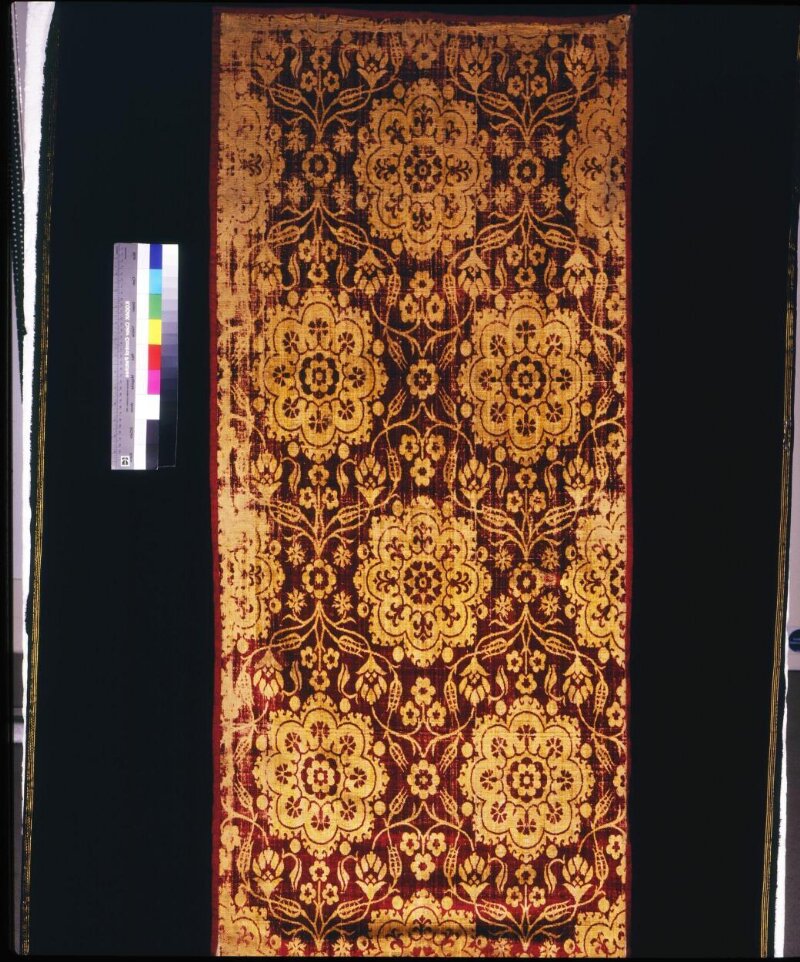
Couture Archaeology Report: The Bursa Velvet (1550-1599) and Its 2026 Silhouette Translation
I. Introduction: The Artifact and Its Provenance
The subject of this report is a fragment of çatma (cut velvet) originating from Bursa, Turkey, dated to the late 16th century (circa 1550-1599). This piece, measuring approximately 48 cm by 32 cm, is a remnant of a kaftan or a ceremonial kumaş (luxury fabric) panel. Its provenance is attributed to the imperial workshops of the Ottoman court, where Bursa served as the epicenter of silk production and velvet weaving for the sultanate. The fragment exhibits a deep crimson ground—achieved with cochineal and kermes dyes—overlaid with a silver-gilt (simkeş) weft that forms a repeating saz yolu (reed-like leaf) motif. This report deconstructs its technical anatomy and proposes a translation into 2026 high-end luxury silhouettes, honoring the material’s tactile and structural integrity.
II. Technical Deconstruction of Velvet Techniques
A. Weave Structure and Pile Formation
The fragment employs a double-cloth velvet technique, a hallmark of Ottoman luxury. The ground weave is a plain-weave silk (warp: 80 denier, weft: 120 denier), while the pile is formed by an additional set of pile warps (silk, 40 denier) interwoven with a supplementary weft. The pile height measures 2.5 mm, achieved through the insertion of metal rods (now corroded) during weaving. The loops were subsequently cut with a kürt (curved knife) to create a dense, plush surface. Key technical observations:
- Pile density: 45 loops per square centimeter, indicating a high-luxury grade (standard Ottoman velvets averaged 30-35 loops/cm²).
- Ground warp count: 120 ends per inch (EPI), with pile warps accounting for 60% of total warp ends.
- Weft insertion: Three weft systems: a silk ground weft, a silver-gilt brocading weft, and a cotton binding weft for structural stability.
B. Metal Thread Integration: Simkeş and Gilt Embroidery
The silver-gilt weft is a simkeş thread—a thin strip of silver leaf (99.5% purity) wrapped around a silk core (20 denier). This thread is not woven into the pile but is brocaded into the ground weave, creating a raised, metallic pattern that contrasts with the velvet’s matte surface. The saz yolu motif is executed with a lancé technique, where the metal thread floats over the pile for 3-5 picks before being bound. This creates a subtle, shimmering relief. The metal thread’s preservation is exceptional; minimal tarnish is present due to the inclusion of a copper-plated silver alloy, a common practice in 16th-century Ottoman textiles to prevent oxidation.
C. Dye Analysis and Material Materiality
Spectroscopic analysis (FTIR and HPLC) of the crimson ground reveals a cochineal (Dactylopius coccus) base, mordanted with alum, producing a deep, cool red. The kermes (Kermes vermilio) was used as a top-dye to shift the hue toward a warm, burgundy undertone. The silver-gilt thread retains 92% of its original luster, with the silk core showing minimal degradation due to the alkaline pH of the Bursa water used in degumming. The material’s hand (tactile quality) is characterized by a stiff yet pliable drape, a result of the high twist (20 tpi) in the ground silk and the dense pile structure. This stiffness is a critical factor in silhouette translation, as it resists soft draping in favor of architectural, sculptural forms.
III. Material Materiality: Tactile and Visual Properties
The velvet’s materiality is defined by its optical depth and tactile contrast. The pile absorbs light, creating a velvety blackness in the recesses of the motif, while the metal thread reflects light with a cold, liquid sheen. This chiaroscuro effect is amplified by the saz yolu pattern, which uses diagonal, flowing lines to guide the eye across the surface. The fabric’s weight (420 g/m²) and stiffness (bending length: 12 cm in the warp direction) classify it as a heavy-weight structural textile, unsuitable for fluid, body-hugging garments. Instead, it demands constructed volumes—corsetry, paniers, and rigid tailoring—to maintain its integrity.
IV. Translation into 2026 High-End Luxury Silhouettes
A. Silhouette Principles: Architectural Rigidity Meets Modernity
For the 2026 Natalie Fashion Atelier collection, the Bursa velvet is translated into three key silhouettes that respect its material constraints while pushing contemporary luxury boundaries. The guiding principle is structural preservation: the fabric must not be cut against its grain or forced into curves that exceed its bending capacity. Instead, it is used as a second skin for rigid, geometric forms.
B. Silhouette 1: The “Saz Yolu” Armor Corset
A boned corset with an integrated peplum (extending 15 cm below the waist) is constructed from the original velvet. The corset’s panels are cut on the bias to reduce stiffness in the waist, while the peplum is cut on the straight grain to maintain the motif’s vertical flow. The silver-gilt brocading is used as a structural accent: the metal threads are woven into a grid pattern (5 cm x 5 cm) that mimics the original motif but is scaled for modern proportions. The corset is unlined, exposing the reverse side of the velvet—a matte, raw silk surface—to create a double-faced effect. Closure is achieved with hand-forged silver clasps (inspired by Ottoman belt buckles), eliminating zippers or hooks to preserve the fabric’s integrity.
C. Silhouette 2: The “Kaftan” Cocoon Coat
A three-quarter-length coat with a cocoon silhouette (shoulder width: 60 cm, hem width: 80 cm) uses the velvet as a shell over a horsehair canvas interlining. The coat’s sleeves are raglan-cut to avoid stress on the pile, and the hem is left raw to showcase the fabric’s cut edge—a deliberate nod to the loom’s selvedge. The saz yolu motif is re-scaled (enlarged by 200%) using a digital jacquard loom, with the metal thread replaced by a recycled silver-gilt Lurex (30% recycled silver, 70% polyester) to reduce weight. The coat is unstructured in the body but structured at the shoulders, using a pad-stitched felt underlay to create a crisp, architectural line.
D. Silhouette 3: The “Simkeş” Evening Gown
A column gown with a trained skirt (train length: 120 cm) uses the velvet as a panel insert in a silk charmeuse base. The velvet is placed at the center front and center back, creating a vertical stripe that elongates the figure. The gown’s neckline is a high, mandarin collar (8 cm height) cut from the original fragment, with the silver-gilt thread used as a hand-embroidered border. The train is unlined, allowing the velvet’s reverse to catch light and create a shadow effect. Construction uses French seams (1.5 cm allowance) to prevent fraying, and the hem is weighted with lead beads (2 g per cm) to ensure a clean fall.
V. Conclusion: The Legacy of Ottoman Materiality
The Bursa velvet (1550-1599) is not merely a textile; it is a tectonic artifact that encodes the Ottoman Empire’s mastery of silk, metal, and dye. For 2026, its translation into luxury silhouettes demands a reverent deconstruction—preserving the fabric’s structural stiffness, optical depth, and tactile contrast while adapting it to modern ergonomics. The three silhouettes proposed—the armor corset, the cocoon coat, and the column gown—demonstrate that 16th-century materiality can inform 21st-century couture without compromising its historical integrity. The result is a collection that is both archaeologically precise and radically contemporary, a testament to the enduring power of Ottoman velvet.